
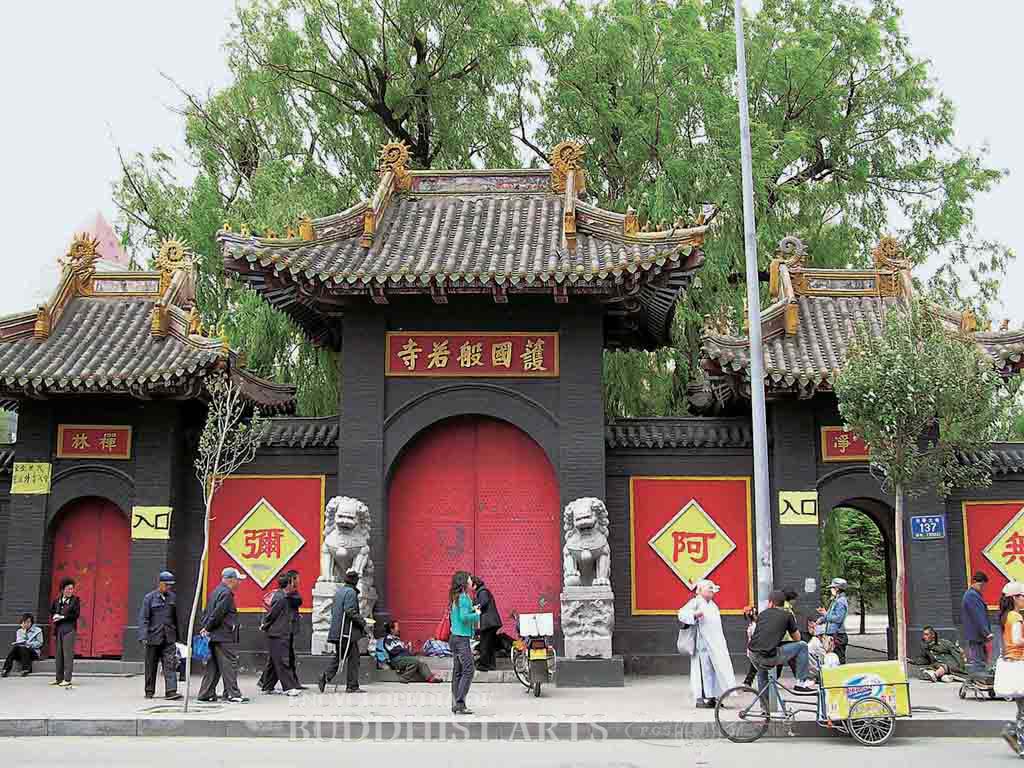
Huguo Bo’re Temple: Main Gate
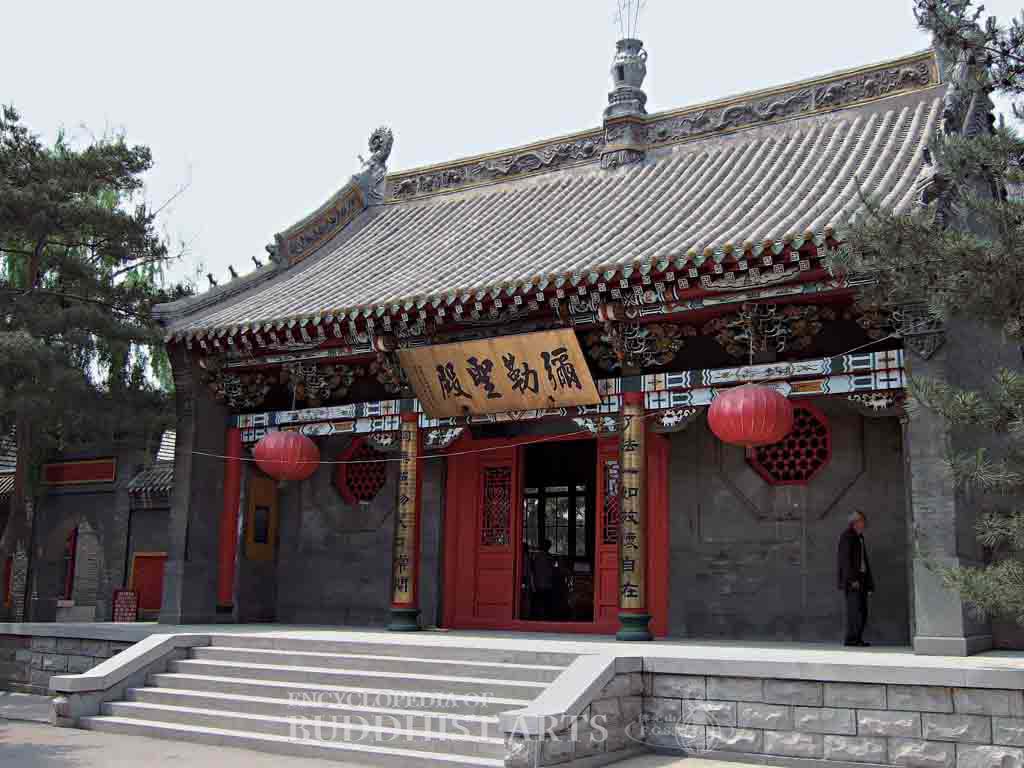
Huguo Bo’re Temple: Maitreya Hall
Huguo Bo’re Temple
CHINA, Jilin, Changchun
In 1923 Master Tanxu came to Changchun to teach the Heart Sutra. He subsequently built Bo’re Temple. In 1931 the temple was moved to its current location and in 1934 it was renamed Huguo Bo’re Temple. A precepts transmission ceremony held in 1936 was attended by more than 1,300 people. This had an important influence on the development of Buddhism in northeast China. It was listed as a key Buddhist temple in the Han region in 1983.
The temple occupies 1.4 ha and the buildings take up 2,700 sq m. Behind the main temple gate there is a wide courtyard with the bell and drum towers located on either side. Along the central axis are the Maitreya Hall, Great Hero Hall and the sutra repository. Side buildings include the Avalokitesvara Hall and Ksitigarbha Hall. The main temple gate is set into the wall with subsidiary gateways on either side. It has a hip-and-gable roof with upturned eaves at the corners. The roofs of the other gateways are similar but on a lower level. The Maitreya Hall has a flush gable roof and a gilt camphorwood statue of Maitreya Buddha is enshrined within. In front of the Maitreya Hall there is a stele made of white stone recording the history of the temple. The Great Hero Hall houses a gilt camphorwood statue of Sakyamuni Buddha. The sutra repository is two stories high and has a hip-and-gable roof. The upper level is the actual sutra repository, while the lower level contains the Amitabha Buddha Triad. Behind the sutra repository are a pillar commemorating Master Tanxu’s 70th birthday, and the relic stupas of Master Tanxu and Master Shupei.
The temple is the center of Buddhism in Changchun and the Buddhist associations of Jilin province and Changchu city are based here.
For more details, go to the Encyclopedia of Buddhist Arts: Architecture G-L, page 469.
Cite this article:
author = Hsingyun and Youheng and Johnson, Peter and Mankuang and Lancaster, Lewis,
booktitle = {Encyclopedia of Buddhist Arts: Architecture G-L},
pages = 469,
title = {{Huguo Bo’re Temple}},
volume = 2,
year = {2016}}