
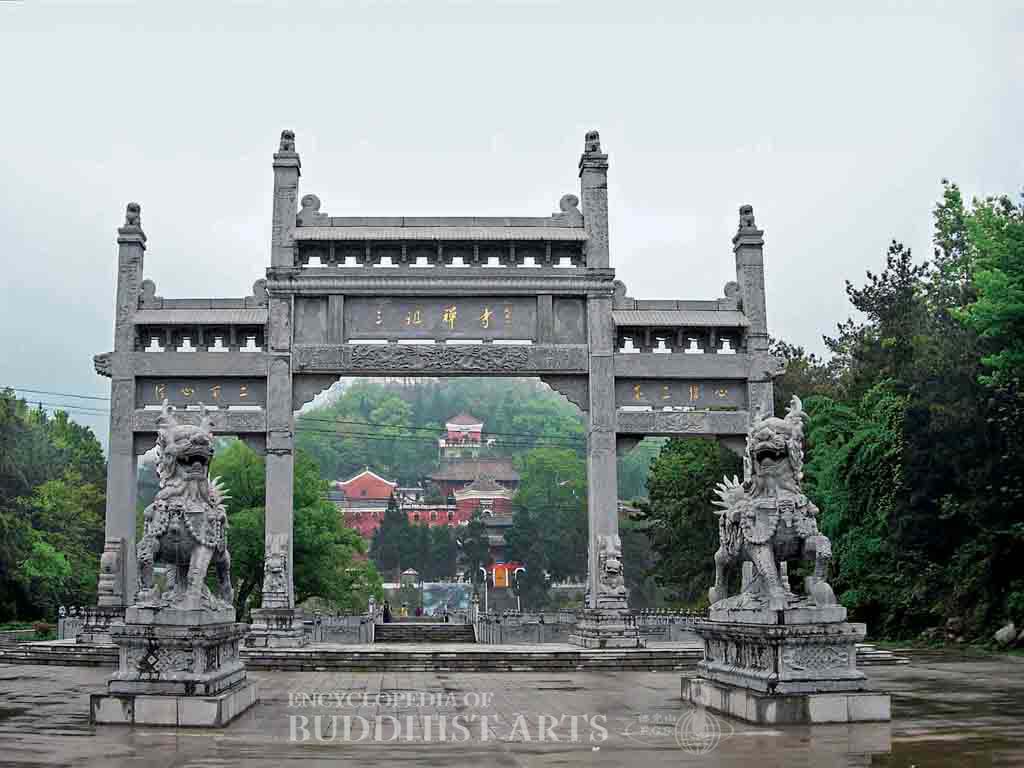
Sanzu Temple
Sanzu Temple
CHINA, Anhui, Anqing
Sanzu means Third Patriarch. It is the largest temple on Tianzhushan (Heaven Pillar Mountain). The temple was built by Chan Master Baozhi during the Southern Dynasties (420–589). During the Sui dynasty (581–618), Master Sengcan, the Third Chan Patriarch, stayed at this temple and wrote the Verses on the Faith Mind. Sengcan passed away in 606 and was buried behind the temple. His remains were dug up and cremated in 745 during the Tang dynasty, producing 300 five-color relics, which were then enshrined in a pagoda built specifically for this purpose. After the Song dynasty (960–1279), the temple was damaged during wartime. It was repaired in 1979, and was listed as a key Buddhist temple in the Han region of China in 1983.
The temple is built to fit the contours of the mountain, and occupies more than 1 ha. The principal buildings include the main temple gate, Heavenly King Hall, Great Hero Hall, Thousand Buddha Hall, Patriarch Hall, sutra repository, Jueji Pagoda, and Third Patriarch Pagoda. The seven-story, octagonal, brick and timber Jueji Pagoda was rebuilt in 1564 during the Ming dynasty. It is around 30 m high. There are stairs inside for access to the upper stories. Each story is surrounded by a balcony. The cliffs on the west side of the temple contain a collection of inscriptions penned by well-known calligraphers. They are mostly well-preserved and are a valuable resource for the study of calligraphy.
For more details, go to the Encyclopedia of Buddhist Arts: Architecture M-S, page 946.
Cite this article:
author = Hsingyun and Youheng and Johnson, Peter and Mankuang and Lancaster, Lewis,
booktitle = {Encyclopedia of Buddhist Arts: Architecture M-S},
pages = 946,
title = {{Sanzu Temple}},
volume = 3,
year = {2016}}