
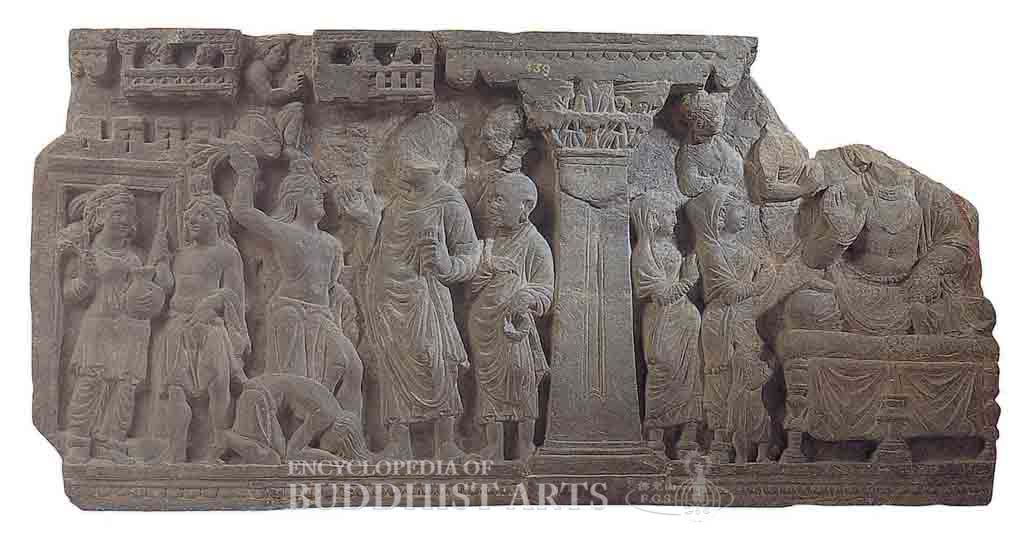
Prophecy of Dipamkara Buddha
Schist
Prophecy of Dipamkara Buddha
PAKISTAN
The scenes are set in an architectural environment that divides the composition both horizontally and vertically. To the right of the Corinthian column, a seated Bodhisattva forms the abhaya (fearlessness) mudra and also holds a vase. Damage to the section eliminates further detail. Female figures wearing headscarves face the figure with their palms joined. Opinions vary as to whether this represents the Bodhisattva teaching in Tusita Heaven or the Buddha instructing his deceased mother in Trayastrimsa Heaven.
To the left of the Corinthian column is a depiction of the prophecy of Dipamkara. Both scenes are conventionally depicted. The latter is often mentioned in Buddhist texts such as the Prince Mangala Nidana, Sutra of Cause and Effect in the Past and Present, Abhiniskramana Sutra, and the Caryanidana Sutra. The scene showing Dipamkara presents a composite narrative in which the young Megha appears four times in more or less contiguous roles. On the left he purchases flowers as an offering to Dipamkara and then turns and throws them in the Buddha’s direction, where they circle his head. Then, in order that the Buddha should not soil his feet, he kneels down and spreads his hair on the ground. Dipamkara prophesizes that he would become a Buddha in the future, whereupon the elated young man rises into the air with his hands joined in homage. The girl on the far left carrying flowers and a vase is an important element in the story, since she made Megha promise that they will become husband and wife in all his future reincarnations. She is eventually reborn as Yasodhara and he as Prince Siddhartha.
For more details, go to the Encyclopedia of Buddhist Arts: Sculpture N-Sr, page 844.
Cite this article:
author = Hsingyun and Youheng and Lovelock, Yann and Chou, Yuan and Huntington, Susan and Edson, Gary and Neather, Robert,
booktitle = {Encyclopedia of Buddhist Arts: Sculpture N-Sr},
pages = 844,
title = {{Prophecy of Dipamkara Buddha}},
volume = 12,
year = {2016}}