
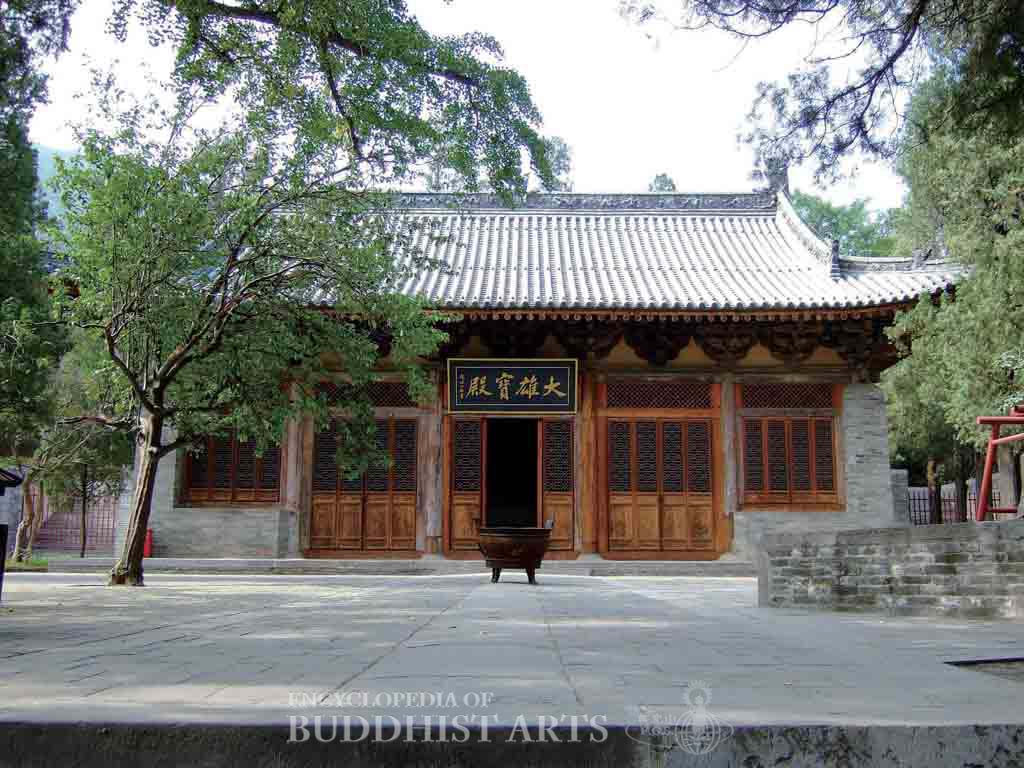
Huishan Temple: Great Hero Hall
Huishan Temple
CHINA, Henan, Zhengzhou
The temple is located at the southern foot of Jicui Peak. According to the temple records, it was founded between 57 and 75 CE during the Eastern Han dynasty. It is also believed to have been converted from an imperial lodge into a temple by Emperor Xiaowen (reigned 471–499) of the Northern Wei dynasty. The temple flourished during the Tang dynasty (618–907). Monk Yixing, a famous astronomer, renounced here and later built the Glazed Ordination Platform. During the Ming (1368–1644) and Qing (1644–1911) dynasties the temple was abandoned then reoccupied a number of times. It was listed as a National Cultural Heritage Site in 2001.
The buildings along the central axis include the main temple gate and the Great Hero Hall. Along either side there are buildings such as the Manjusri Hall, Fire Deity Hall, East Ordination Hall, West Ordination Hall, Avalokitesvara Hall and Ksitigarbha Hall. The Chan Master Jingcang Pagoda, glazed pagoda, a multi-story pagoda and the Meigong Pagoda, as well as the ruins of a Tang dynasty ordination platform, are located outside the walls of the temple. The five-by-three bay Great Hero Hall is the only Yuan dynasty timber structure on Songshan Mountain. It has a single-eave hip-and-gable roof covered in cylindrical tiles. The bracket sets supporting the eaves are exceptionally large. Inside columns have been removed to create an open space. The temple houses numerous steles dating from the Northern Qi (550–577) to the Qing dynasty, as well as an iron bell cast during the Ming dynasty.
For more details, go to the Encyclopedia of Buddhist Arts: Architecture G-L, page 472.
Cite this article:
author = Hsingyun and Youheng and Johnson, Peter and Mankuang and Lancaster, Lewis,
booktitle = {Encyclopedia of Buddhist Arts: Architecture G-L},
pages = 472,
title = {{Huishan Temple}},
volume = 2,
year = {2016}}