
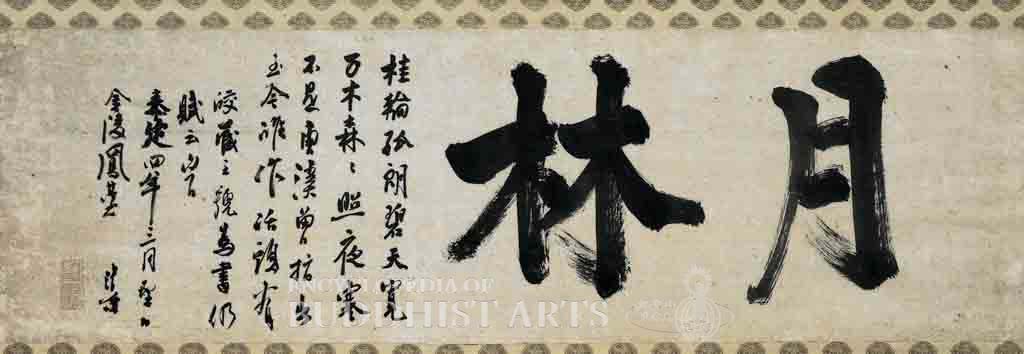
Characters - Yuelin
Ink on paper
Characters - Yuelin
CHINA; Yuan dynasty
Scripted by Chan Master Gulin Qingmao as a gift to his disciple Yuelin, this work consists of two large Chinese characters: “Yue” meaning “moon” and “lin” representing “woods.” Two characters thus have the connotation of the moon shining upon the woods. Additionally there is an accompanying verse derived from the two characters that reads, “The full moon shines in the clear sky, the dense forest mirrors the cold night. If not proclaimed by Master Huineng at Caoxi, who would speak of Chan today?” The piece was listed as a National Treasure of Japan in 1953.
The style of this calligraphic work is similar to that of Zhang Jizhi, whose concise and prominent writing style heavily influenced the calligraphy of Chan Buddhism. Elements of Yan Zhenqing’s style are also present, as the brushwork is richer and bolder, and the formation of characters is more consistent.
Gulin Qingmao was an influential monk and calligrapher of the Linji school of Chan Buddhism during the Yuan dynasty (1271–1368). He was widely venerated for his calligraphy, as well as his immense virtue and integrity.
For more details, go to the Encyclopedia of Buddhist Arts: Calligraphy, page 31.
Cite this article:
author = Hsingyun and Youheng and Youlu and Pokorski, Stefanie and Mankuang and Edson, Gary,
booktitle = {Encyclopedia of Buddhist Arts: Calligraphy },
pages = 31,
title = {{Characters - Yuelin}},
volume = 17,
year = {2016}}