
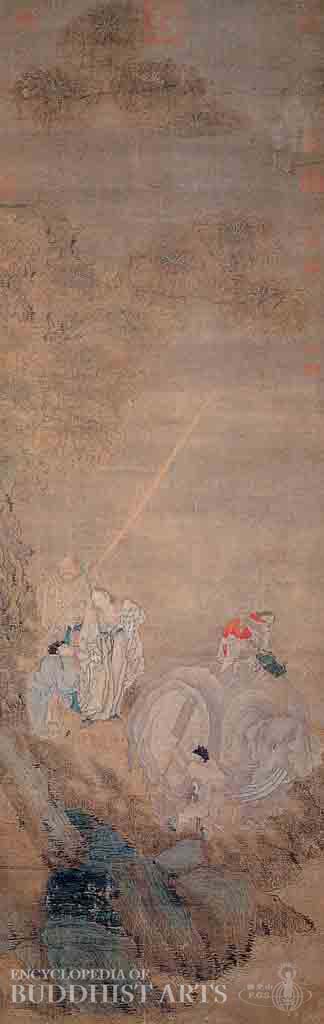
Washing the Elephants
Ink and color on silk
Washing the Elephants
CHINA; Ming dynasty
The washing of elephants was a popular theme in Buddhist paintings during the late Ming dynasty (1368–1644). In Chinese, the word “elephant” is a homonym of the word “form.” Washing the elephant therefore implies the removal of attachment to name and form. In the Gatha of the Seven Buddhas of the Past, the “Gatha of Vipasyin Buddha” reads, “From non-appearance arises the body; likewise, shapes and sizes arise from illusions. The illusory mind is empty by nature; so are fortunes and misfortunes, abiding nowhere.” Though it was once classified as a Song dynasty artwork, this picture greatly resembles another painting Washing the Elephant by Cui Zizhong kept in the National Palace Museum in Taipei, and is now thought to have been painted by Cui.
Two six-tusked elephants stand by a creek in the lower register. A figure wearing red crouches on the back of the elephant on the right, showering it with water. A man wearing a black hat cleans the other elephant with a huge brush. On the left, three figures stand and watch. The tall figure holding a staff has a usnisa on the top of his head, identifying him as a Buddha. A similar portrayal of a Buddha can be seen in Cui Zizhong’s drawing Buddha and Disciples made in 1631 and now kept in the Shanghai Museum, as well as in the other painting Washing the Elephant kept in the National Palace Museum. The trunk of a large tree is painted on the left; its leaves fill the upper register. The signature seal on the painting has been scraped away, but a seal imprint identifying it as part of the collection of the Qing dynasty imperial palace remains.
For more details, go to the Encyclopedia of Buddhist Arts: Painting P-Z, page 967.
Cite this article:
author = Hsingyun and Youheng and Youlu and Wilson, Graham and Manho and Mankuang and Huntington, Susan,
booktitle = {Encyclopedia of Buddhist Arts: Painting P-Z},
pages = 967,
title = {{Washing the Elephants}},
volume = 16,
year = {2016}}