
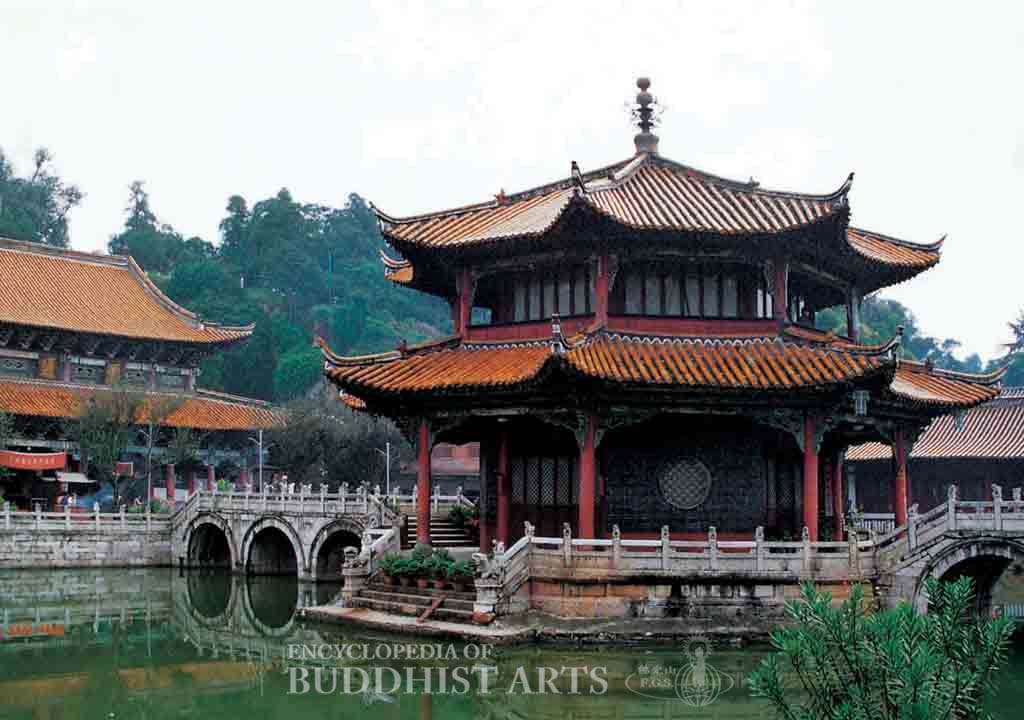
Yuantong Temple: Octagonal Pavilion
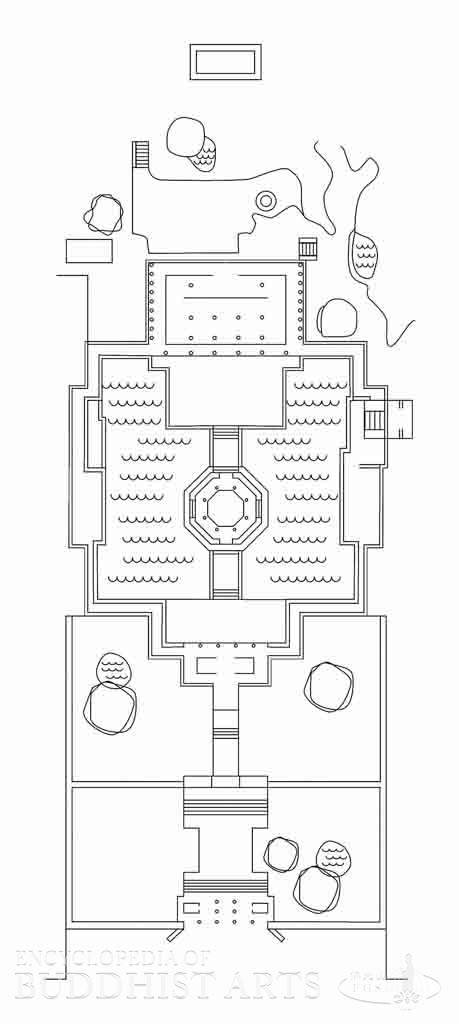
Yuantong Temple (site layout)
Yuantong Temple
CHINA, Yunnan, Kunming
Yuantong means Perfect Understanding. The temple was built when Prince Feng Jiayi was expanding the city eastwards during the Kingdom of Nanzhao (752–902). It was renovated between 1301 and 1320 during the Yuan dynasty. During the rule of Emperor Kangxi (reigned 1661–1722) of the Qing dynasty, the Perfect Understanding Hall, octagonal pavilion and stone gate were added to form its current layout. It was listed as a key Buddhist temple in the Han region of China in 1983.
Facing south, the principal buildings along the central axis are the main temple gate, the gateway, front hall, octagonal pavilion, Perfect Understanding Hall, Copper Buddha Hall, and the Welcoming Hall. The Dharma Hall, assembly hall, and Vajrayana Hall are located along either side. In front of the Perfect Understanding Hall there is a giant pond with the octagonal pavilion standing in the middle. On either side of the Perfect Understanding Hall there are covered walkways that surround the pond and lead to the front hall. This type of layout, with its waterside pavilion, is usually found during the Tang dynasty (618–907).
The octagonal pavilion has a pyramidal roof. A large wooden statue of Avalokitesvara Bodhisattva and a clay statue of Maitreya are enshrined within the pavilion. The five-bay wide Perfect Understanding Hall has a double-eave hip-and-gable roof. The eaves are supported by three-tier bracket sets and struts. A flood occurred in 1866 during the Qing dynasty and the Triad of the South Sea statues inside were destroyed. They were later replaced by the Three Buddhas. The walls are lined with ten statues of Avalokitesvara Bodhisattva from the time of Emperor Kangxi. In between these are colorful molded statues of Arhats, sages, scholars, and generals, which were included later. The Copper Buddha Hall was originally the sutra repository, which was converted to a Thai-style Buddhist building in 1985. The hall houses a 3.1 m high gilt copper Buddha statue weighing 4.7 t donated by Thai Buddhists.
For more details, go to the Encyclopedia of Buddhist Arts: Architecture T-Z, page 1372.
Cite this article:
author = Hsingyun and Youheng and Johnson, Peter and Mankuang and Lancaster, Lewis,
booktitle = {Encyclopedia of Buddhist Arts: Architecture T-Z},
pages = 1372,
title = {{Yuantong Temple}},
volume = 4,
year = {2016}}