
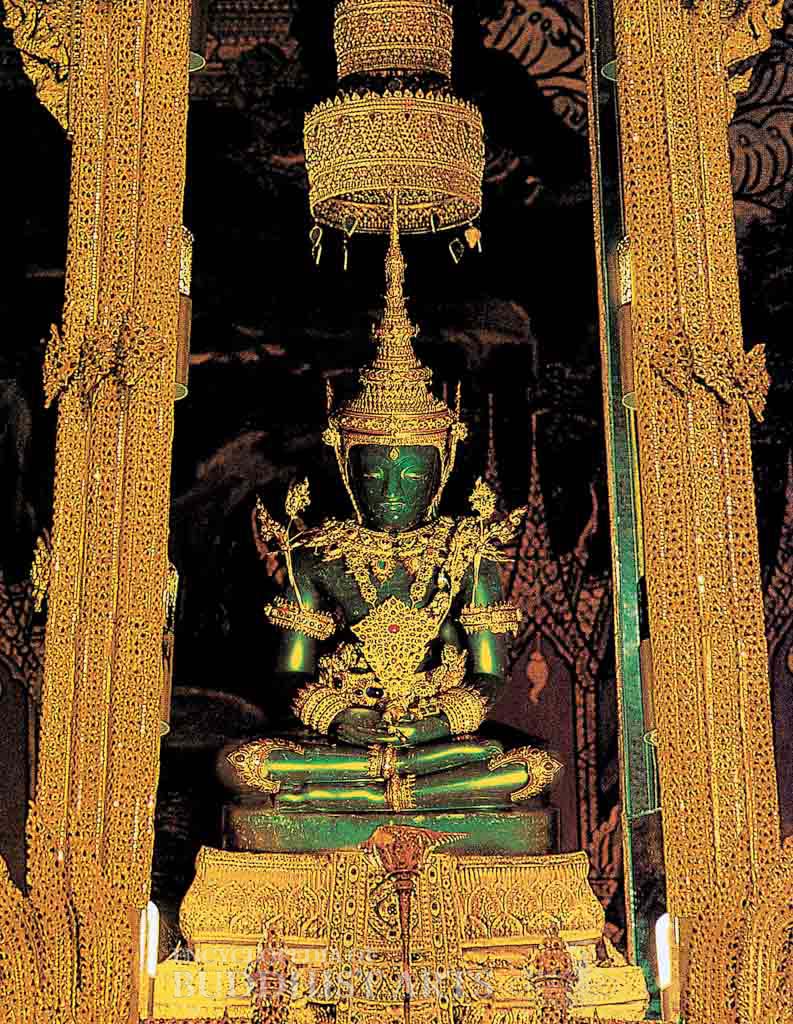
Wat Phra Kaeo Ordination Hall: Emerald Buddha
Jadeite
Wat Phra Kaeo Ordination Hall: Emerald Buddha
THAILAND, Bangkok
This statue, reckoned to have its origin in the late 14th century, is situated in the ordination hall of Wat Phra Kaeo. Thai historical records relate that this statue was discovered in 1434 in the rubble of Wat Phra Kaeo in Chiang Rai, after its collapse due to the effects of a lightning strike. For over 300 years the statue passed through many hands and eventually found its way to Laos. However, King Rama I (reigned 1782–1809) had the Emerald Buddha returned to Thailand in 1778 and enshrined the statue at Wat Phra Kaeo in Bangkok in 1782. Up until the present day, the Emerald Buddha has been officially under the protection of the crown and is widely respected by the populace.
Each season the king will preside over a costume changing ceremony. During this ceremony the statue will be draped in one of three sets of clothing specifically made for the rainy, summer, and winter seasons. In summer, the season depicted in the photo, it has a pointed crown of gold and jewels surmounted by a quadruple parasol, and a set of jeweled ornaments that adorns the image from the shoulders to the ankles. In winter, drapery made of gold beads covers it from the neck down. During the rainy months it wears a top-knot headdress studded with gold, enamel, and sapphires; its golden monastic robe is draped over the left shoulder with the right shoulder left bare, while gold ornaments embellish the image up to the ankles.
Contrary to the official name of “Emerald Buddha,” the statue is actually carved out of jadeite. It is 47.5 cm high and 42.5 cm wide. Sitting in half lotus position in a high chamber decorated with golden thread and jewels, the Buddha is depicted in the northern Thai style. The figure makes the dhyana (meditation) mudra. Both the fingers and toes are of equal length with the soles completely flat, in accordance with the traditional description of the Buddha. As usual with Thai statues, the topknot is depicted as conical and the hairline is bordered by a band. Between the eyebrows is a diamond urna placed by King Rama IV (reigned 1851–1868). The statue’s eyes gaze gently downward through partially opened lids. The Buddha is depicted with a large nose, small mouth, and deep-set eyes. The lips are particularly deeply carved, with a bow-like upper lip and a thick lower lip. The earlobes are slightly raised and shaped like lotus petals.
For more details, go to the Encyclopedia of Buddhist Arts: Sculpture St-Z, page 1327.
Cite this article:
author = Hsingyun and Youheng and Lovelock, Yann and Chou, Yuan and Huntington, Susan and Edson, Gary and Neather, Robert,
booktitle = {Encyclopedia of Buddhist Arts: Sculpture St-Z},
pages = 1327,
title = {{Wat Phra Kaeo Ordination Hall: Emerald Buddha}},
volume = 13,
year = {2016}}