
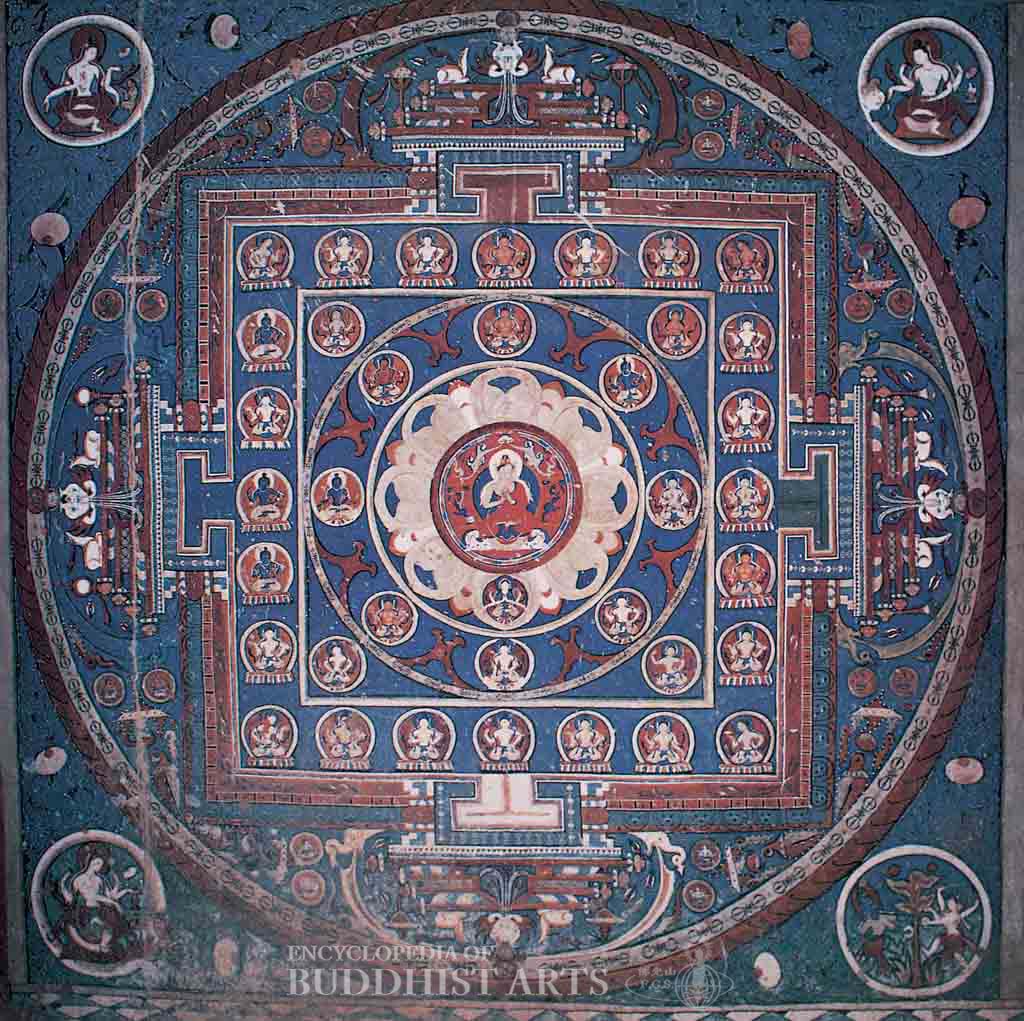
Alchi Monastery Three Story Hall: Vairocana Buddha Mandala

Alchi Monastery Three Story Hall: Vairocana Buddha Mandala - Vairocana Buddha
Alchi Monastery Three Story Hall: Vairocana Buddha Mandala
INDIA, Jammu and Kashmir, Ladakh
The north, east, and west walls on the third story of Three Story Hall are painted with mandalas featuring Six-Armed Prajnaparamita, Vairocana Buddha, and Four-Headed, Eight-Armed Manjusri Bodhisattva. This mandala is painted on the west wall. Concentric inner circles are surrounded by square palace walls, which are contained within a large outer circle.
In the center, Vairocana Buddha sits in full lotus position within an eight-petal lotus wheel. Colored in white, the Buddha has a tall, circular usnisa and wears a three-pointed crown decorated with ribbons that hang down to the elbows. The Buddha forms a mudra with both hands and sits on a throne supported by two snow lions. Bird-headed, animal-bodied auspicious creatures stand with raised claws beside Vairocana. Above, the elongated bodies of two makaras curve around the Buddha’s nimbus. The ends of their tails are gripped by the outstretched claws of a white leonine beast and held in its mouth. Lotus petals are arranged symmetrically around the outside of the wheel that surrounds Vairocana. Eight-Armed Prajnaparamita is seated within the white petal at the bottom.
In the outer circle, there are eight Bodhisattvas depicted in different forms, positioned in the four cardinal and four intercardinal directions. The outer edge of the circle is decorated with vajras, and is surrounded by the inner square of palace walls. Four Bodhisattvas are painted in the corners of the inner square, and 24 Bodhisattvas are painted around the outer square, resembling the Diamond Realm Mandala in layout. Tall palace gates stand in the middle of each of the four walls.
Deities, canopies, vajras, and flames fill the space between the palace and the outer circle. In each of the four corners of the painting, there are white Bodhisattvas with four arms. Three of the Bodhisattvas teach the Dharma to animals; one faces a wrathful blue figure.
For more details, go to the Encyclopedia of Buddhist Arts: Painting A-H, page 25.
Cite this article:
author = Hsingyun and Youheng and Youlu and Wilson, Graham and Manho and Mankuang and Huntington, Susan,
booktitle = {Encyclopedia of Buddhist Arts: Painting A-H},
pages = 25,
title = {{Alchi Monastery Three Story Hall: Vairocana Buddha Mandala}},
volume = 14,
year = {2016}}