
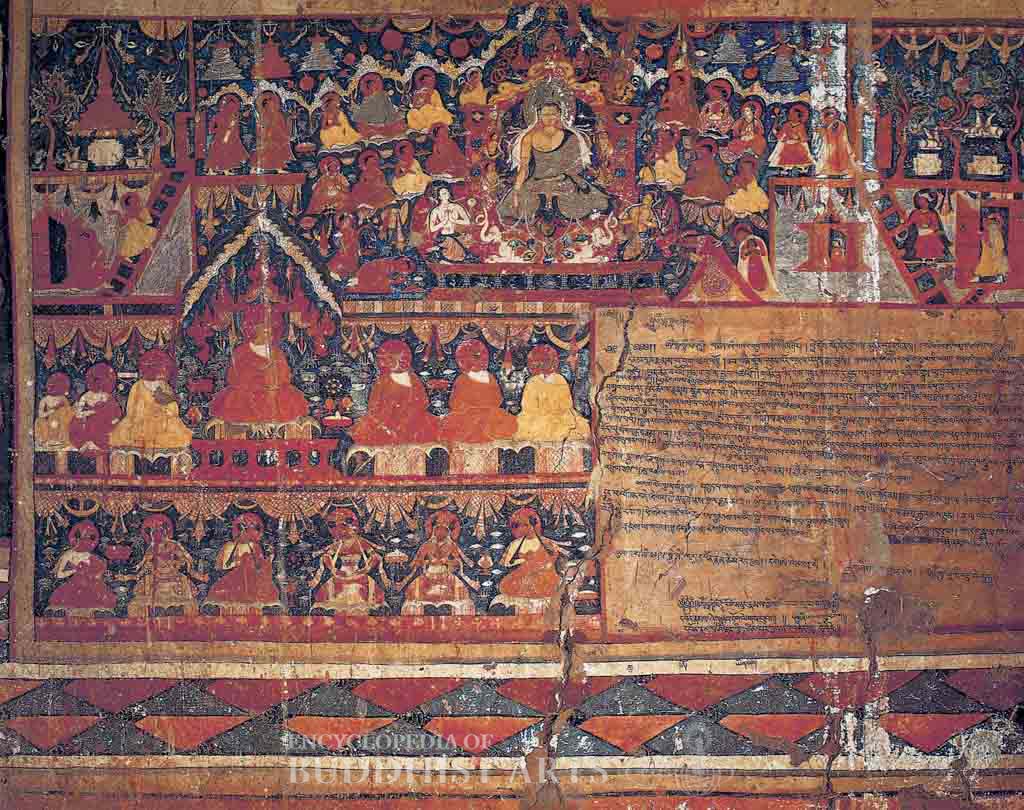
Alchi Monastery Three Story Hall: Aksobhya Buddha
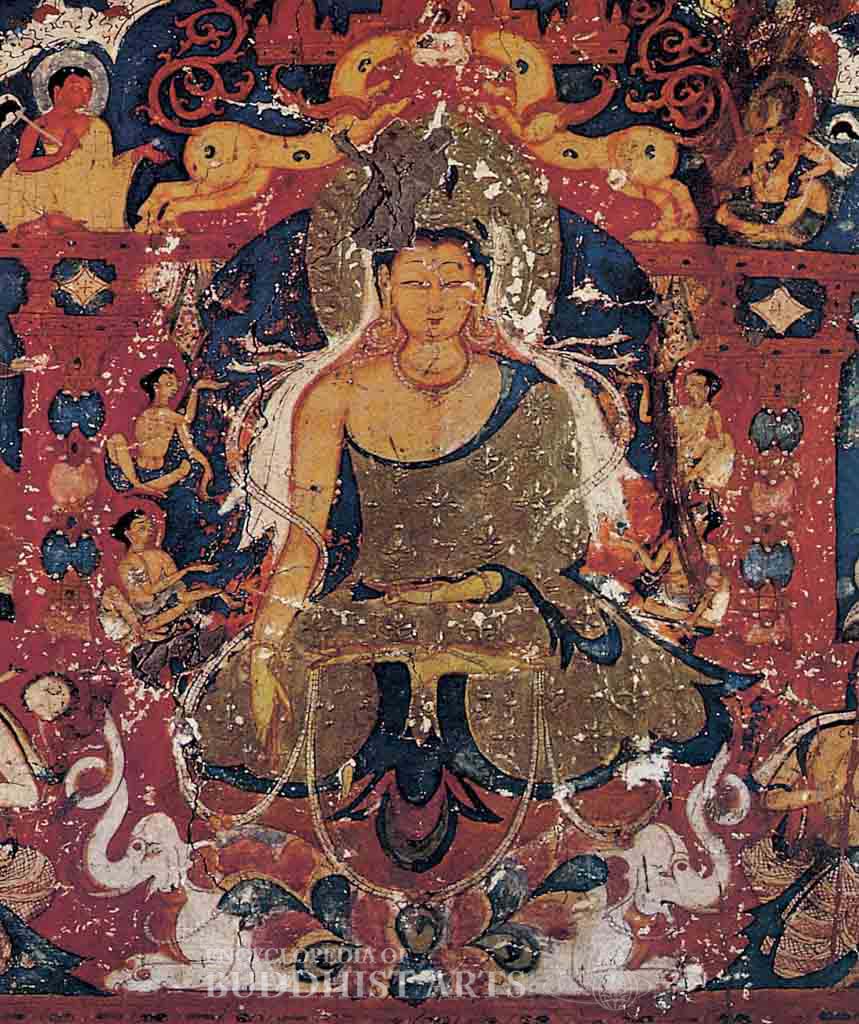
Alchi Monastery Three Story Hall: Aksobhya Buddha (detail)
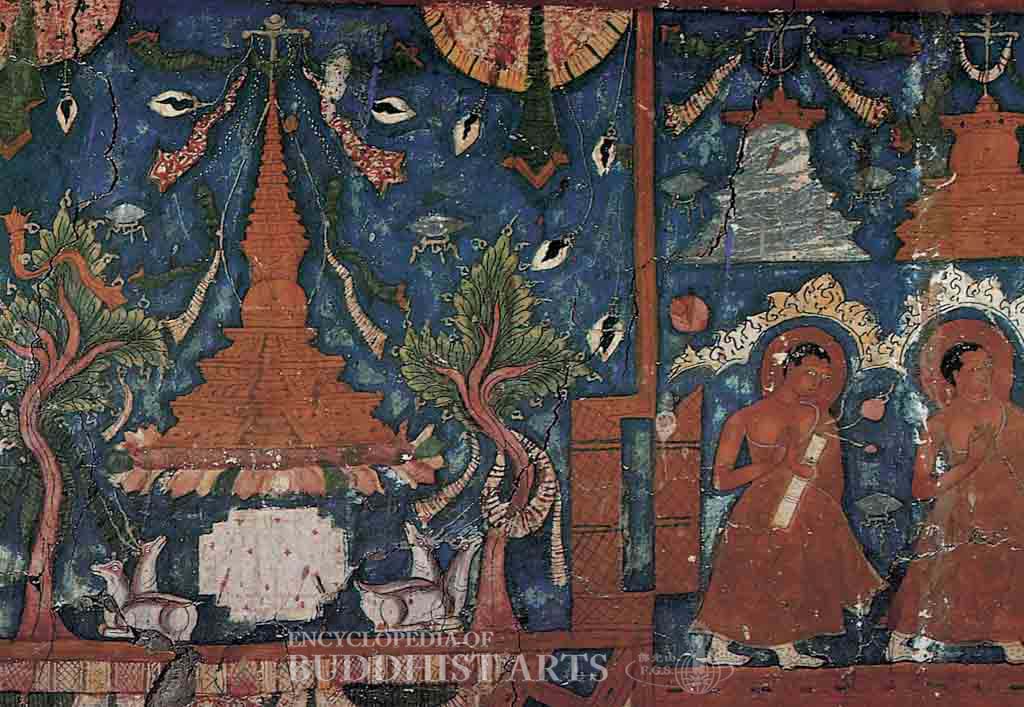
Alchi Monastery Three Story Hall: Aksobhya Buddha - Stupa, Trees, and Antelope
Alchi Monastery Three Story Hall: Aksobhya Buddha
INDIA, Jammu and Kashmir, Ladakh
This mural is painted on the bottom of the right inner wall of the niche in the north wall of the first story of the Three Story Hall in Alchi Monastery. Its layout is similar to that of the Manjusri Bodhisattva mural on the left wall of the same niche, with several distinct illustrations and a large inscription separated by red lines.
In the center of the upper register, Aksobhya Buddha is shown with a yellow skin color rather than the usual blue. The Buddha wears a headdress, ornaments, and a brown monastic robe. With hands forming the bhumisparsa (earth-touching) mudra, the Buddha sits on a lotus throne supported by a pair of white elephants. Four small figures making offerings are painted around the Buddha’s aureole, and two auspicious creatures form an arch above the nimbus. Attendant Bodhisattvas and monks are arranged in rows surrounding the Buddha, all kneeling with their palms joined in reverence. Further to the sides, there are royally dressed male and female worshippers, and youths holding prayer beads. Flame patterns are painted above the heads of the top row of figures. Small stupas can be seen above the flames.
In the top left corner of the upper register, two trees and a red stupa are depicted. Below the stupa, there is a white offering table flanked by two antelopes on each side. Further down, a monk climbs a ladder that leads up to a door to the right of the stupa, where two monks stand facing towards the central Buddha image. In the top right corner there are three trees, a lake, and pairs of antelopes. Parrots and peacocks are painted at the ends of the tree branches. Below, a male figure with beads in hand climbs a ladder as if to make an offering. A female figure stands by a window, gazing outside. These images likely represent parts of the Alchi Monastery grounds.
The left side of the lower register is divided into two distinct rows. In the upper row, seven monks are seated together, clothed in monastic robes and wearing hats. The monk in the center of the group is slightly larger than the rest of the figures, and there is a canopy above his head. Offerings and ceremonial objects are placed between the seven monks. The lower row consists of six figures sitting in a row wearing trefoil crowns. With hands holding vajras or bells, they sit in lotus positions, appearing to participate in a Vajrayana Buddhist ceremony.
There is an inscription in Tibetan on the right side of the lower register. Written during the rule of King Tashi Namgyal (reigned 1555–1575), it describes the restoration of Three Story Hall during that period, and lists the names of those involved, including the names of women who were responsible for preparing turquoise dyes.
The mural is neatly arranged and carefully drawn. It is painted with fine brushstrokes and rich colors. With depictions of both religious figures and monastic life, it provides valuable information for research on local religious activities and ceremonies during the late 12th century.
For more details, go to the Encyclopedia of Buddhist Arts: Painting A-H, page 8.
Cite this article:
author = Hsingyun and Youheng and Youlu and Wilson, Graham and Manho and Mankuang and Huntington, Susan,
booktitle = {Encyclopedia of Buddhist Arts: Painting A-H},
pages = 8,
title = {{Alchi Monastery Three Story Hall: Aksobhya Buddha}},
volume = 14,
year = {2016}}