

Alchi Monastery Three Story Hall: Aksobhya Buddha (first story, north wall niche, exterior, right side)
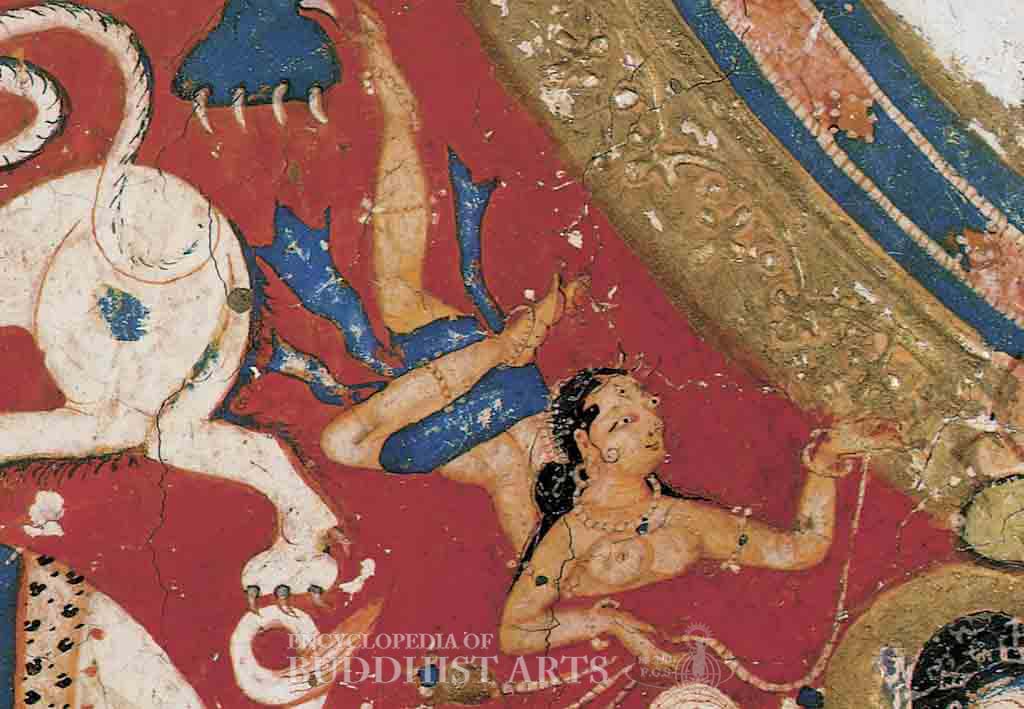
Alchi Monastery Three Story Hall: Aksobhya Buddha (detail) (first story, north wall niche, exterior, right side)

Alchi Monastery Three Story Hall: Aksobhya Buddha (first story, north wall niche, exterior, left side)

Alchi Monastery Three Story Hall: Aksobhya Buddha - male heavenly musician (first story, north wall niche, exterior, left side)
Alchi Monastery Three Story Hall: Aksobhya Buddha
INDIA, Jammu and Kashmir, Ladakh
These murals are painted to the left and right of the niche on the north wall of the first story of Three Story Hall. The mural on the right is relatively well preserved compared to the one the left, which was damaged in many areas due to erosion by rain water, and repaired in the 1980’s. Both murals feature a large Aksobhya Buddha as the central figure. Arranged in orderly rows and columns around the outside of the murals are 712 smaller images of Aksobhya Buddha, seated in full lotus position on the backs of white elephants. They are all colored in blue, wear red monastic robes, and form the bhumisparsa (earth-touching) mudra.
The central Aksobhya Buddha in the mural on the right sits on a lotus throne supported by five white elephants. A large, gold-rimmed mandorla surrounds the Buddha. Four-armed apsaras making offerings are painted above the mandorla. Directly below the mandorla, there is an illustration of a Dharma wheel with figures seated on either side, both holding whisks. The figure on the right is dressed in a monastic robe and holds a bowl. The figure on the left, appearing to be a Bodhisattva, offers a vase and a conch shell to the Buddha.
The Buddha is painted within a large red square topped with an ogee arch. The figures and creatures on both sides within the square and arch are mirror images of each other. Outside the top of the arch, apsaras with four arms fly through the air holding whisks, garlands, and other objects. Within the top of the niche, two heavenly musicians sit on the tails of a pair of makaras, which curve downwards, forming a bell shape. Two more heavenly musicians playing instruments sit beside the elephant-like heads of the makaras. Below the heads, there are two small Buddha images and identical columns of auspicious creatures on each side. Heavenly beings ride on the backs of one pair of creatures, wrapping one arm around the beast’s neck and reaching towards the central Buddha with the other arm. A row of nine figures runs along the base of the square. The figure in the middle is upside down, with both arms outstretched on the ground to support the body. The remaining figures are portrayed dancing, beating drums, or holding offerings.
The mural on the left is similar to the one on the right, except that there is no arch atop the red square and there are fewer figures painted within it. The Buddha is clothed in a red monastic robe decorated with a swastika pattern, and has a blue-rimmed mandorla containing flying apsaras with four arms. To the left and right at the bottom of the mandorla, male figures bow to the Buddha. On the sides, there are mirrored illustrations of elephants, snow lions, and auspicious creatures. A male and a female heavenly musician ride on the backs of the auspicious creatures. The red male on the right wears a crown and holds a whisk. He is dressed in tight-fitting garments decorated with images of twin lions gazing at each other. This exquisite design is also found on the ceiling of the hall. The female heavenly being on the left carries an instrument that resembles a flute. Above the Buddha, two green makaras ridden by heavenly musicians form an arch with their tails. Below the Buddha, there are red and blue squares, some containing images of heavenly beings and others left blank. Moving downwards, a small row of patterns representing mountains, trees, and sky is painted above five groups of animals.
For more details, go to the Encyclopedia of Buddhist Arts: Painting A-H, page 6.
Cite this article:
author = Hsingyun and Youheng and Youlu and Wilson, Graham and Manho and Mankuang and Huntington, Susan,
booktitle = {Encyclopedia of Buddhist Arts: Painting A-H},
pages = 6,
title = {{Alchi Monastery Three Story Hall: Aksobhya Buddha}},
volume = 14,
year = {2016}}