
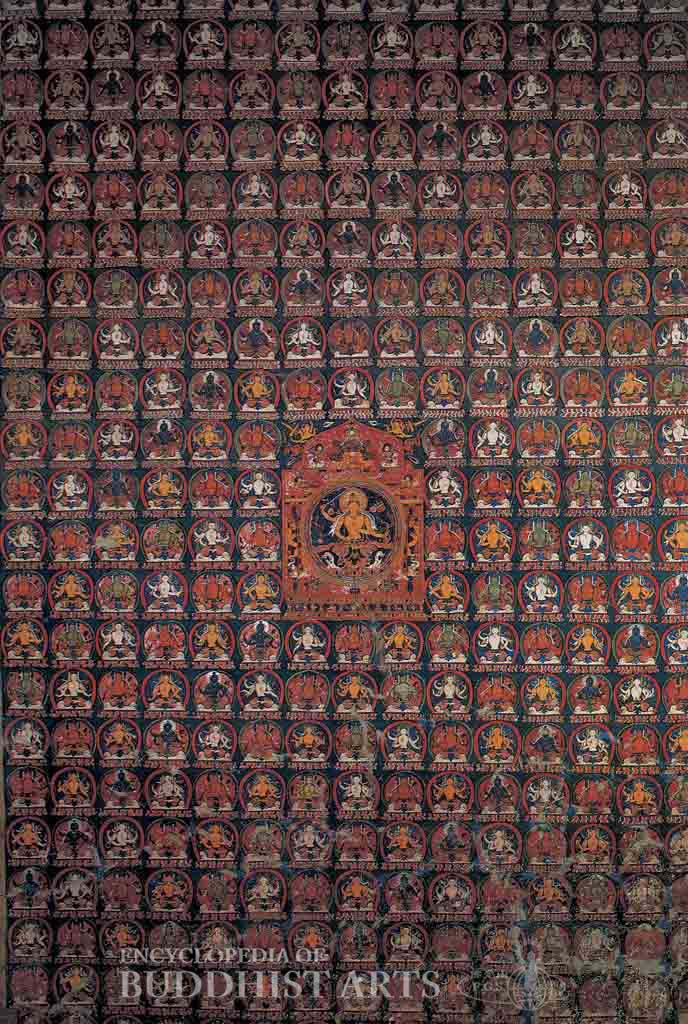
Alchi Monastery Three Story Hall: Manjusri Bodhisattva (first story, east wall niche, exterior, left side)

Alchi Monastery Three Story Hall: Manjusri Bodhisattva (detail) (first story, east wall niche, exterior, left side)
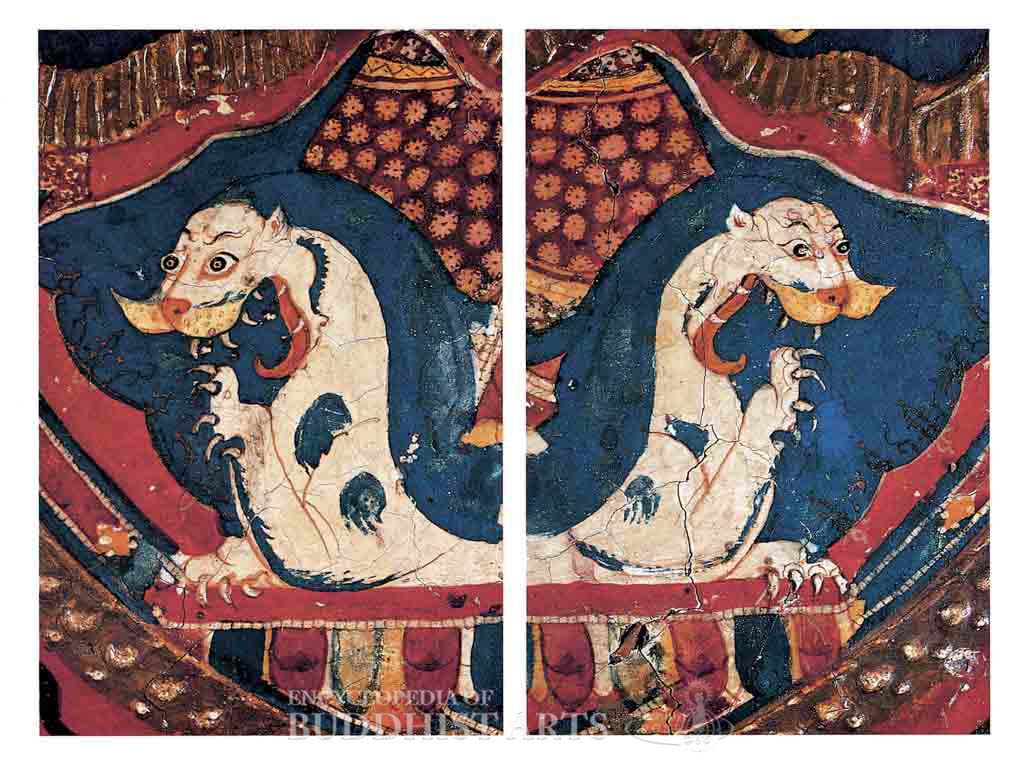
Alchi Monastery Three Story Hall: Manjusri Bodhisattva (detail) (first story, east wall niche, exterior, right side)
Alchi Monastery Three Story Hall: Manjusri Bodhisattva
INDIA, Jammu and Kashmir, Ladakh
Located on the first story of the Three Story Hall, these murals are painted on both sides of the niche in the east wall. The two murals are similar; both feature Manjusri Bodhisattva seated in the center within a niche that is surrounded by numerous smaller images of the Bodhisattva. The two murals contain a total of 728 painted figures. The central Manjusri figure has yellow skin and four arms. One of the right hands carries an arrow, and a left hand holds a lotus that supports a sutra. The long stem of the lotus is uniquely painted, resembling a loose string. The two other hands are raised, holding a sword and a bow. Near the four arms, there are small red circles that contain images of female deities. Manjusri sits upon a lotus throne flanked by two snow lions with open mouths and sharp claws.
On each side below the mandorla, there are four-armed apsaras in unusual poses. The images on the niche lintel are elaborate, with a double-bodied creature in the center and two symmetrical deities riding auspicious creatures on the sides. More auspicious creatures are shown clinging to the niche pillars. The bottom of the niche is decorated with images of the seven treasures of the cakravartin.
The mural on the right is similar to the left mural, though the figures on the niche lintel are even more colorful. The bottom of the niche is decorated with the eight auspicious symbols, which began to appear in Indian images during the Kushan period (circa 1st–3rd century). Smaller images of Manjusri colored in blue, white, red, yellow, or green surround the central niche. These figures have bare upper bodies and wear headdresses and ornaments. Their hands form mudras or hold objects, and they sit in full lotus position on lotus thrones supported by snow lions. The bright colors of the figures contrast with the dark background.
For more details, go to the Encyclopedia of Buddhist Arts: Painting A-H, page 16.
Cite this article:
author = Hsingyun and Youheng and Youlu and Wilson, Graham and Manho and Mankuang and Huntington, Susan,
booktitle = {Encyclopedia of Buddhist Arts: Painting A-H},
pages = 16,
title = {{Alchi Monastery Three Story Hall: Manjusri Bodhisattva}},
volume = 14,
year = {2016}}