
Alchi Monastery Three Story Hall: Green Tara
Alchi Monastery Three Story Hall: Green Tara
Alchi Monastery Three Story Hall: Green Tara
INDIA, Jammu and Kashmir, Ladakh
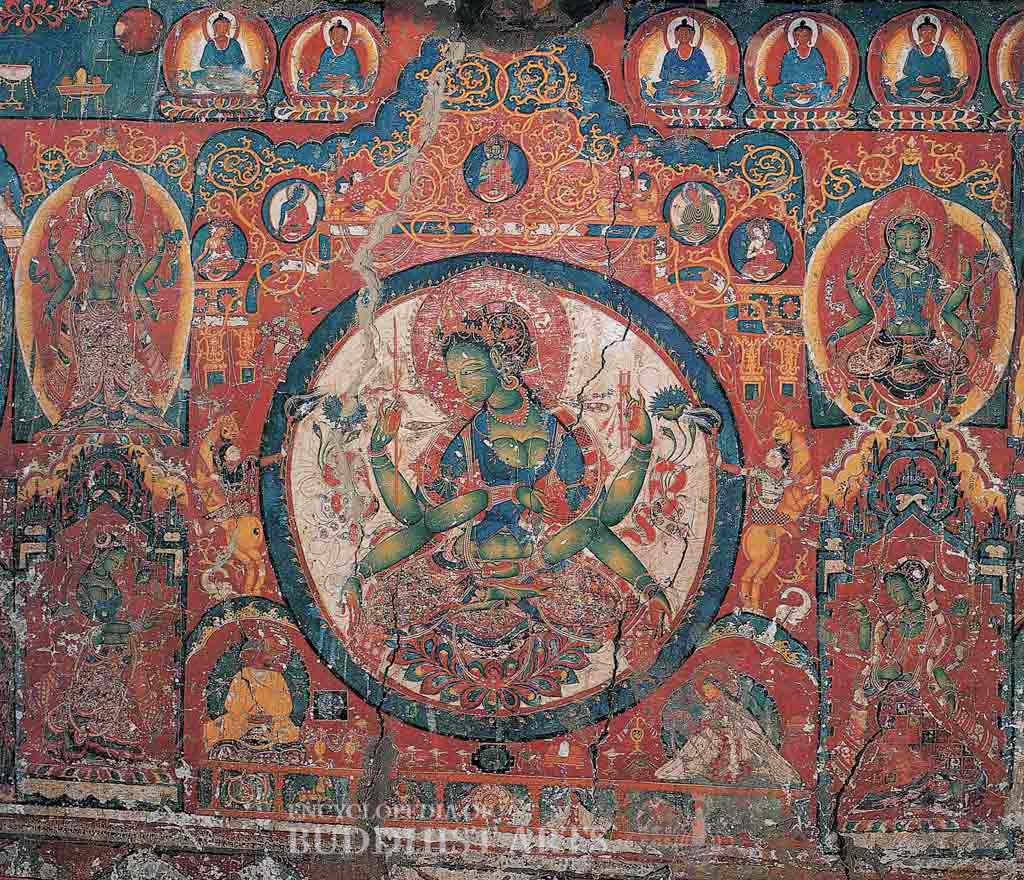
This mural, 68 cm high and 118 cm wide, depicts five Green Tara figures below the niche on the west wall of the Three Story Hall in Alchi Monastery. The central Tara has six arms and wears a patterned dhoti. Prayer beads and a vajra halberd are held in two of the right hands, and the third right hands forms the varada (wish-granting) mudra. One of the left hands forms a mudra, and the other two hold a sutra and a vase. Green Tara sits in full lotus position on a lotus throne flanked by two long-stemmed blue lotuses. A white, round mandorla with a red and blue border is painted around Tara, and many offerings are placed below it. This portrayal of the Bodhisattva seems to have been inspired by the Sadhanamala, a Vajrayana Buddhist text. The arch surrounding Tara is decorated with curvy, vine-like patterns and circles containing the Five Dhyani Buddhas. The auspicious creatures that form the columns of the arch have the heads of mythical birds and the bodies of horses. They stand on white elephants and kinnaras holding whisks while riding on their backs.
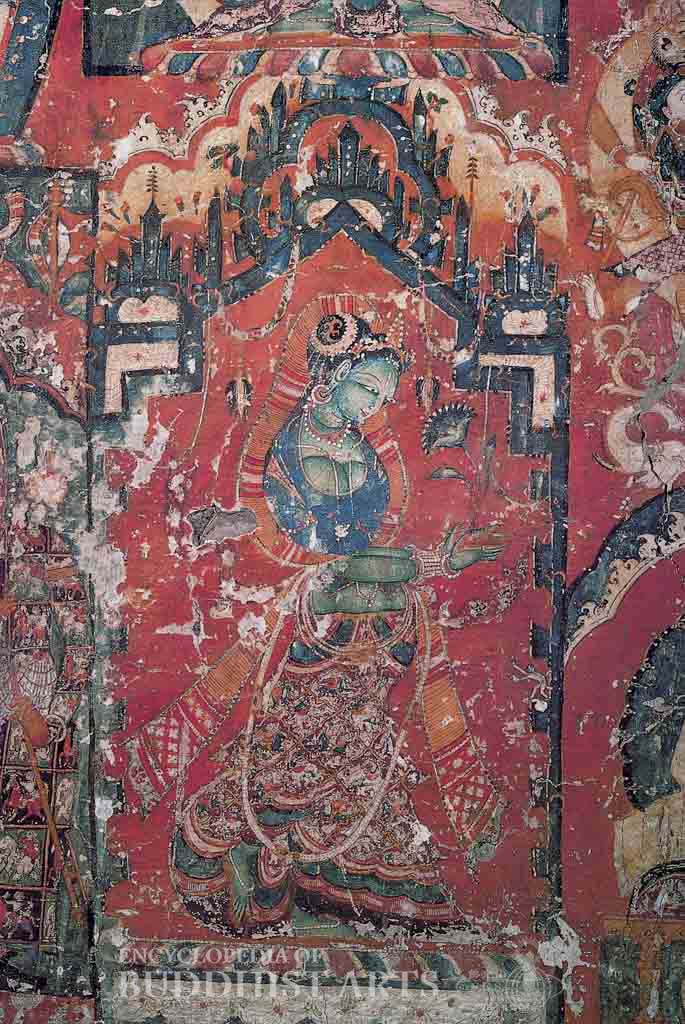
The two Tara figures in the top corners each have four arms. One of the figures stands barefoot on a lotus pedestal and the other is seated in full lotus position. Both figures are adorned with ornaments, wear headdresses, carry Dharma instruments, and form mudras. The two Green Tara figures in the bottom corners are dressed in fine robes and stand in graceful postures. The Tara on the left holds a blue lotus. The figure on the right holds prayer beads in one of the right hands and a long-stemmed lotus in one of the left hands. All the Taras are surrounded by arches decorated with colored patterns that represent hills, trees, clouds, and lakes.
The tilted heads of the main figure and the two figures at the bottom, with carefully painted eyes that stand out within the faces, are featured in many of the murals in the Alchi Monastery. This style is also seen in the 8th century murals of the Ellora Caves, and in illustrations of sutra manuscripts from the 11th and 12th century.
For more details, go to the Encyclopedia of Buddhist Arts: Painting A-H, page 14.
Cite this article:
author = Hsingyun and Youheng and Youlu and Wilson, Graham and Manho and Mankuang and Huntington, Susan,
booktitle = {Encyclopedia of Buddhist Arts: Painting A-H},
pages = 14,
title = {{Alchi Monastery Three Story Hall: Green Tara}},
volume = 14,
year = {2016}}