
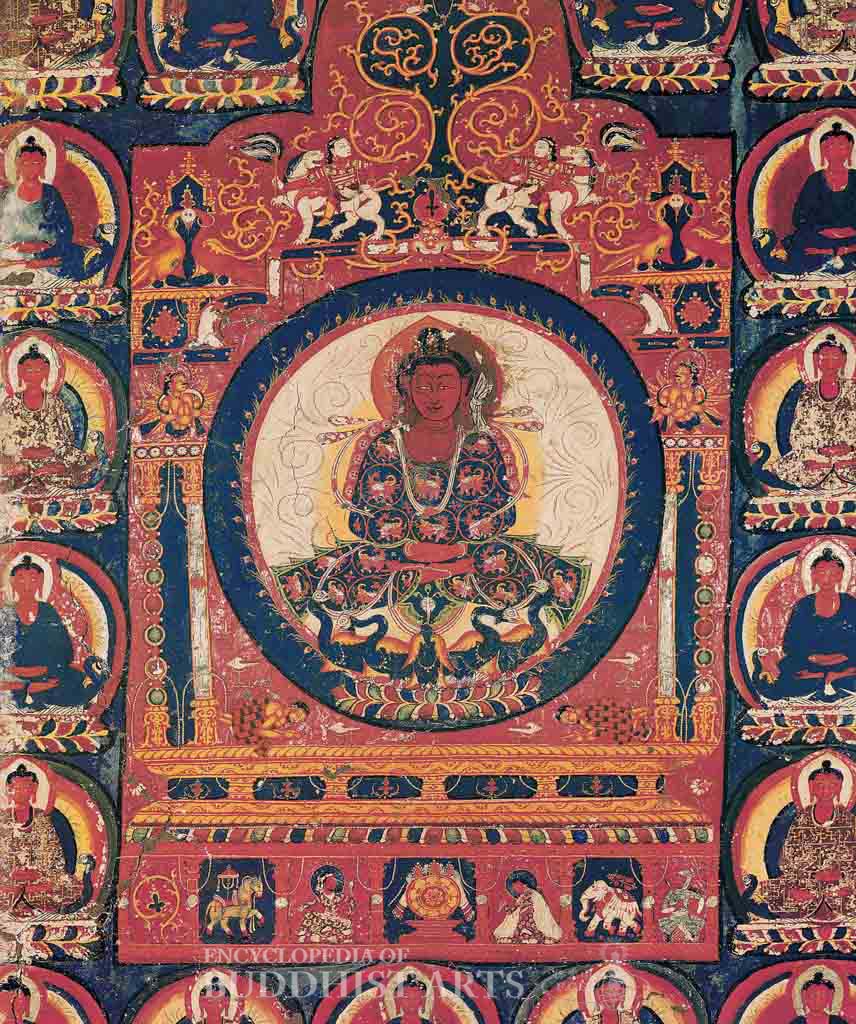
Alchi Monastery Three Story Hall: Thousand Buddhas (first story, west wall niche, exterior, left side)

Alchi Monastery Three Story Hall: Thousand Buddhas (first story, west wall niche, exterior, right side)
Alchi Monastery Three Story Hall: Thousand Buddhas
INDIA, Jammu and Kashmir, Ladakh
These murals are painted on the exterior sides of the west wall niche, located on the first story of the Three Story Hall. They contain a total of 814 painted images of Amitabha Buddha, a representation of the Thousand Buddhas. In the center of each mural, there is a larger image of Amitabha within a 59 cm high and 35 cm wide niche. Each of these central Buddhas has a high, rounded topknot and an urna between their eyebrows. They wear ornaments and a pointed, leaf-shaped headdress adorned with ribbons that hang down to the shoulders. The Buddhas sit in lotus position on lotus thrones with colorful petals. Their nimbuses, aureoles, and mandorlas are also brightly colored. In front of their thrones, there are five blue peacocks standing side by side.
The monastic robe of the central Buddha figure on the left is decorated with patterned circles containing half-lion, half-elephant creatures. Above the Buddha, there are two figures riding white lions, each holding a whisk. A kinnara stands on the capital of each pair of columns on the sides of the orange niche, paying respect to the Buddha with joined palms. Beneath the Buddha’s throne, there are two bearded males bowing in reverence on a golden platform. Below, red squares contain the seven treasures of the cakravartin.
The central Buddha figure in the mural on the right wears a monastic robe decorated with patterned flowers, images of archers on horseback, and geometric shapes. A red rectangular niche surrounds the Buddha. In the top corners of the niche, there are four apsaras holding conch shells and scattering flowers as offerings. Intricate gold scrolling patterns are painted above the Buddha. Beside these patterns, two kinnaras playing musical instruments stand on the capitals of two columns. The kinnara on the left beside the Buddha holds a parasol, while the one on the right holds a hanging banner. In front of the columns, there are several auspicious creatures standing on top of one another. A gold Sumeru throne painted with images of three female deities rests below the Buddha. Beneath the Sumeru throne, there are six musicians, each holding a different instrument, reflecting the importance of music in Vajrayana Buddhist rituals. Each of the many small images of Amitabha Buddha surrounding the central figures have a nimbus and a seven-colored mandorla. They wear a blue or brown monastic robe, which is either plain or decorated with swastika patterns.
For more details, go to the Encyclopedia of Buddhist Arts: Painting A-H, page 24.
Cite this article:
author = Hsingyun and Youheng and Youlu and Wilson, Graham and Manho and Mankuang and Huntington, Susan,
booktitle = {Encyclopedia of Buddhist Arts: Painting A-H},
pages = 24,
title = {{Alchi Monastery Three Story Hall: Thousand Buddhas}},
volume = 14,
year = {2016}}