
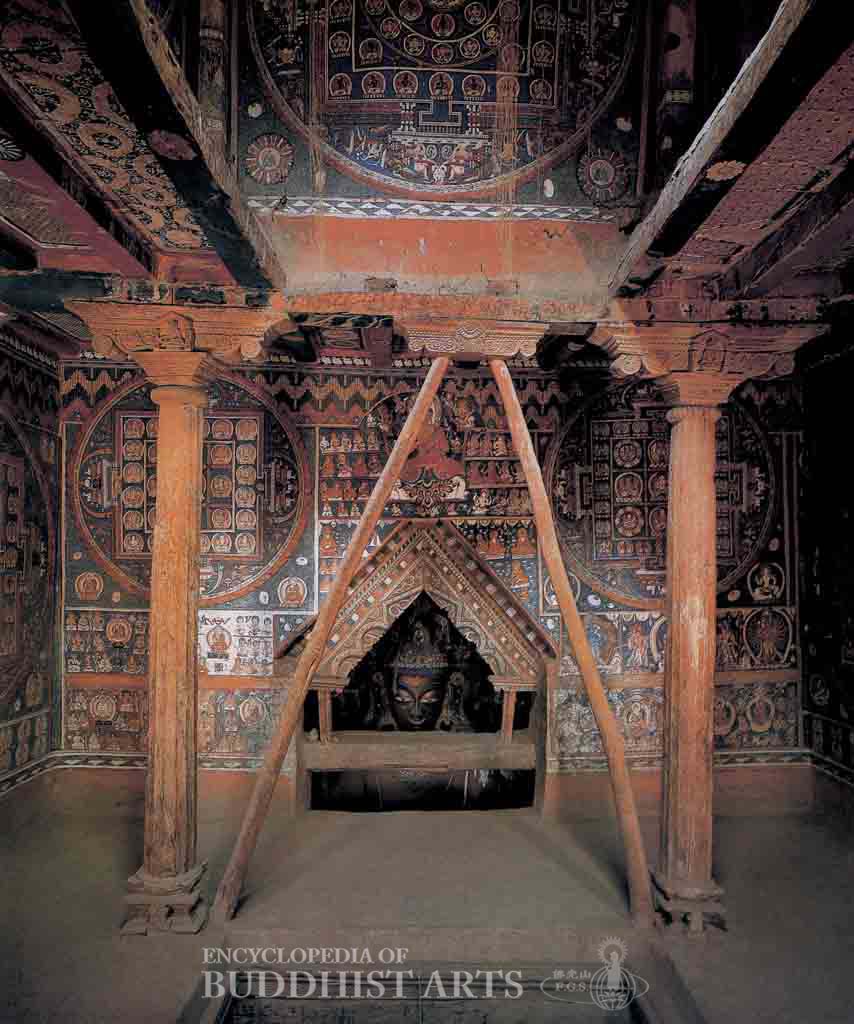
Alchi Monastery Three Story Hall Murals (second story, north wall)
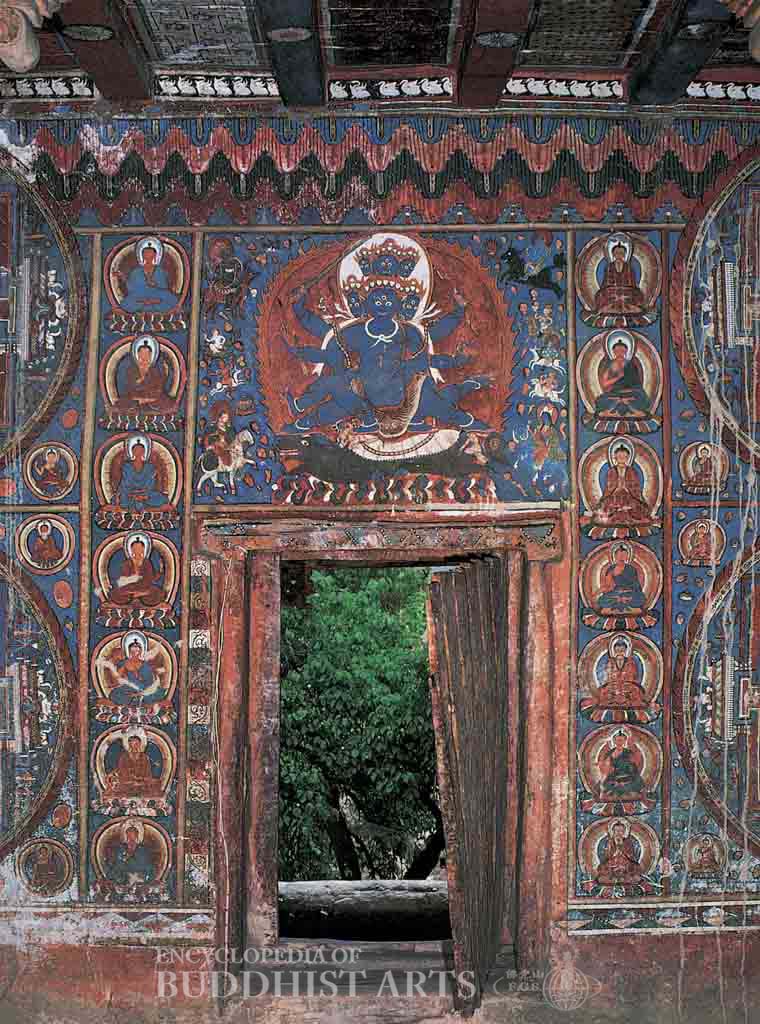
Alchi Monastery Three Story Hall Murals (second story, south wall)

Alchi Monastery Three Story Hall Murals (third story, south wall)

Alchi Monastery Three Story Hall Murals: Ceilings (first and second stories)

Alchi Monastery Three Story Hall Murals: Female Deity (first story, south wall)
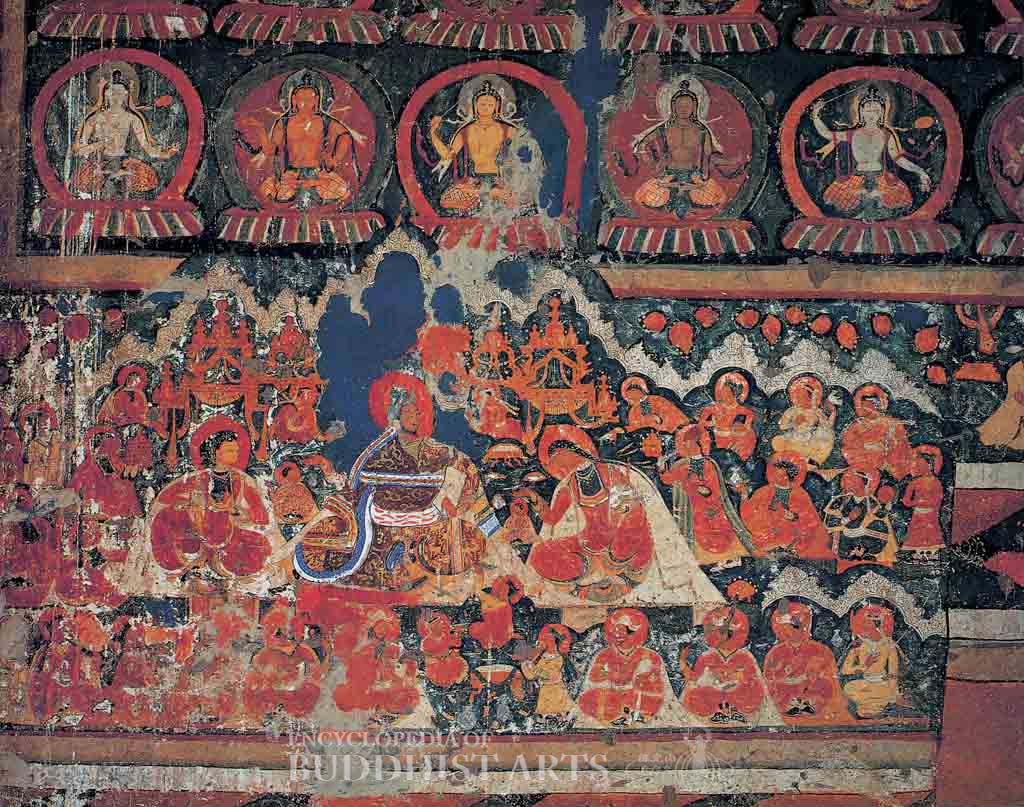
Alchi Monastery Three Story Hall Murals: Imperial Banquet (first story, east wall niche)
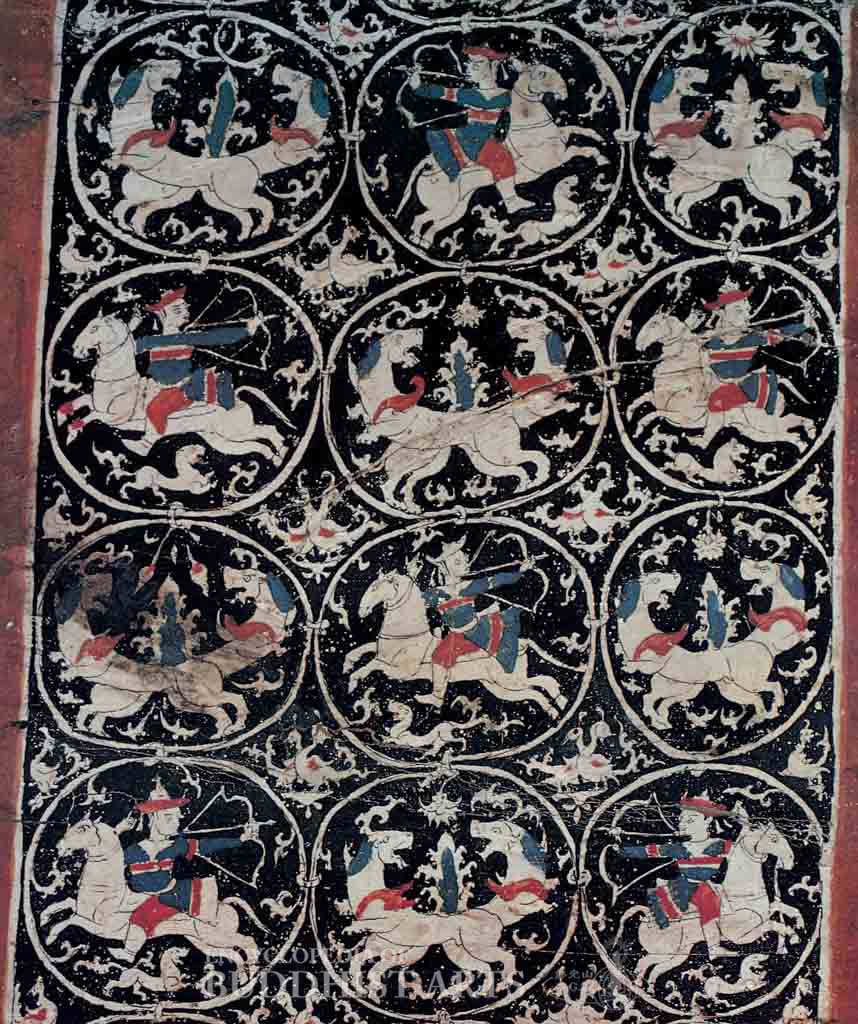
Alchi Monastery Three Story Hall Murals: Ceiling Motifs (second story)

Alchi Monastery Three Story Hall Murals: Plafond (third story)
Alchi Monastery Three Story Hall Murals
INDIA, Jammu and Kashmir, Ladakh
The Three Story Hall of Alchi Monastery was built around year 1200. Intricate murals are painted on the walls and ceilings of all three stories of the hall. The north, east, and west walls of the first story of the hall contain large niches that enshrine statues of Avalokitesvara, Manjusri, and Maitreya Bodhisattvas wearing painted dhotis. The former two statues measures 4 m in height, while the statue of Maitreya is 4.63 m high. According to the inscription beneath the statue of Maitreya, these three Bodhisattva represent the respective karma of body, speech, and mind. There are over 3,000 images of Buddhas and Bodhisattvas painted on the south wall, as well as the exterior sides of the north, east, and west niches. These images include 814 seated Amitabha Buddha images, 728 images of Manjusri on the east wall, and images of Aksobhya Buddha amounting to 712 and 1,063 respectively on the north and south walls. The lower registers of the inner side walls of the three niches are covered with images. Those in the east wall niche illustrate scenes of imperial life. The right inner wall shows a queen with a monk on her right, probably representing the benefactor and the founder of the hall. On the left inner wall, there is a depiction of a king and queen at a banquet.
The murals on the second story include images of Buddhas, Bodhisattvas, and other deities. Ten mandalas, including four on the south wall and two on each of the remaining three walls, were painted for use in rituals. The layouts of the murals on the east and west walls are similar, with a central figure flanked by two mandalas. The Eleven-Headed Avalokitesvara Bodhisattva on the west wall corresponds to the image of Green Tara on the east wall. The north wall features an image of Sakyamuni Buddha teaching the Dharma. Beneath the mandala on the left beside the Buddha, there are two rows of images depicting the Pure Lands of the Five Dhyani Buddhas. Below the mandala on the right, there are also two rows of images: Prajnaparamita Bodhisattva and two Eleven-Headed Avalokitesvara Bodhisattvas are in the upper row, and the Five Dhyani Buddhas are seated side by side in the lower row. Six-Headed, Six-Armed Yamantaka is painted above the door in the south wall, which is flanked by seven vertically arranged seated Buddhas. Further to the sides, there are four mandalas that feature depictions of Aksobhya, Ratnasambhava, Amitabha, and Amoghasiddhi Buddhas, a rare combination of images.
On the third story, Acala is depicted on the south wall above the door, flanked by Jambhala and Ucchusma. To the sides of the door, there are images of lineage holders and monastics of the Kagyu school. The mandalas on the north, east, and west walls feature Four-Headed, Eight-Armed Manjusri Bodhisttva, Six-Armed Prajna Vidyarajni, and Vairocana Buddha.
The ceilings of the first and second stories are hollow in the center and are covered by 24 rectangles partitioned by wooden beams. The floral, animal, and swastika designs on the beams are similar to patterns on fabrics made in Kashmir and Ladakh at the time of the hall’s construction. The image of two lions within a circle gazing backwards and leaning against each other can be traced back to a pattern used on Greek silverware in Persia during the 2nd century. Similar motifs can also be seen on the clothing of the figures in the wall murals. The ceiling of the third story consists of six overlapping square grids. There is a lotus in the center, and patterns on the four corners of the grids. These murals inspired the art found in many other temples in the area. They are regarded as some of the most impressive artworks of the Himalaya region.
For more details, go to the Encyclopedia of Buddhist Arts: Painting A-H, page 3.
Cite this article:
author = Hsingyun and Youheng and Youlu and Wilson, Graham and Manho and Mankuang and Huntington, Susan,
booktitle = {Encyclopedia of Buddhist Arts: Painting A-H},
pages = 3,
title = {{Alchi Monastery Three Story Hall Murals}},
volume = 14,
year = {2016}}