
Amitayus Buddha
Ink and color on cotton
Amitayus Buddha
CHINA; Qing dynasty
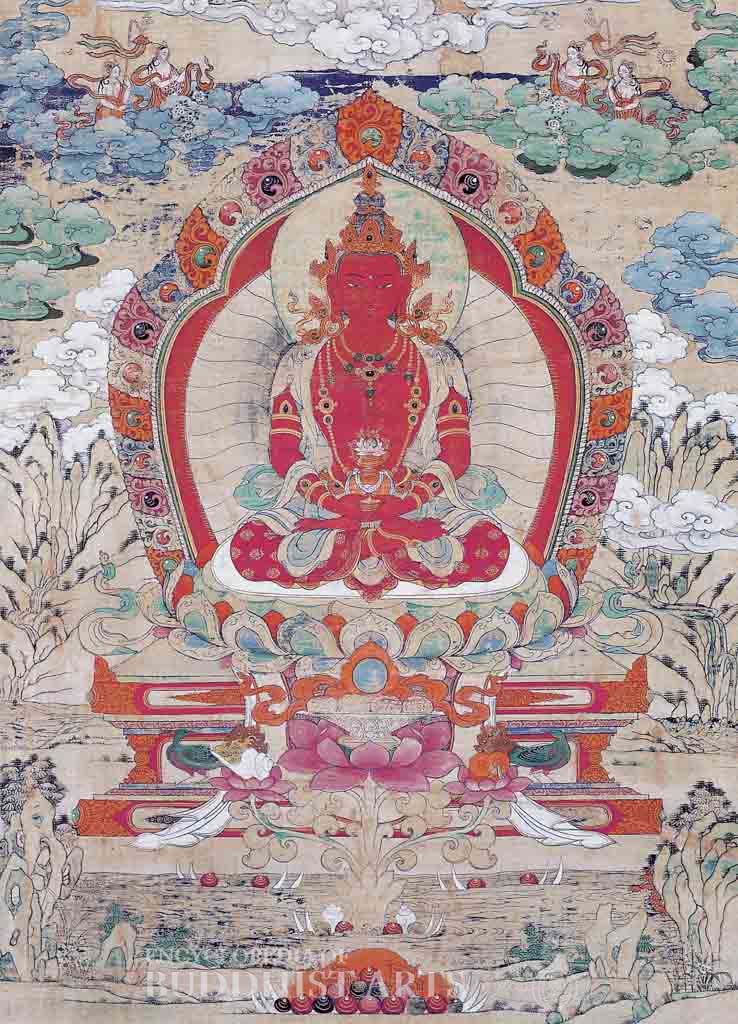
This thangka from Chengde, Hebei, dates from the rule of Emperor Qianlong (reigned 1736–1795). The red-bodied Amitayus Buddha wears a gold headdress and ornaments. Sitting in full lotus position on a lotus throne, Amitayus holds a vase containing the elixir of longevity. The nimbus and radiating aureole are enveloped within a mandorla bordered with colorful scrolling patterns and jewels.
Clouds and mountains are painted around the central image. At the top of the picture, four heavenly beings scatter flowers in honor of the Buddha. Two peacocks stand on the base of the Buddha’s throne. A large lotus rises from the pond at the bottom of the painting. Its three flowers support a mirror, a conch shell, and cymbals. Offerings of precious gems, conch shells, and rhino horns are depicted within the pond and along the shore. The pale background contrasts with the vividly colored central figure, resulting in a striking image.
For more details, go to the Encyclopedia of Buddhist Arts: Painting A-H, page 42.
Cite this article:
author = Hsingyun and Youheng and Youlu and Wilson, Graham and Manho and Mankuang and Huntington, Susan,
booktitle = {Encyclopedia of Buddhist Arts: Painting A-H},
pages = 42,
title = {{Amitayus Buddha}},
volume = 14,
year = {2016}}