
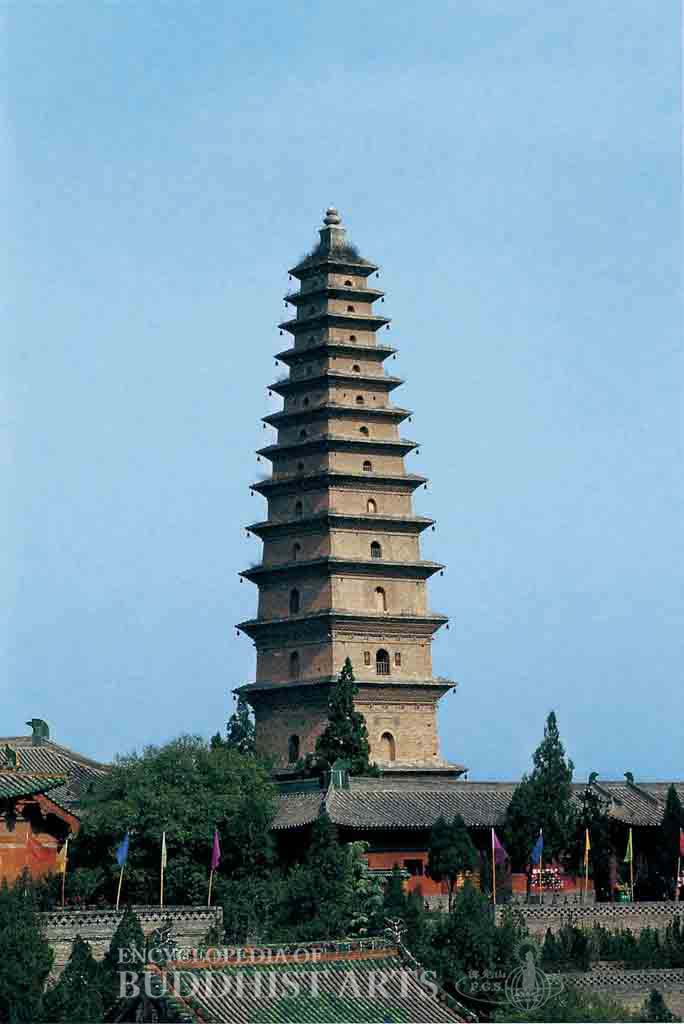
Pujiu Temple Pagoda
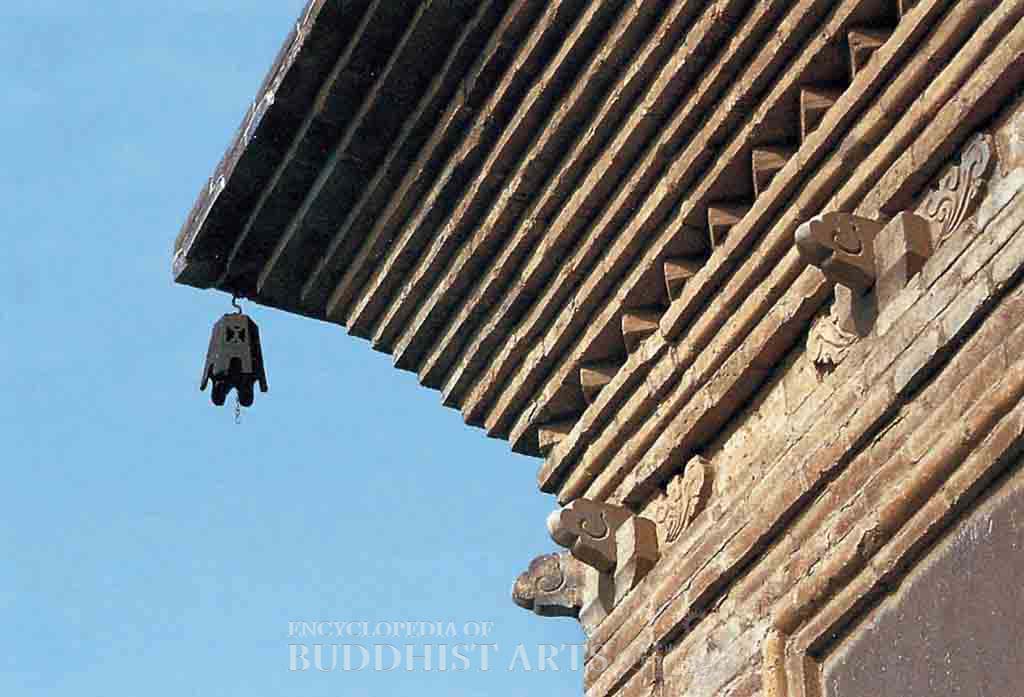
Pujiu Temple Pagoda: Eaves
Pujiu Temple Pagoda
CHINA, Shanxi, Yuncheng
The pagoda was built some time during the late Sui (581–618) and early Tang (618–907) dynasties. In 1555 during the Ming dynasty it was destroyed by an earthquake and rebuilt in 1564; however, it still retains some of its original Tang features. It is listed as a Provincial Cultural Heritage Site.
This 13-story brick pagoda is 50 m high with each side measuring 8 m at the base. A door is located on the south side. From the second story upwards, there are alternate real and fake arched doors on each side of the pagoda. Arched doors are a popular Ming dynasty feature. The eaves are formed of brick corbeling, which is straight, unlike the usual Tang corbeling, which is curved.
The pagoda’s structure echoes, which is rare, and it is one of four major structures in China that possesses this quality.
For more details, go to the Encyclopedia of Buddhist Arts: Architecture M-S, page 846.
Cite this article:
author = Hsingyun and Youheng and Johnson, Peter and Mankuang and Lancaster, Lewis,
booktitle = {Encyclopedia of Buddhist Arts: Architecture M-S},
pages = 846,
title = {{Pujiu Temple Pagoda}},
volume = 3,
year = {2016}}