
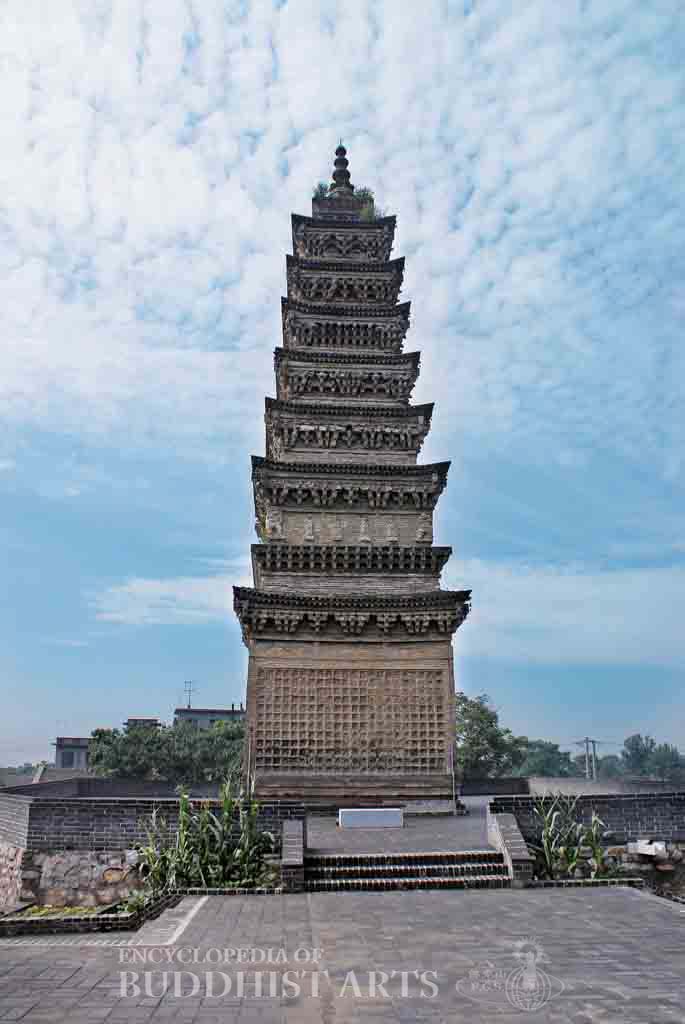
Puli Temple Pagoda
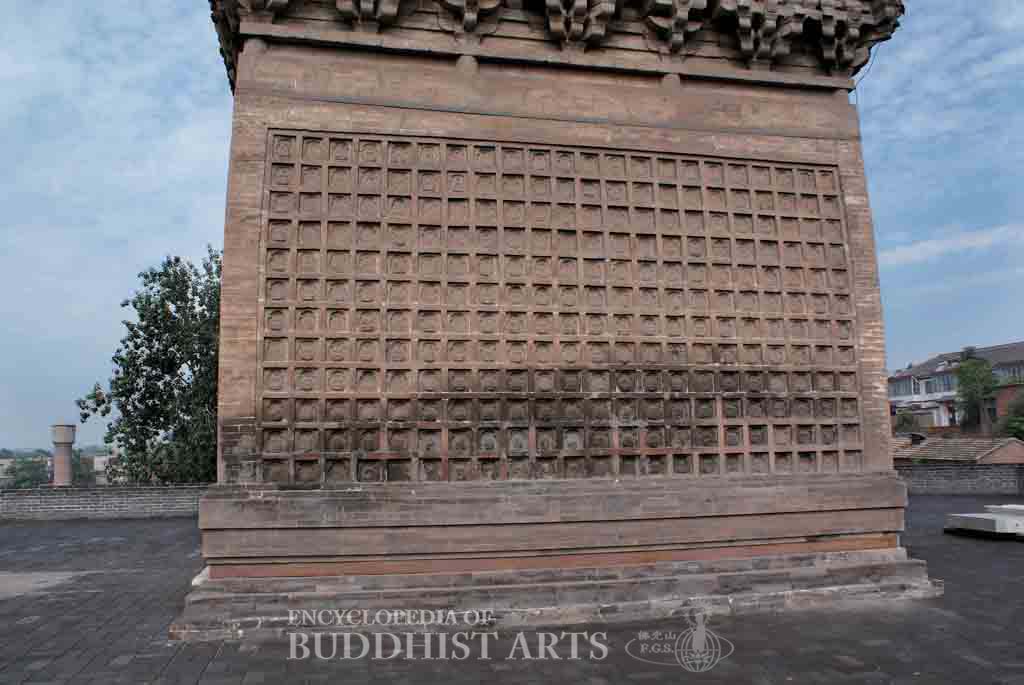
Puli Temple Pagoda (detail)
Puli Temple Pagoda
CHINA, Hebei, Xingtai
It is also called Ten Thousand Buddhas Pagoda or Puli Temple Relic Pagoda. It was built on the grounds of Puli Temple, which no longer exists. It is one of the better preserved pagodas from the Northern Song dynasty (960–1127) and is a valuable resource for the study of Chinese architecture of that period. The pagoda was built in 1051 and was repaired during the Ming dynasty (1368–1644); however, it still retains its original Song style. It was listed as a National Cultural Heritage Site in 2001.
The eight-tier, square, solid brick pagoda is 33 m high. The first tier of the pagoda is higher than the other tiers, with an arched doorway on the south side. There are Buddha niches carved into the walls of the first tier, which is surmounted by eaves supported by complex bracket sets. The base of the second tier is supported by simpler bracket sets. Reliefs of Arhats are carved on each side of the pagoda body, while there are warriors at the corners. There are different styles of bracket sets supporting the eaves on each tier. The spire is made of cast iron.
For more details, go to the Encyclopedia of Buddhist Arts: Architecture M-S, page 847.
Cite this article:
author = Hsingyun and Youheng and Johnson, Peter and Mankuang and Lancaster, Lewis,
booktitle = {Encyclopedia of Buddhist Arts: Architecture M-S},
pages = 847,
title = {{Puli Temple Pagoda}},
volume = 3,
year = {2016}}