
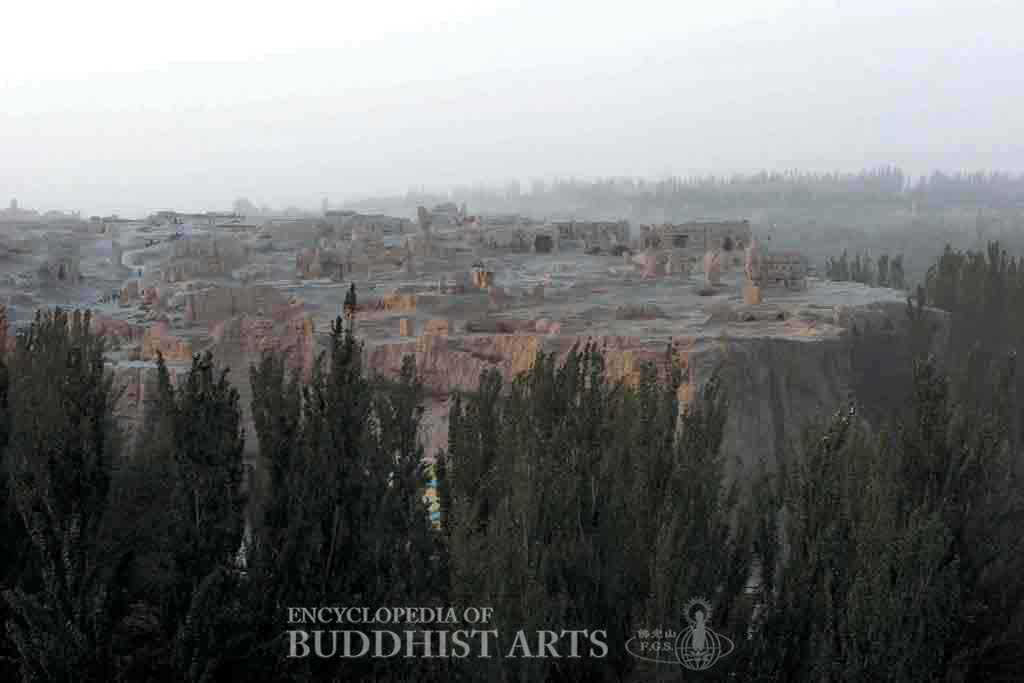
Yarhu
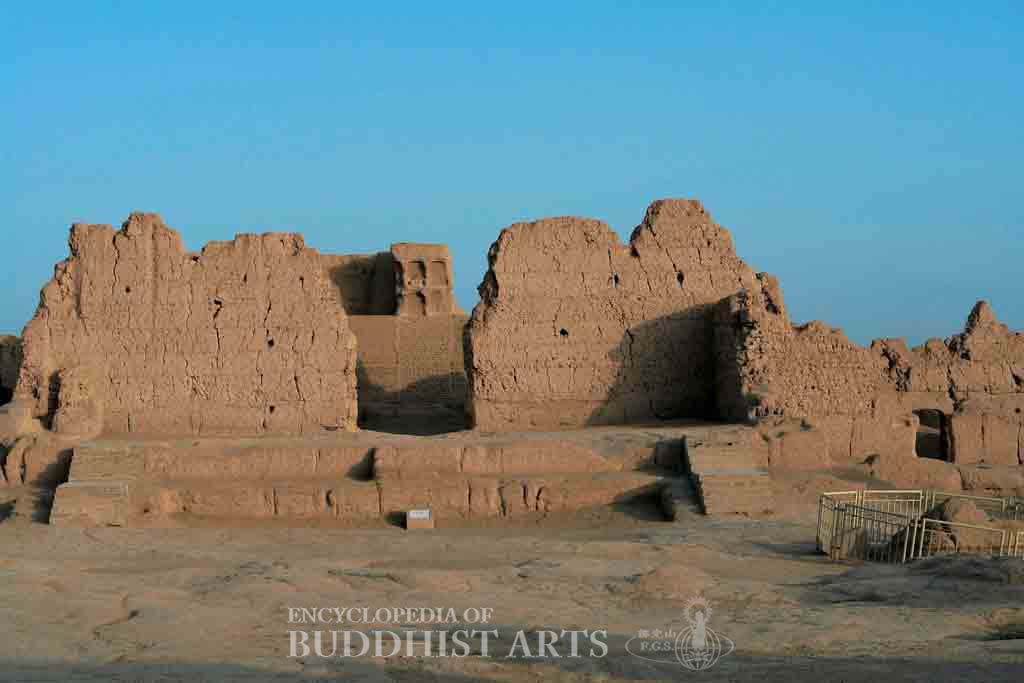
Yarhu: Great Buddha Temple - Main Hall
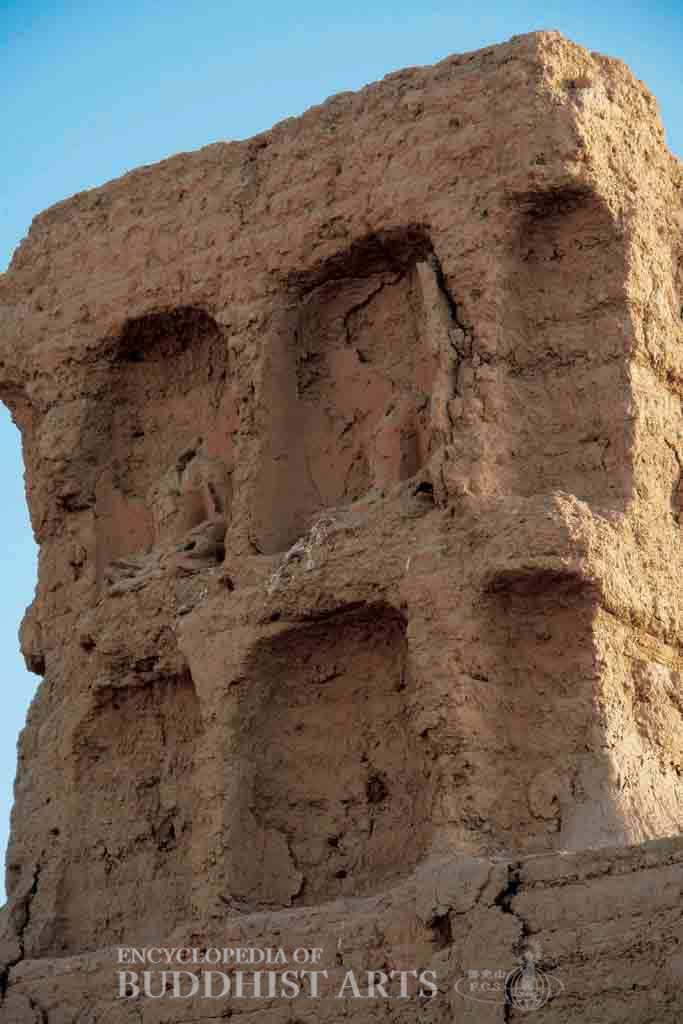
Yarhu: Great Buddha Temple - Main Hall - Central Pillar
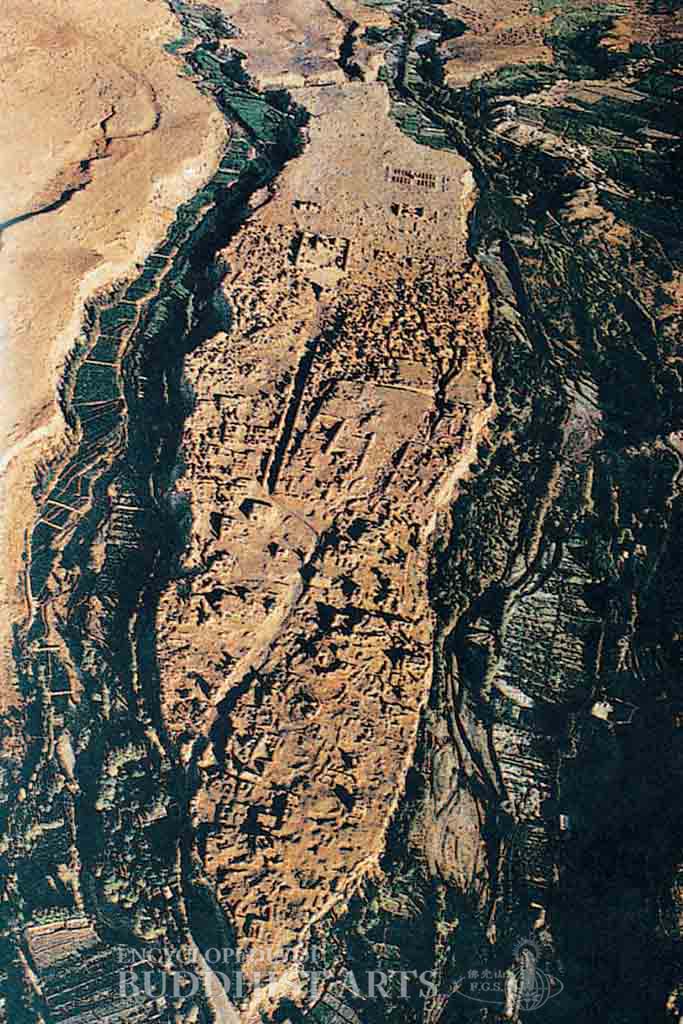
Yarhu (aerial view)
Yarhu
CHINA, Xinjiang, Turpan
The ancient city of Yarhu is located at a junction of two rivers. This is one of the earliest and best preserved early cities in China. Jiaohe became a prefecture of the Gaochang Kingdom (499–640) and developed during the Tang dynasty (618–907). The city went into decline and was destroyed in warfare in the middle of the 14th century. The ruins are from the Tang dynasty and later periods. This ancient city was listed as a National Cultural Heritage Site in 1961.
The city is located on a long plateau at the intersection of two rivers. The plateau is shaped like a leaf: it is approximately 1,000 m long from north to south and 300 m wide from east to west at its broadest point. The plateau is surrounded by ravines up to 30 m deep. The city is laid out in accordance with the precipitous terrain without city walls. The city is concentrated in the middle and southern areas, with the northern area reserved for graveyards and a forest of stupas. Altogether there are 52 Buddhist sites, including the Central Large Stupa, the Great Buddha Temple, the Northeastern Temple, and the Northwestern Small Temple. The Great Buddha Temple is the largest temple in the city. It is 88 m long from north to south and 59 m wide from east to west. The main hall is situated at the rear of the temple and is in the form of a cave with a central pillar. The central pillar is a square stupa with niches, in which there are traces of Buddha statues.
Unlike conventional buildings, which are constructed upwards, the buildings are formed from excavation of earth. Pits form dwelling spaces and rooms, while the walls consist of the sides of the pits. Where required, the earthen walls are heightened either by laying large adobe blocks or by rammed earth. The unusual construction technique at Yarhu is due to the distinctive local geology.
For more details, go to the Encyclopedia of Buddhist Arts: Architecture T-Z, page 1346.
Cite this article:
author = Hsingyun and Youheng and Johnson, Peter and Mankuang and Lancaster, Lewis,
booktitle = {Encyclopedia of Buddhist Arts: Architecture T-Z},
pages = 1346,
title = {{Yarhu}},
volume = 4,
year = {2016}}