
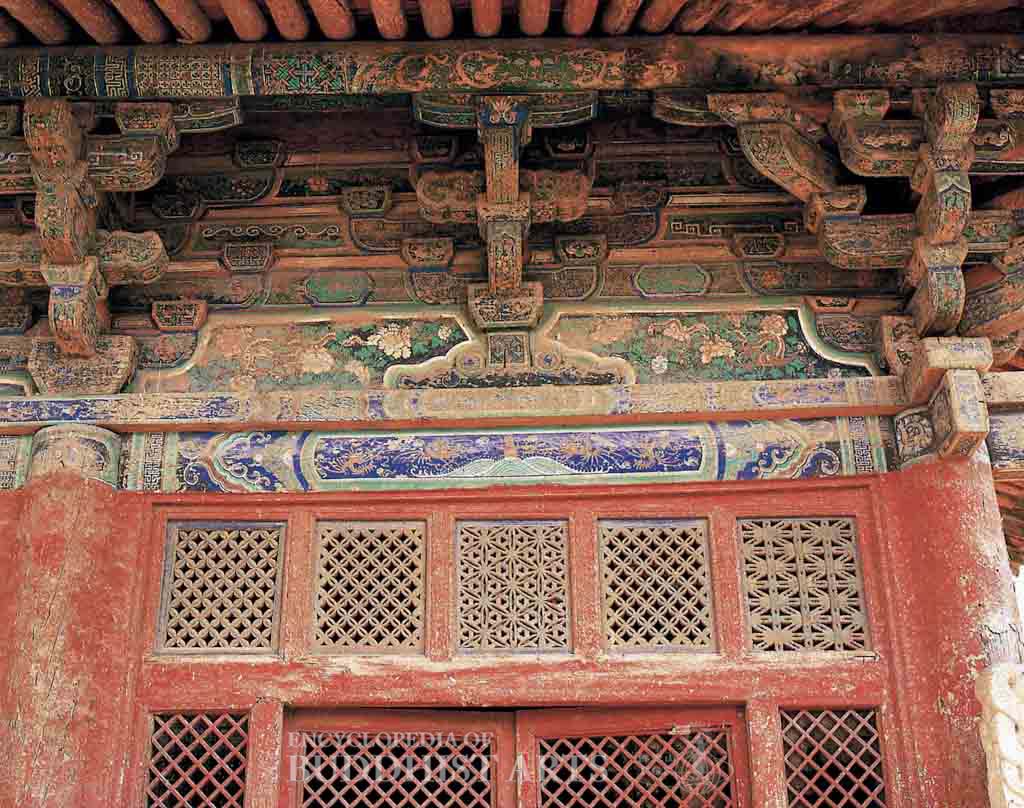
Geyuan Temple: Manjusri Hall

Geyuan Temple: Manjusri Hall
Geyuan Temple
CHINA, Hebei, Laiyuan
According to the Laiyuan County Gazetteer, the temple was founded during the Eastern Han dynasty (25–220), and was renovated during the Tang dynasty (618–907). Apart from the Manjusri Hall, which was built in the Liao dynasty (907–1125), the rest of the existing buildings were either renovated or rebuilt during the Ming (1368–1644) and Qing (1644–1911) dynasties. It was listed as a National Cultural Heritage Site in 1996.
The temple covers an area of 7,000 sq m and faces south. Along the central axis there are the Heavenly King Hall, Manjusri Hall, and the sutra repository. Along either side there are auxiliary halls and meditation rooms. The three-by-three bay Manjusri Hall is the main building of the temple. It was built in 966 during the Liao dynasty, and is one of the oldest and best preserved timber and mud structures in China. It has a single-eave hip-and-gable roof. There is a wide platform surrounded by a wall in front of the building. Above the lattice doors, the facade contains two lattice panels that date back to the Liao dynasty. These are the oldest and best preserved wooden lattice panels. The other lattice panels date to the Yuan (1271–1368), Ming, and Qing dynasties. Inside, the framework comprises a four-purlin beam, two-step cross beam with three pillars. The east, west and north walls are covered with murals depicting Buddhist stories. The temple houses an iron bell made in 1114 during the Liao dynasty. It is the only existing bell for which there is clear proof that it was made during the Liao dynasty.
For more details, go to the Encyclopedia of Buddhist Arts: Architecture G-L, page 375.
Cite this article:
author = Hsingyun and Youheng and Johnson, Peter and Mankuang and Lancaster, Lewis,
booktitle = {Encyclopedia of Buddhist Arts: Architecture G-L},
pages = 375,
title = {{Geyuan Temple}},
volume = 2,
year = {2016}}