
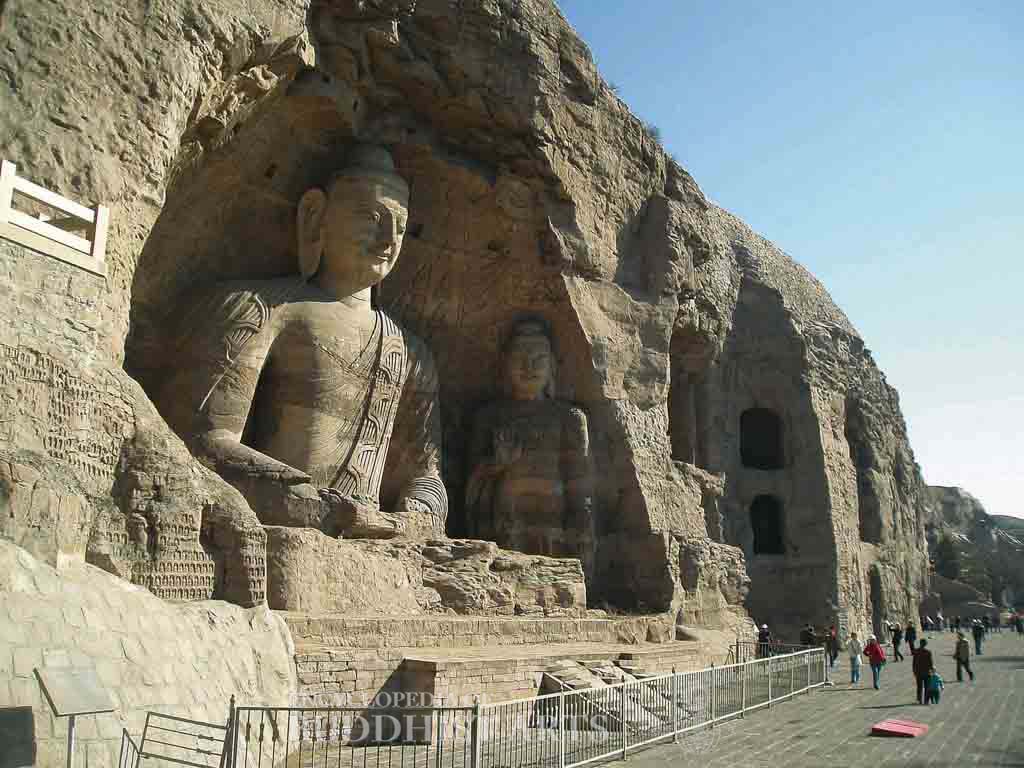
Yungang Grotto 20 by Tanyao; Dated 460–465
Stone
Tanyao
CHINA; Northern Wei dynasty
Tanyao was a monk, sculptor, and architect who practiced meditation in Liangzhou (present day Wuwei, Gansu). He renounced at a young age and originally practiced Chan Buddhism. During the persecution of Buddhism by Emperor Taiwu (reigned 423–452) of the Northern Wei dynasty, Tanyao vowed to defend it until death and secretly stored and preserved Buddhist items such as ritual clothing, robes, utensils, and more. An interesting anecdote came about when Buddhism was reinstated by Emperor Wencheng (reigned 452–465), and Tanyao traveled to the capital for celebration. Upon his arrival, one of the imperial horses bit and tugged at his clothing. When the emperor saw this, he felt it was an auspicious sign indicating that he should employ Tanyao to work in his court.
Between 460 and 465, Tanyao served as the National Master and proposed the creation of five grottoes to house Buddha statues representing the five emperors of the Northern Wei dynasty (386–534) at Wuzhaishan in Shaanxi. He personally took charge of the excavation work and produced the five great Buddha grottoes, also known as the Five Grottoes of Tanyao, which comprise Grottoes 16 to 20 of the Yungang Grottoes.
Tanyao also organized the translation of several Buddhist sutras and books, including Account of the Causes and Conditions of the Dharma-Treasury Transmission. His efforts, which additionally included building temples and overseeing other activities, greatly contributed in the promotion and development of Buddhism during the Northern Wei dynasty. Tanyao’s biography was recorded in Book of Wei and Expanded Edition of Biographies of Eminent Monks.
For more details, go to the Encyclopedia of Buddhist Arts: People, page 255.
Cite this article:
author = Hsingyun and Youheng and Youlu and Pokorski, Stefanie and Yichao and Mankuang and Miaohsi,
booktitle = {Encyclopedia of Buddhist Arts: People },
pages = 255,
title = {{Tanyao}},
volume = 19,
year = {2016}}