
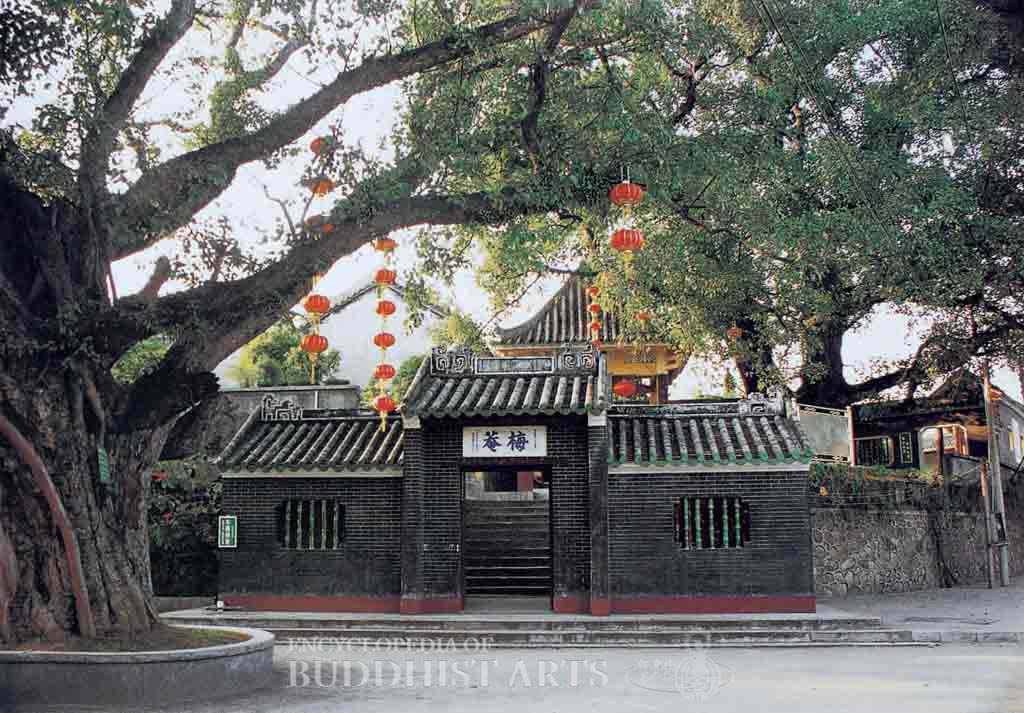
Mei Temple: Main Temple Gate
Mei Temple
CHINA, Guangdong, Zhaoqing
Mei means Plum, and the temple is recorded as being built during the Five Dynasties (907–960). However, it is also said that it was built in 996 during the Northern Song dynasty by Master Zhiyuan to commemorate Master Huineng, the Sixth Chan Patriarch. Legend has it that it was built at the location where Huineng had planted some plum trees. Over the years it has undergone repairs. It was listed as a National Cultural Heritage Site in 1996.
The Mei Temple occupies 0.5 ha and its principal structures include the main temple gate, Great Hero Hall, and the Sixth Patriarch Hall. Other structures of note are the platform in front of the temple, the Sixth Patriarch Well, and the buildings situated along the sides of the complex, namely the Hall of Numerous Conditions, Eternal Light Pavilion, Six Cloud Pavilion, Plum Garden, and the stele passageway.
The main temple gate is three bays wide with a flushed gable roof. There are adjoining rooms on either side. It has a brick and timber structure and was built during the Qing dynasty (1644–1911). The five-by-three bay Great Hero Hall is 9.1 m high with a flushed gable roof. The framework inside spans ten rafters with four tie-beams at both front and back. At the front, the eaves are supported with four-tier bracket sets with a single projecting bracket arm and three down-pointing cantilevers. The beams and bracket sets still retain the original Song dynasty (960–1279) features, and it is one of the oldest timber structures in the province.
For more details, go to the Encyclopedia of Buddhist Arts: Architecture M-S, page 727.
Cite this article:
author = Hsingyun and Youheng and Johnson, Peter and Mankuang and Lancaster, Lewis,
booktitle = {Encyclopedia of Buddhist Arts: Architecture M-S},
pages = 727,
title = {{Mei Temple}},
volume = 3,
year = {2016}}