
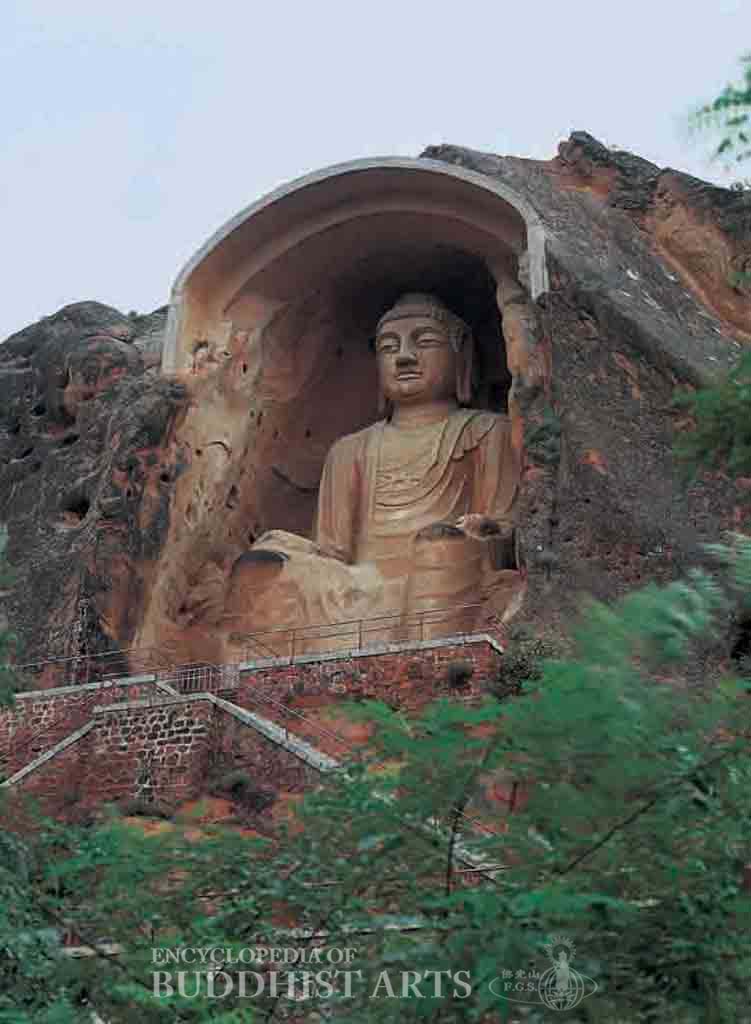
Xumishan Grotto 5: Great Maitreya Buddha
Stone
Xumishan Grotto 5: Great Maitreya Buddha
CHINA, Ningxia, Guyuan; Tang dynasty
Situated in the southern part of the Dafolou (Great Buddha Building) area, this is Xumishan’s largest statue and also one of the largest among all of China’s grottoes. Originally, a multi-story tower named Jingyun Temple from the Tang dynasty (618–907) stood before the grotto. It received its current name of Dafolou during the Ming dynasty (1368–1644). The wooden tower was destroyed in an earthquake in 1920.
The niche was carved from the top of the mountain and is 21.5 m high, 15.5 m wide, and 16.5 m deep. Inside the niche is a 20.6 m high Maitreya Buddha seated with legs pendent. The upper part of the body is well-preserved, but the statue has been severely weathered below the hands. The figure wears a monastic robe over both shoulders, and the folds of the robe appear to flow naturally. The great skill needed to carve this figure from sandstone and the techniques displayed were standard for the Tang dynasty.
For more details, go to the Encyclopedia of Buddhist Arts: Caves T-Z, page 1530.
Cite this article:
author = Hsingyun and Youheng and Johnson, Peter and Mankuang and Huntington, Susan and Edson, Gary and Neather, Robert,
booktitle = {Encyclopedia of Buddhist Arts: Caves T-Z},
pages = 1530,
title = {{Xumishan Grotto 5: Great Maitreya Buddha}},
volume = 9,
year = {2016}}