

Qingtongxia One Hundred and Eight Stupas
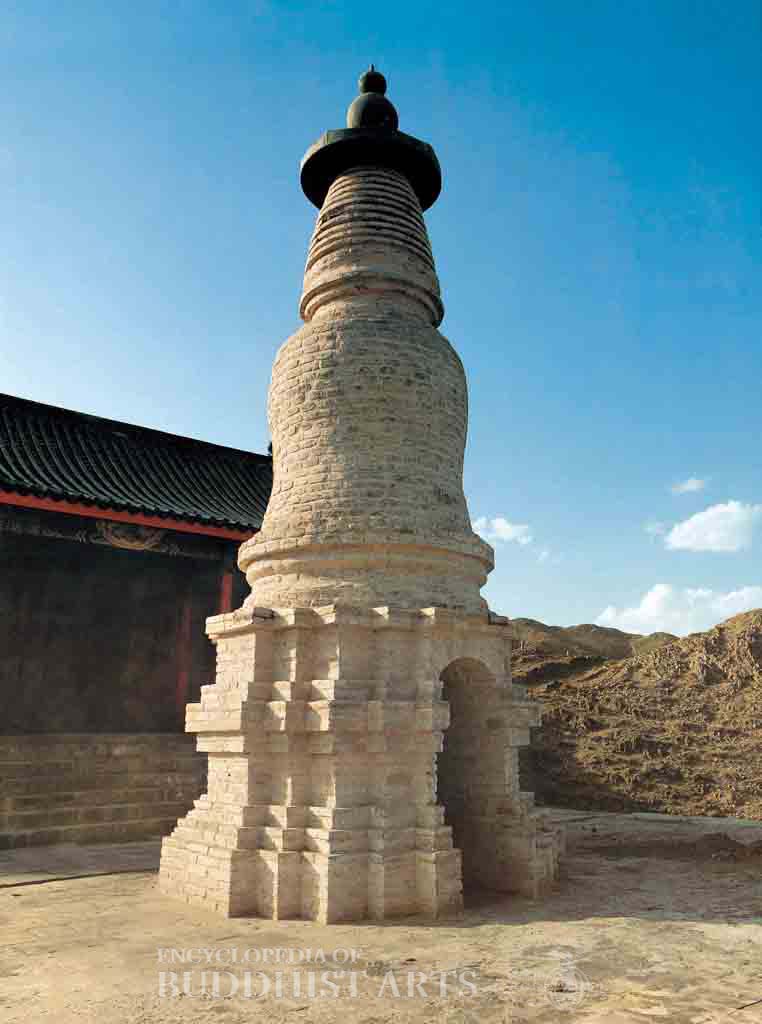
Qingtongxia One Hundred and Eight Stupas: Topmost Stupa
Qingtongxia One Hundred and Eight Stupas
CHINA, Ningxia, Wuzhong
According to evidence excavated during a survey in preparation for the stupas’ repair, these stupas were probably built during the Western Xia period (1032–1227). They were repaired during the Yuan (1271–1368) and Qing (1644–1911) dynasties, while further reinforcement work was carried out from 1987 to 1988. The area was listed as a National Cultural Heritage Site in 1988.
The stupas face east, toward the Yellow River. They were built on the side of a hill in 12 rows with a total of 108 stupas. They form a triangle with the sides measuring 65 m and the base measuring 48 m.
The structure of each stupa is slightly different. The topmost stupa is the largest at around 4.9 m high. It is a Tibetan stupa with an archway that passes through it. Its base has multiple corners with a niche on the east side. The rest of the stupas are solid and are between 2.5 to 3 m high. Their bases are either octagonal or square with multiple corners. Above the base there is the stupa body, the spire with stacked rings, a canopy, and a jewel. When these structures were first built, a wooden pole was erected and then surrounded by piled earth. The exterior was then covered in plaster and painted over. When they were repaired, a layer of brick was built around them, covered in plaster and then painted. Silk inscriptions in Tangut were excavated underneath the platform bases.
For more details, go to the Encyclopedia of Buddhist Arts: Architecture M-S, page 878.
Cite this article:
author = Hsingyun and Youheng and Johnson, Peter and Mankuang and Lancaster, Lewis,
booktitle = {Encyclopedia of Buddhist Arts: Architecture M-S},
pages = 878,
title = {{Qingtongxia One Hundred and Eight Stupas}},
volume = 3,
year = {2016}}