
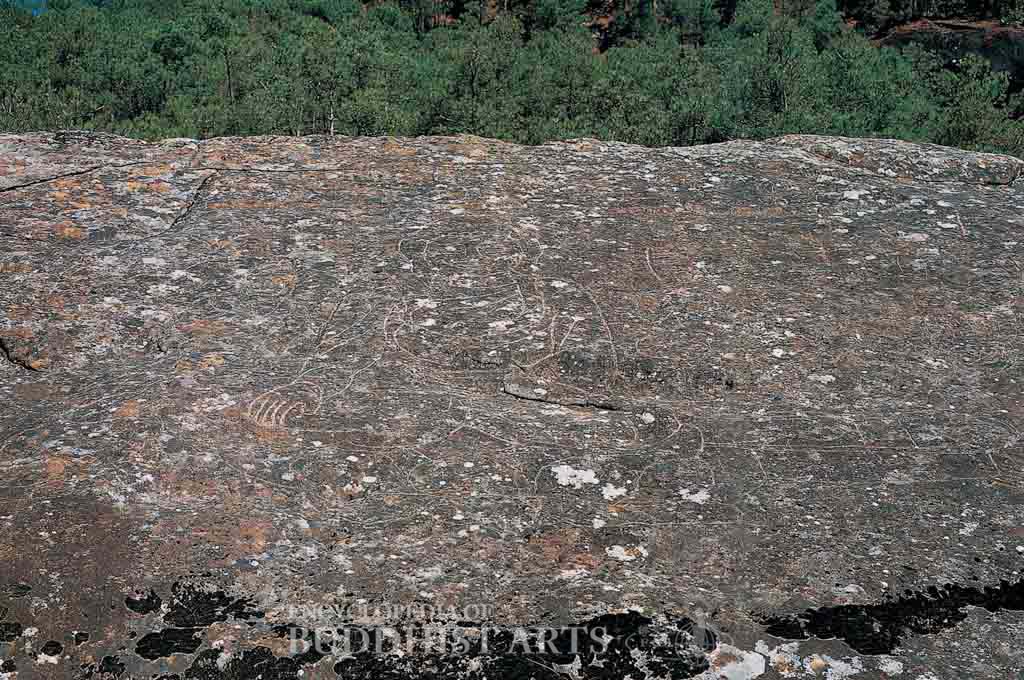
Boshenwahei Rock Carvings: Aksobhya Buddha and Reclining Buddha
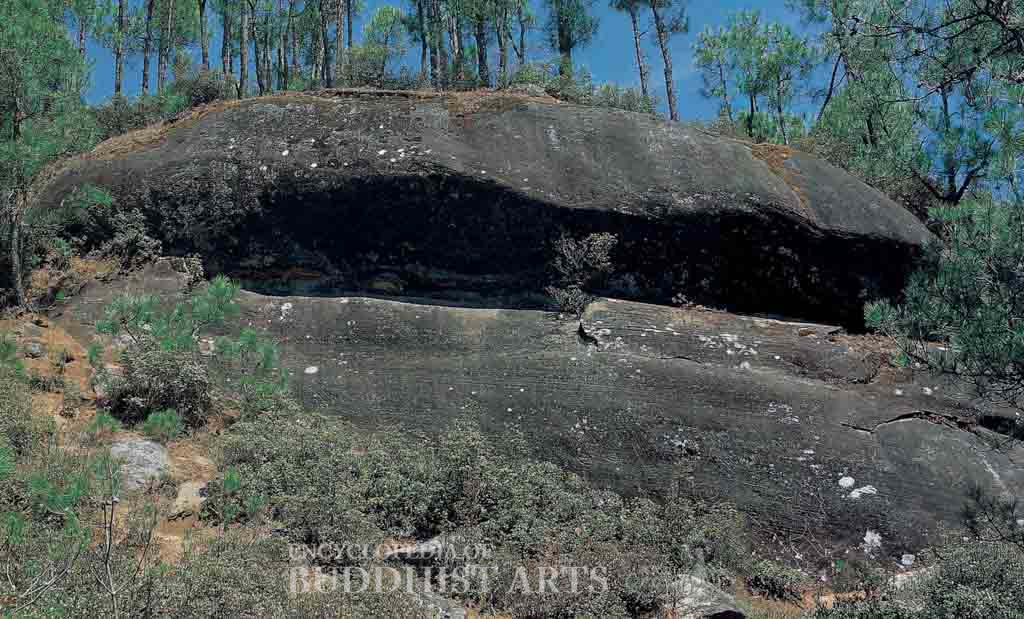
Boshenwahei Rock Carvings: Illustration of King Nanzhao
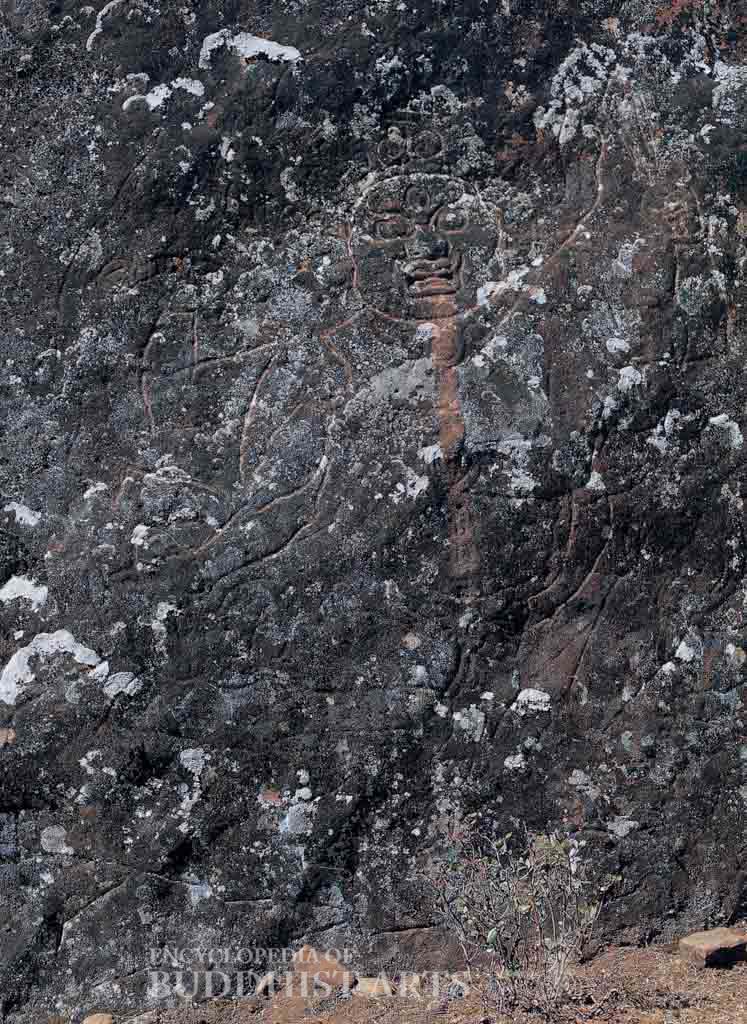
Boshenwahei Rock Carvings: Wisdom King
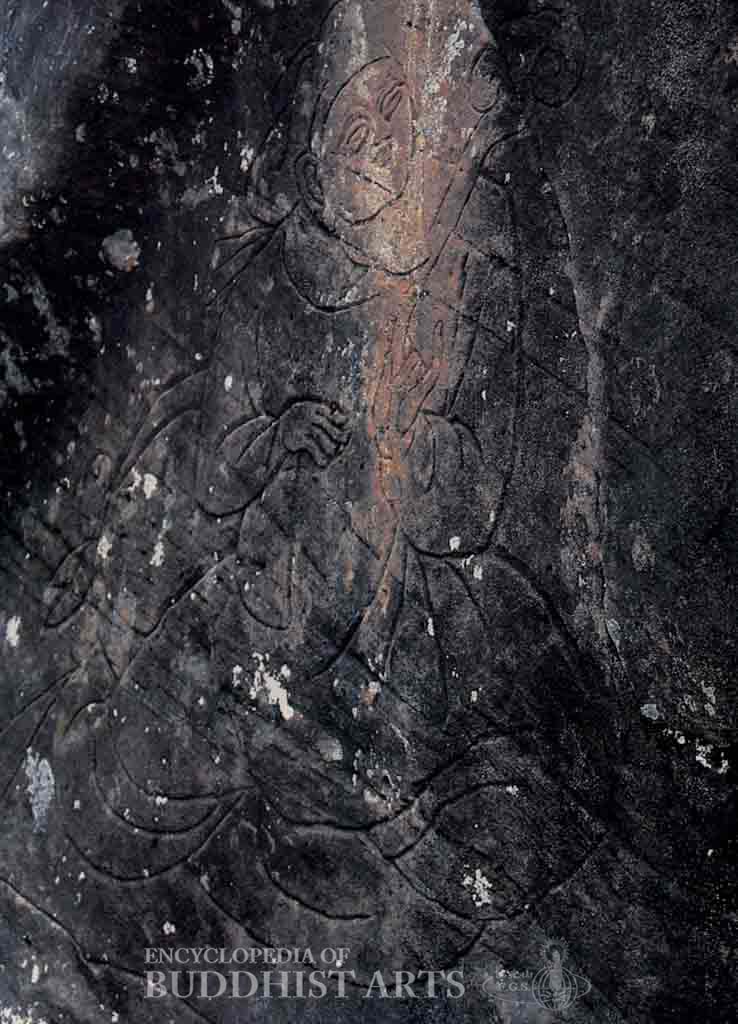
Boshenwahei Rock Carvings: Figure Making an Offering
Boshenwahei Rock Carvings
CHINA, Sichuan, Liangshan
The Boshenwahei Rock Carvings are located in Wanchang village in Liangshan. In total, there are 91 figures on 16 large rocks, over an area of 650 sq m. The caved figures include images of the Buddha, Bodhisattvas, Arhats, Heavenly Kings, Wisdom Kings, figures making offerings, animals, and Tibetan-style stupas. The carvings date to the late Nanzhao Kingdom (752–902) and the early Dali Kingdom (937–1253), and most of them are on Vajrayana subjects. Many of the carvings were made with line incisions, though most are not visible, except under sunlight at certain angles. The site was listed as a National Cultural Heritage Site in 2006.
At the southern end of the carvings is a 7.6 m reclining Buddha. A Bodhisattva is located near the head of the reclining Buddha, and another is near the feet. Below the reclining Buddha is another Buddha, who is seated in full lotus position upon a lotus throne. Behind the reclining Buddha are numerous heavenly beings, who are depicted in a variety of postures, including kneeling, standing, sitting, contemplating, teaching, and dancing.
A platform with an illustration of King Nanzhao, which measures 17 m wide and 8.8 m high, can be found at the northern end of the carvings. The king is depicted wearing a tall crown and a round-collared, loose-fitting gown, and riding a large horse with grandiose. Five attendants ride behind the king. Three animals are also found within the illustration, including a dog.
The rocks to the west of the reclining Buddha are carved with images of Heavenly Kings, Bodhisattvas, and Wisdom Kings. The Wisdom Kings, many of whom have multiple arms and heads, are depicted in wrathful appearances. On another group of rocks to the west are Bodhisattvas and figures making offerings. One of the figures making offerings sits cross-legged on a platform and wears a headscarf and a round collared gown with narrow sleeves. The right hand is raised to the chest, while the left holds a ruyi (wish-fulfilling talisman).
The Boshenwahei Rock Carvings have many similarities in content, figures, and artistic style with the Shizhongshan Grottoes, as both heritage sites are on the southwest of the ancient Silk Road. While both sites are several kilometers apart, their similarities provide valuable information for the research of art, religions, culture, and the history of minorities in the Nanzhao and the Dali Kingdoms.
For more details, go to the Encyclopedia of Buddhist Arts: Caves A-E, page 197.
Cite this article:
author = Hsingyun and Youheng and Johnson, Peter and Mankuang and Huntington, Susan and Edson, Gary and Neather, Robert,
booktitle = {Encyclopedia of Buddhist Arts: Caves A-E},
pages = 197,
title = {{Boshenwahei Rock Carvings}},
volume = 5,
year = {2016}}