
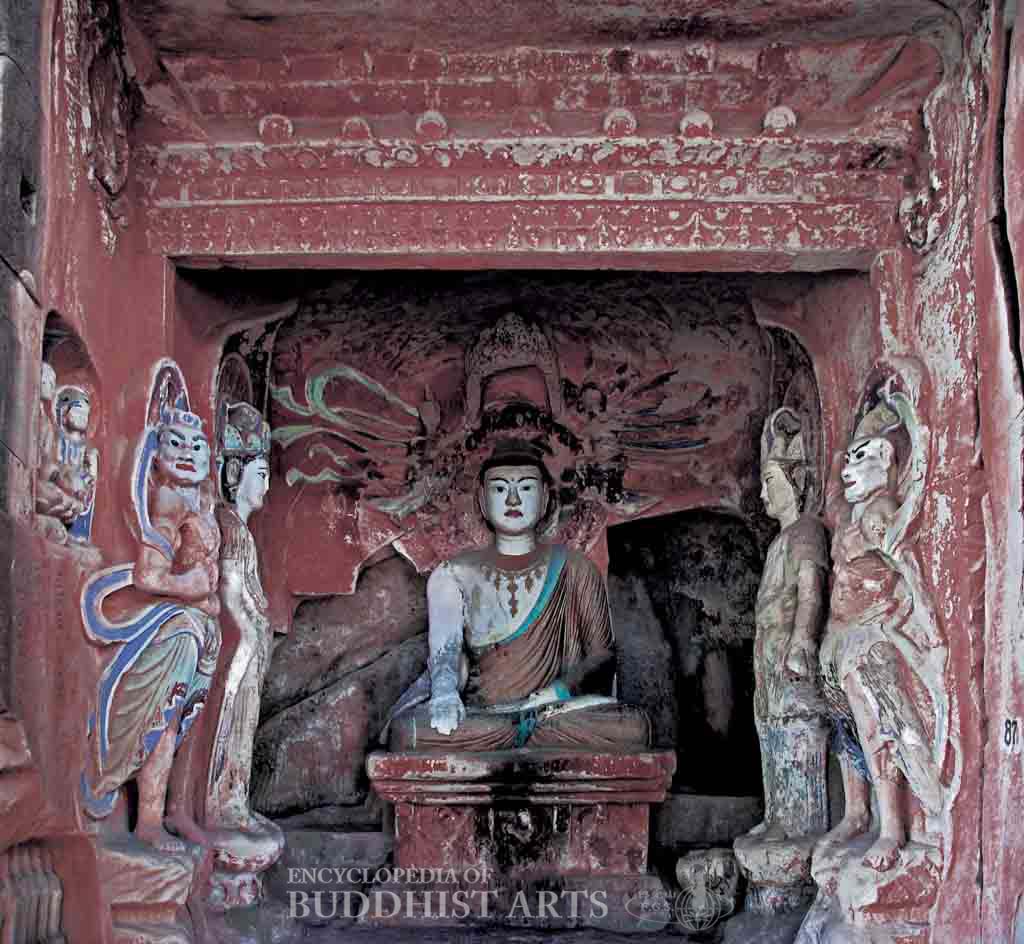
Bazhong Rock Carvings Western Niche 87: Bodhi Figure
Bazhong Rock Carvings Western Niche 87: Bodhi Figure
CHINA, Sichuan, Bazhong; Tang dynasty
Located in Longri Temple, at the peak of Fenggushan (Phoenix Valley Mountain), this double-layer niche is carved with an inner double-eave canopy and measures 2.72 m wide, 2.75 m high, and 1.83 m deep. The carving illustrates the Bodhi Figure, representing the Buddha at the moment of his enlightenment. The statues in this niche were restored during the Qing dynasty (1644–1911).
The central figure in the inner niche sits in full lotus position on a raised Sumeru throne, adorned with a necklace and bracelet over a monastic robe exposing the right shoulder. His right hand forms the bhumisparsa (earth-touching) mudra. Behind the Buddha is a multi-layered nimbus, and above his head is a crown suspended in the air, held by two apsaras draped with flowing stoles.
On both sides of the inner niche, there is a Bodhisattva standing on a lotus pedestal, facing the Buddha. They wear tall headdresses, long skirts, beaded and jeweled ornaments, and draped shawls. Behind each Bodhisattva’s head is a petal-shaped nimbus. Two warriors stand at the entrance of the niche with bare upper bodies and wearing dhotis, and draped stoles. They each have a circular nimbus. The upper side walls of the outer niche layer are sculpted with reliefs of apsaras.
The left wall of the outer layer has two inscriptions, one of which records the restoration of the temple, and also documents the name of a contributing painter, Chen Hao, and dates it to the year 1811.
For more details, go to the Encyclopedia of Buddhist Arts: Caves A-E, page 126.
Cite this article:
author = Hsingyun and Youheng and Johnson, Peter and Mankuang and Huntington, Susan and Edson, Gary and Neather, Robert,
booktitle = {Encyclopedia of Buddhist Arts: Caves A-E},
pages = 126,
title = {{Bazhong Rock Carvings Western Niche 87: Bodhi Figure}},
volume = 5,
year = {2016}}