
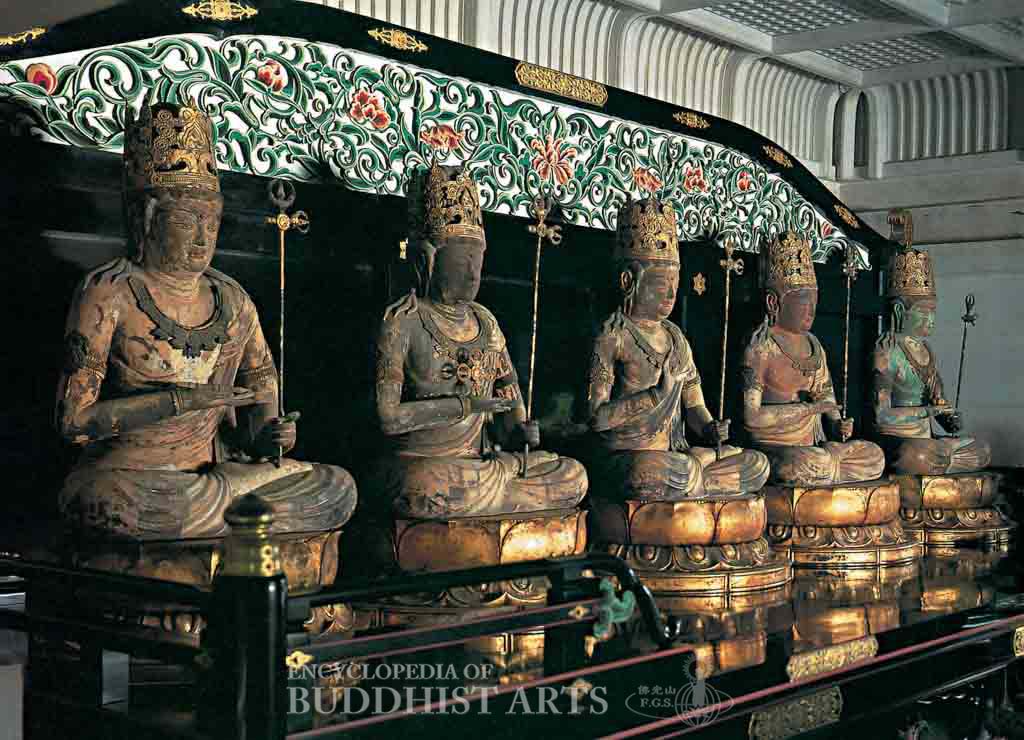
Jingoji Temple Prabhutaratna Pagoda: Five Great Akasagarbha Bodhisattvas
Cypress wood
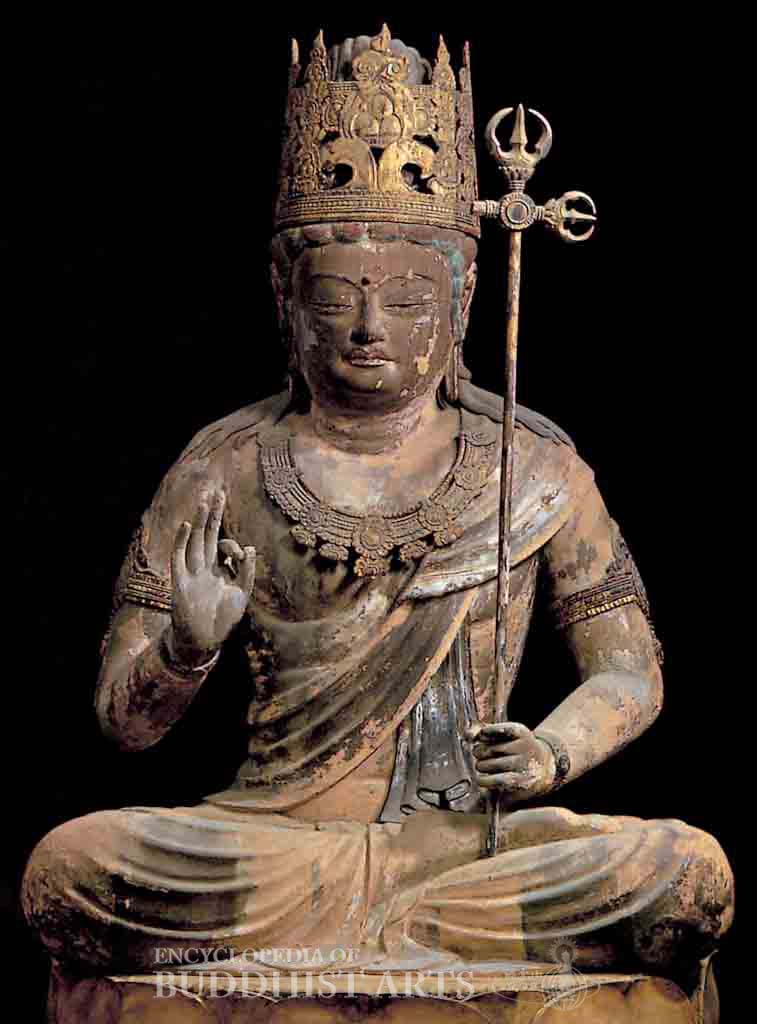
Jingoji Temple Prabhutaratna Pagoda: Five Great Akasagarbha Bodhisattvas - Dharmadhatu Akasagarbha
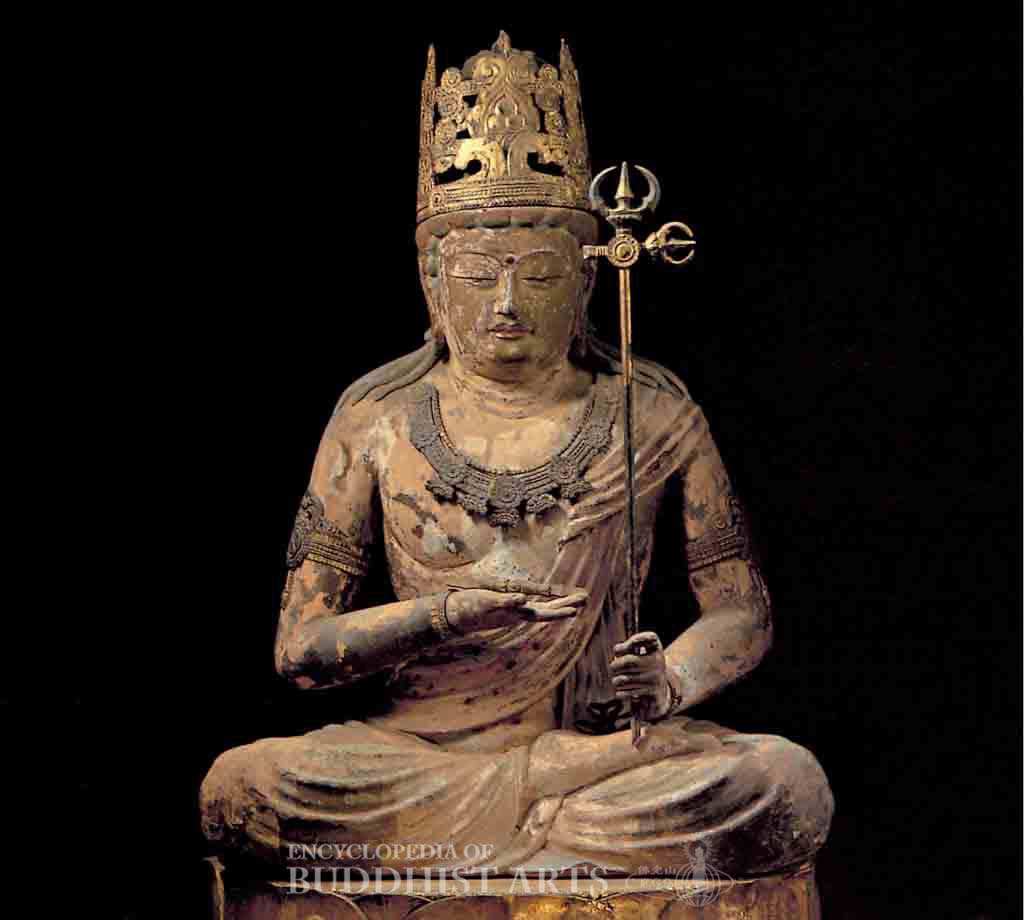
Jingoji Temple Prabhutaratna Pagoda: Five Great Akasagarbha Bodhisattvas - Vajra Akasagarbha
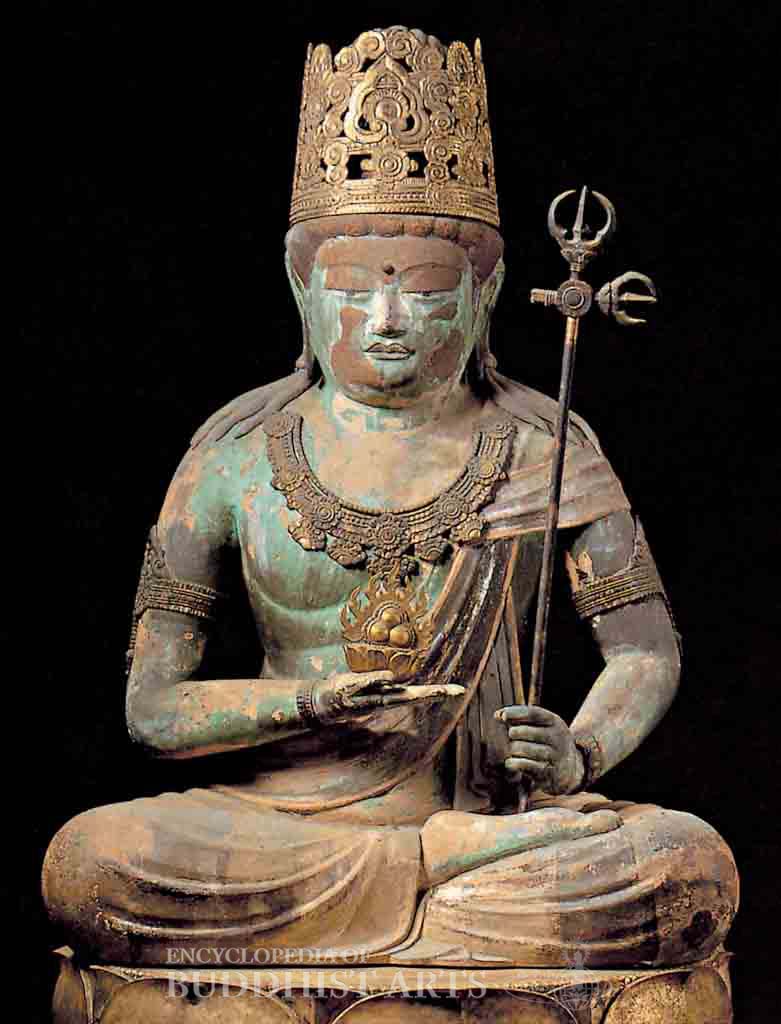
Jingoji Temple Prabhutaratna Pagoda: Five Great Akasagarbha Bodhisattvas - Ratnaprabha Akasagarbha
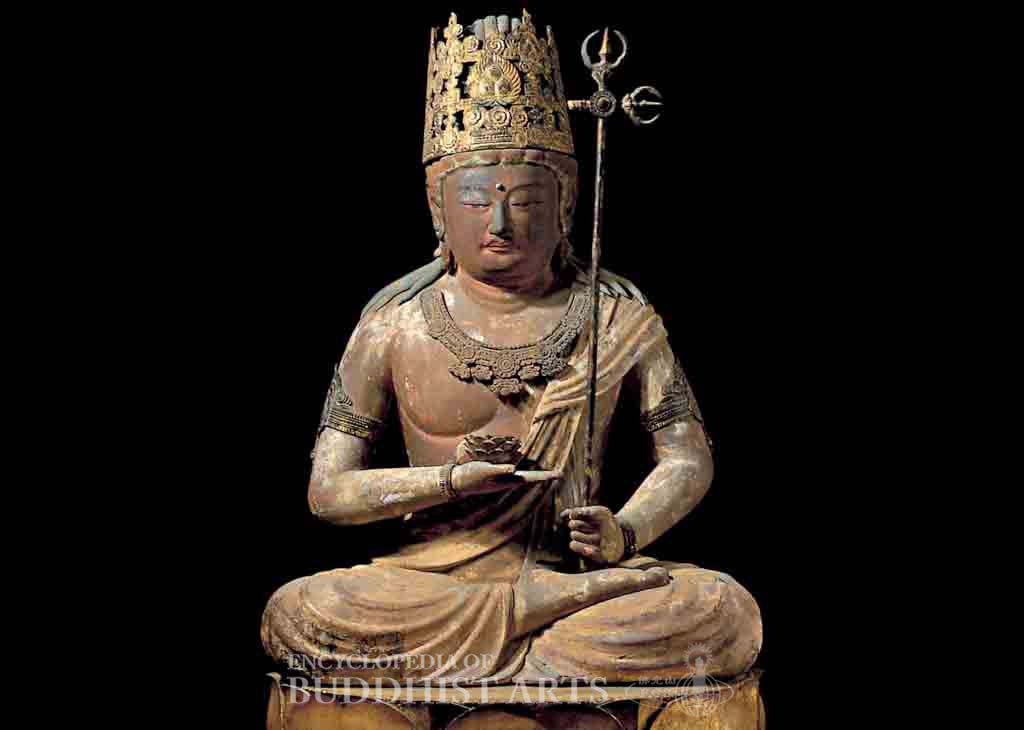
Jingoji Temple Prabhutaratna Pagoda: Five Great Akasagarbha Bodhisattvas - Padma Akasagarbha
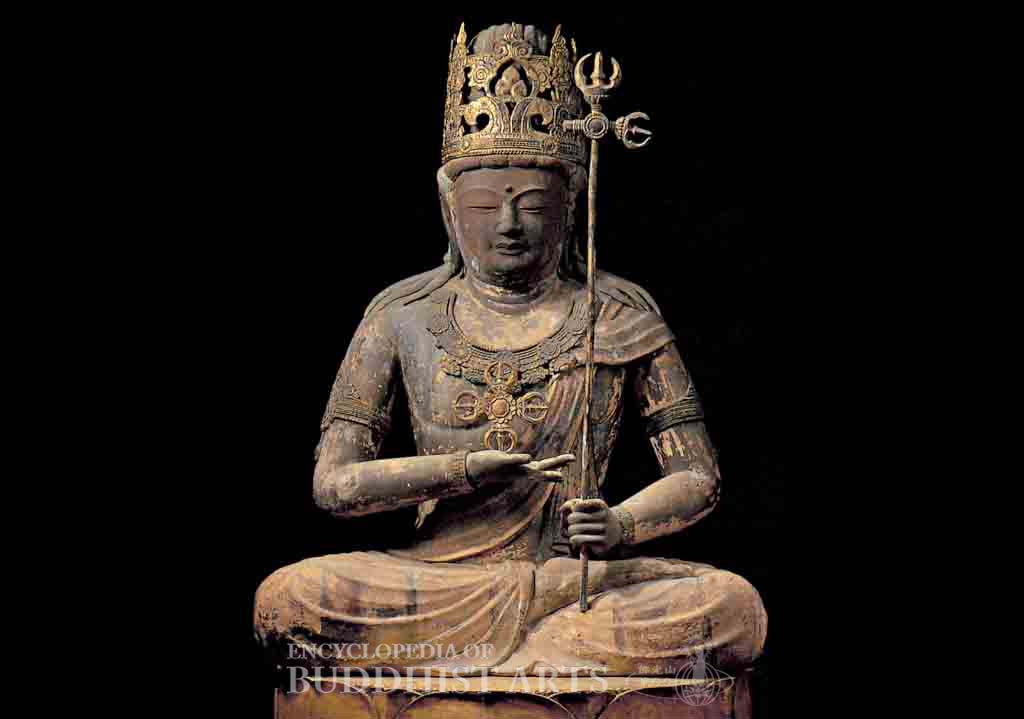
Jingoji Temple Prabhutaratna Pagoda: Five Great Akasagarbha Bodhisattvas - Karmakriya Akasagarbha
Jingoji Temple Prabhutaratna Pagoda: Five Great Akasagarbha Bodhisattvas
JAPAN, Kyoto; Heian period
These sculptures were commissioned by Emperor Ninmyo (reigned 833–850) and produced by Jichie and Shinzei, disciples of the Shingon Master Kukai. The Five Akasagarbha Bodhisattvas are objects of veneration in Japanese Vajrayana Buddhism and these are the earliest representations in Japan. Repair and repainting of the statues were undertaken in 899 according to the Brief Records of Jingoji Temple. The statues were recognized as National Treasures in 1952.
A record states that the figures were originally laid out as a mandala, with one centrally placed and the other four located at the corners. They are now configured in a row as follows: Vajra Akasagarbha in yellow, Karmakriya Akasagarbha in black, Dharmadhatu Akasagarbha in white, Padma Akasagarbha in red, and Ratnaprabha Akasagarbha in green. The statues are carved from solid cypress wood, apart from the wrists, flowing hair and the stoles, which are attached as separate parts. The statues are not hollow, and although they are produced in accordance with traditional wood-core dry lacquer technique, the form is based on the Nara period (710–794) style typical of sculptures of the Shingon school.
The figures are similarly dressed, wearing crowns and rich jewelry. The drapery flows in deeply carved lines as the figures sit cross-legged on lotus seats. Their high coiled hair is overtopped by the crowns, four of which are decorated with flaming gems. All figures hold a single-stake vajra in their left hand but are differentiated by what the right hand carries or the mudra in which it is held. Vajra Akasagarbha holds a single vajra, Karmakriya Akasagarbha supports crossed vajras, Dharmadhatu Akasagarbha’s hand is in vitarka (teaching) mudra, Padma Akasagarbha carries a lotus, and Ratnaprabha Akasagarbha holds flaming jewels.
For more details, go to the Encyclopedia of Buddhist Arts: Sculpture G-M, page 496.
Cite this article:
author = Hsingyun and Youheng and Lovelock, Yann and Chou, Yuan and Huntington, Susan and Edson, Gary and Neather, Robert,
booktitle = {Encyclopedia of Buddhist Arts: Sculpture G-M},
pages = 496,
title = {{Jingoji Temple Prabhutaratna Pagoda: Five Great Akasagarbha Bodhisattvas}},
volume = 11,
year = {2016}}