
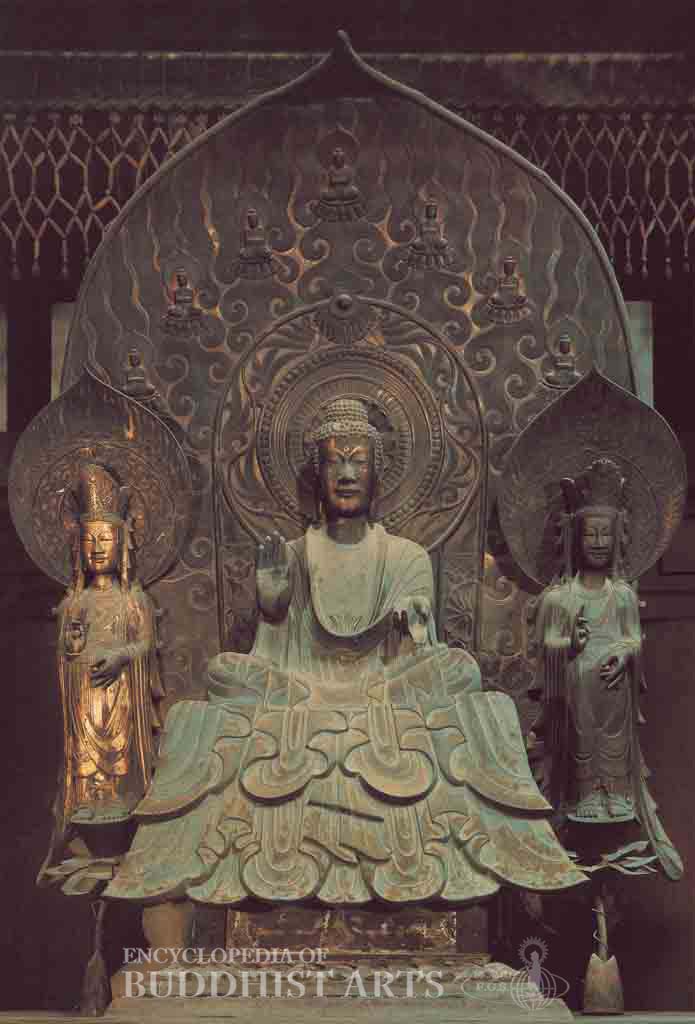
Horyuji Temple Golden Hall: Sakyamuni Buddha Triad
Gilt bronze
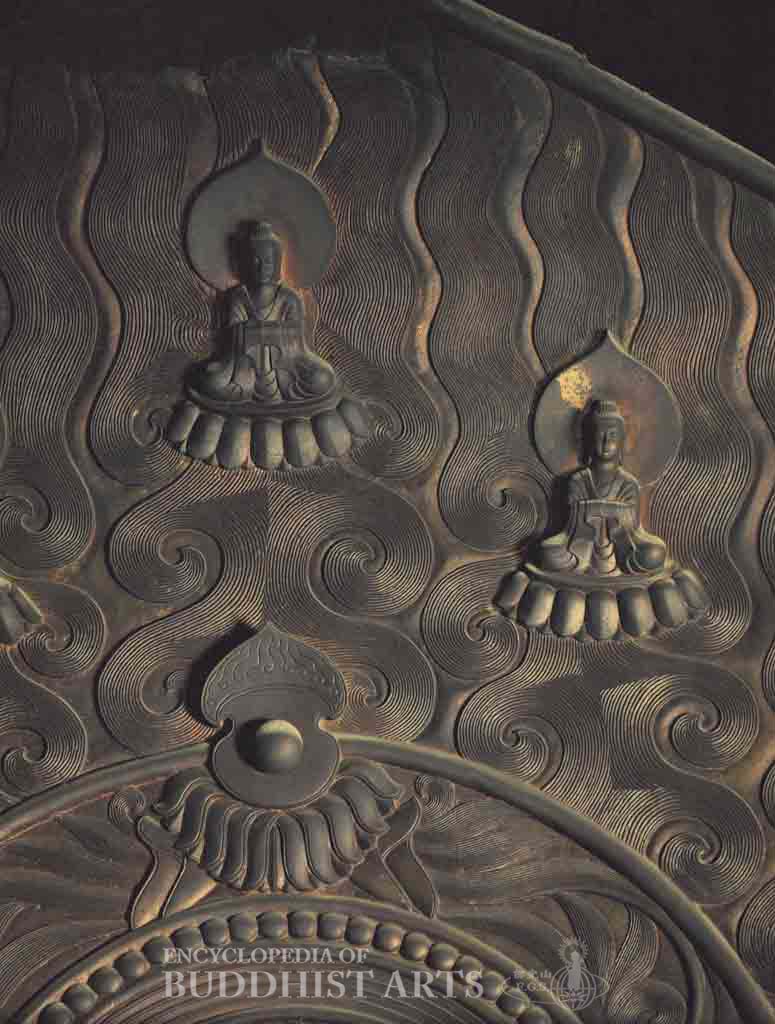
Horyuji Temple Golden Hall: Sakyamuni Buddha Triad - Sakyamuni Buddha Triad - Mandorla (detail)
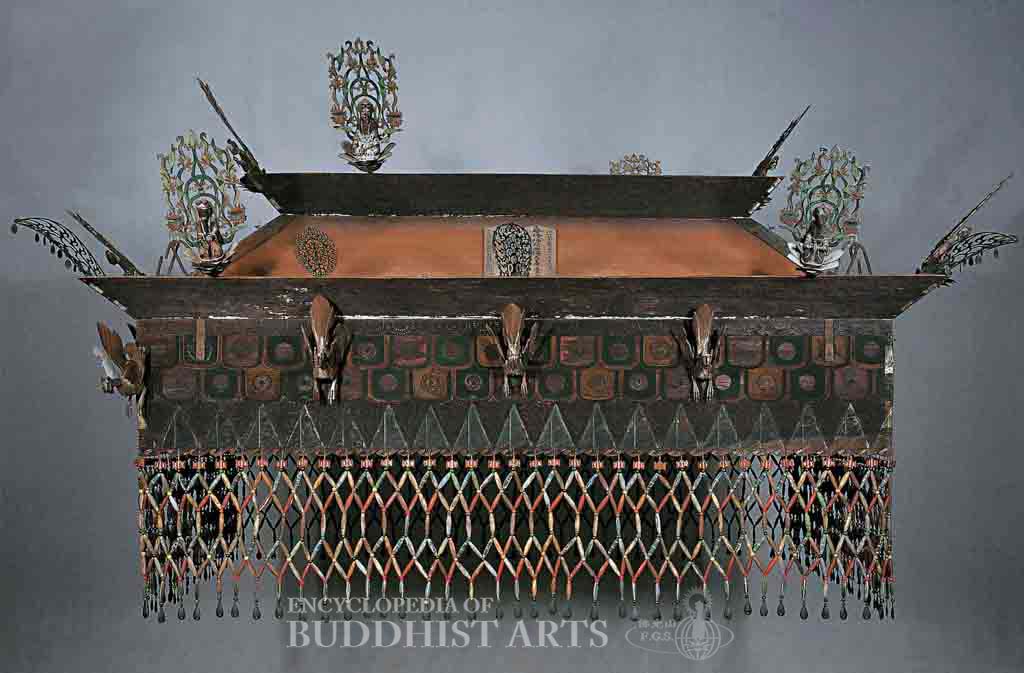
Horyuji Temple Golden Hall: Sakyamuni Buddha Triad - Canopy
Horyuji Temple Golden Hall: Sakyamuni Buddha Triad
JAPAN, Nara, Ikoma; Asuka period
Empress Suiko (reigned 593–628) ordered Tori to make this triad in 622 to pray for the health of Crown Prince Shotoku according to the inscription found on the mandorla. The sculpture was listed as a National Treasure in 1951.
The main figure, Sakyamuni Buddha, sits cross-legged on a concave surface. The way the Buddha’s robe drapes over the seat, as well as the configuration of three figures sharing a common mandorla, are notable firsts of their kind in Japanese sculptural history. The mandorla has decorations of stylized flames and cloud swirls, designs inherited from ancient Chinese art. The overall configuration of the elements appear to form an equilateral triangle, connecting the tip of the large mandorla with the bottom outer edges of the Bodhisattvas’ garments; this proportional configuration provides a visual sense of stability.
The Buddha has a long face and almond-shaped eyes, above which there is an urna. The right hand is in abhaya (fearlessness) mudra and the left hand in a mudra, but with the little and ring fingers turned inward. The attendant Bodhisattvas are at a lower level, so that though they are taller than the main figure, they do not stand above him. Wearing headdresses with floral designs, they are richly dressed and hold gems in both hands. Their clothing projects outwards and downwards to cover the outside of the lotus pedestals supporting them. A lotus immediately behind their heads radiates outwards to a pattern of tendrils, then of flames. The Buddha’s round nimbus unites with the enclosing mandorla, which contains seven seated Buddha floating in clouds.
A rectangular canopy made of wood is suspended above the sculpture. The top portion is carved with phoenixes and colorful apsaras playing music, while the bottom portion is decorated with geometrical motifs and is tasseled with stringed beads.
For more details, go to the Encyclopedia of Buddhist Arts: Sculpture G-M, page 455.
Cite this article:
author = Hsingyun and Youheng and Lovelock, Yann and Chou, Yuan and Huntington, Susan and Edson, Gary and Neather, Robert,
booktitle = {Encyclopedia of Buddhist Arts: Sculpture G-M},
pages = 455,
title = {{Horyuji Temple Golden Hall: Sakyamuni Buddha Triad}},
volume = 11,
year = {2016}}