
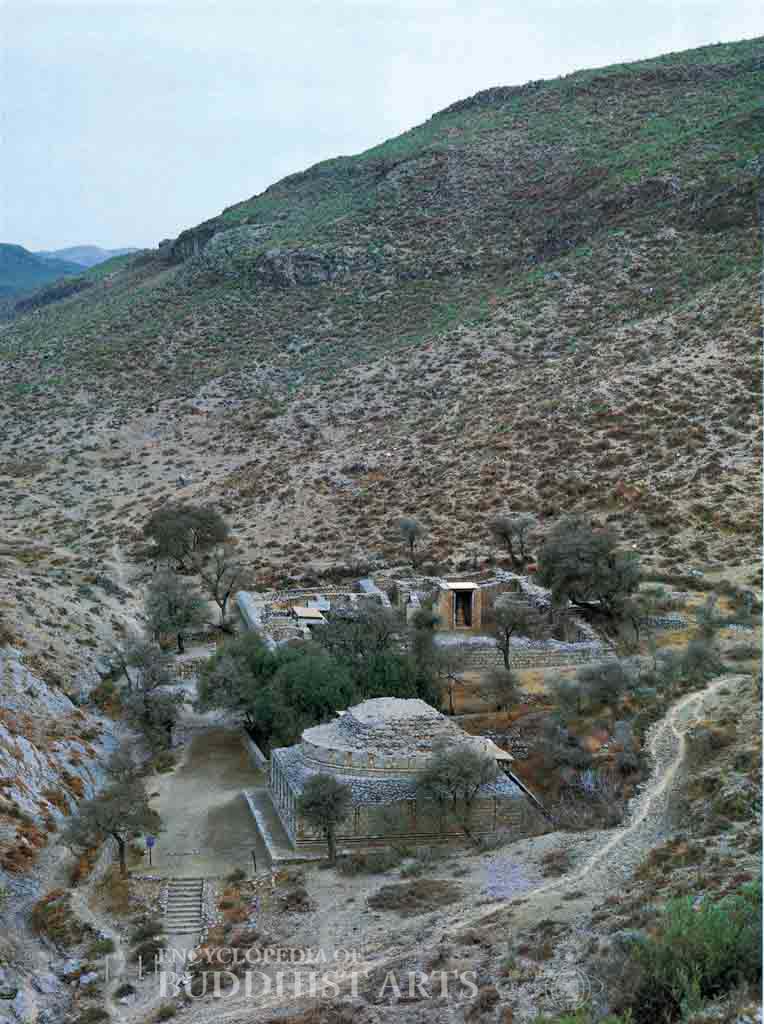
Taxila Mohra Moradu
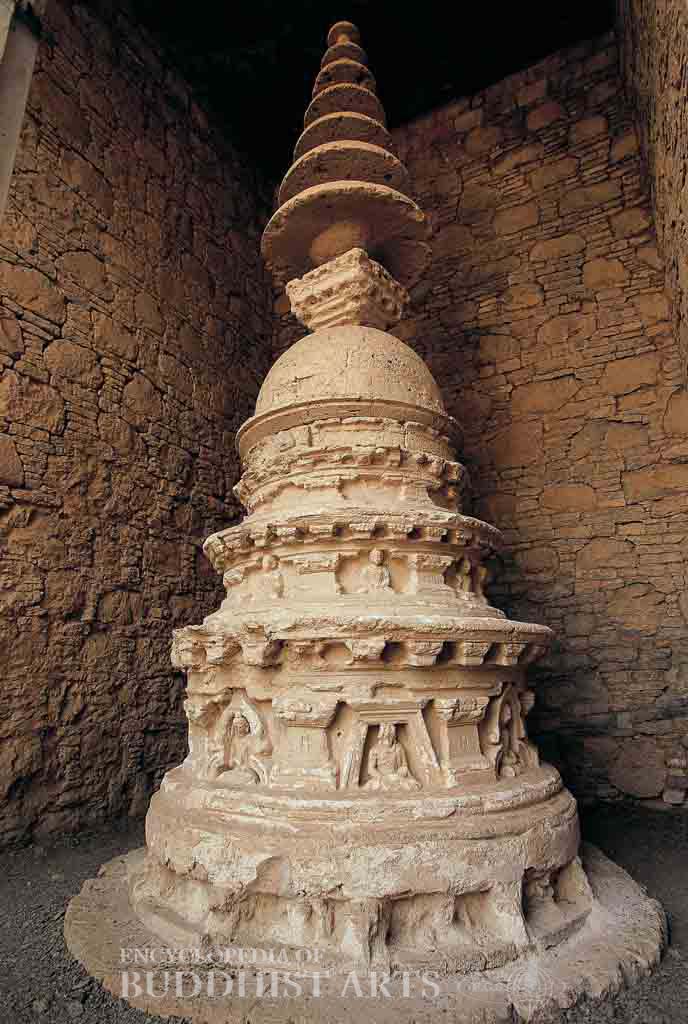
Taxila Mohra Moradu: Small Stupa
Taxila Mohra Moradu
PAKISTAN, Punjab, Taxila
Mohra Moradu was a Buddhist monastery built in the 2nd century and reconstructed during the 5th century. It was visited by Xuanzang during the 7th century. As part of Taxila, it was listed as a UNESCO World Heritage Site in 1980.
The site consists of a stupa in the west and a monastery in the east. The two-layer stupa base is rectangular with stairs in the east wing. There are pilasters on the walls of the stupa base with statues of the Buddha flanked by Bodhisattvas. The rest of the stupa no longer exists.
The monastery includes an assembly hall, monastic cells, a kitchen, and dining hall. Some monastic cells have niches with Buddha statues. The most prominent feature is a small stupa located in one of the cells. It is a replica, as the original has been moved to Taxila Museum. The small stupa is 3.6 m high and sculpted from schist. The base is large and is half the total height of the stupa. It consists of five tiers, which have Buddha niches divided by pilasters. The first tier is damaged due to weathering and only outlines of the columns and Buddha statues remain. The second and third tiers are in better condition, and features, such as different column parts and nimbuses of seated Buddha statues, as well as folds of the garments and even the faces, are still clearly visible. The second to fourth tiers appear to have imitation wooden bracket sets. The stupa body consists of a hemispherical dome, which is followed by a harmika in the form of an inverted truncated pyramid. The spire consists of stacked rings that taper gradually to the top. Similar stupas can be found around the main stupa; however, the only remaining structures are either their bodies or bases. This small stupa is a valuable resource for the study of the design of local stupas.
For more details, go to the Encyclopedia of Buddhist Arts: Architecture T-Z, page 1098.
Cite this article:
author = Hsingyun and Youheng and Johnson, Peter and Mankuang and Lancaster, Lewis,
booktitle = {Encyclopedia of Buddhist Arts: Architecture T-Z},
pages = 1098,
title = {{Taxila Mohra Moradu}},
volume = 4,
year = {2016}}