
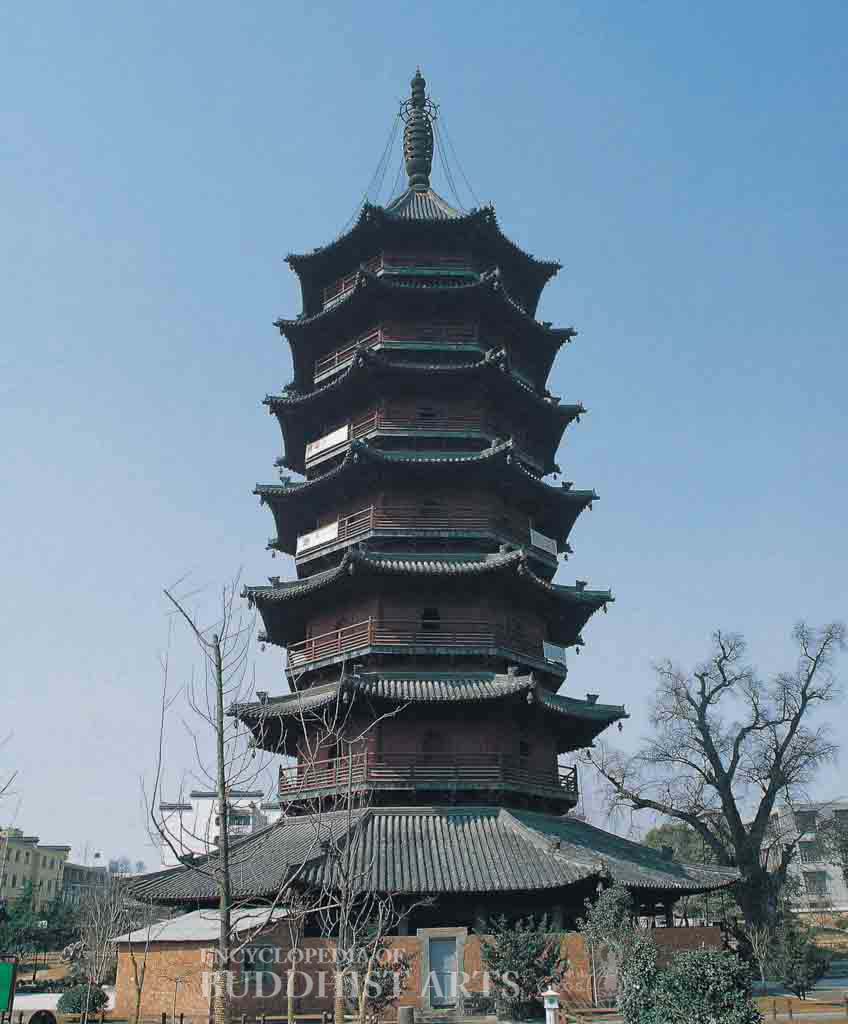
Feiying Pagoda
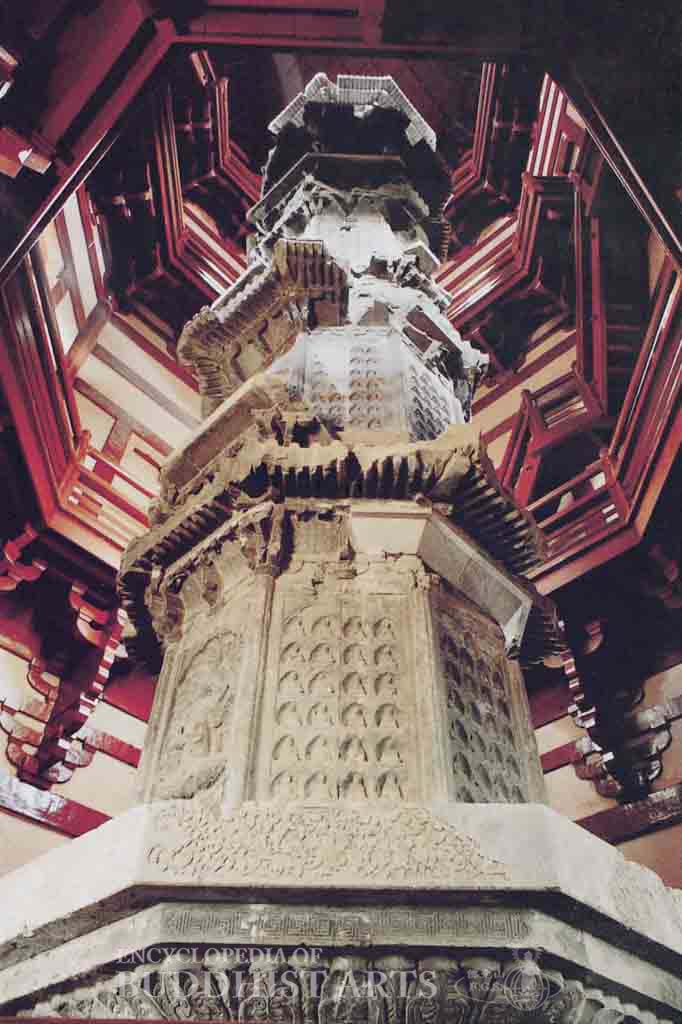
Feiying Pagoda (interior)
Feiying Pagoda
CHINA, Zhejiang, Huzhou
Feiying Pagoda consists of a pagoda within another pagoda, which is rarely seen in Chinese architecture. The inner pagoda was constructed in 884 during the Tang dynasty. It was built by monk Yunjiao to house seven relics and an image of King Asoka (reigned circa 269–232 BCE) of Maurya feeding a tiger. During the rule of Emperor Taizu (reigned 960–976) of the Song dynasty, a wooden pagoda was built around it for protection. It was struck by lightning and badly damaged in 1150 during the Northern Song dynasty, and the inner pagoda was rebuilt four years later. The outer pagoda was reconstructed between 1234 and 1236 during the Northern Song dynasty, and has been repaired a number of times. The roof of the outer pagoda collapsed in 1929 and was not repaired until 1982. It was listed as a National Cultural Heritage Site in 1988.
The octagonal, stone inner pagoda is built in imitation of a timber structure. It is only five tiers high, since the top part is no longer extant, and has a height of 14.6 m. The Sumeru base has carvings of intertwining flora, inverted and upright lotuses, rectangular patterns, and passiflora. Lions in different poses are carved upon the waist. The tiers of the pagoda have either large shallow Buddha niches or numerous small Buddha niches. The eaves are carved in detail with rafters, diagonal beams, tile caps, drip tiles, and ridge decorations in the form of mythical creatures. Beneath the eaves there are bracket sets.
The seven-story, octagonal, brick and timber outer pagoda is 55.5 m high. The first four stories are hollow with inner viewing balconies on stories two, three, and four. The pyramidal roof is covered in tiles and is surmounted by a 12.3 m high iron spire, which is supported by a wooden pole that extends down to the sixth story. When the pagoda was being repaired, a collection of valuable artifacts were discovered dating back to the Five Dynasties period (907–960), as well as to the Southern Song dynasty (1127–1279).
For more details, go to the Encyclopedia of Buddhist Arts: Architecture A-F, page 295.
Cite this article:
author = Hsingyun and Youheng and Johnson, Peter and Mankuang and Lancaster, Lewis,
booktitle = {Encyclopedia of Buddhist Arts: Architecture A-F},
pages = 295,
title = {{Feiying Pagoda}},
volume = 1,
year = {2016}}