
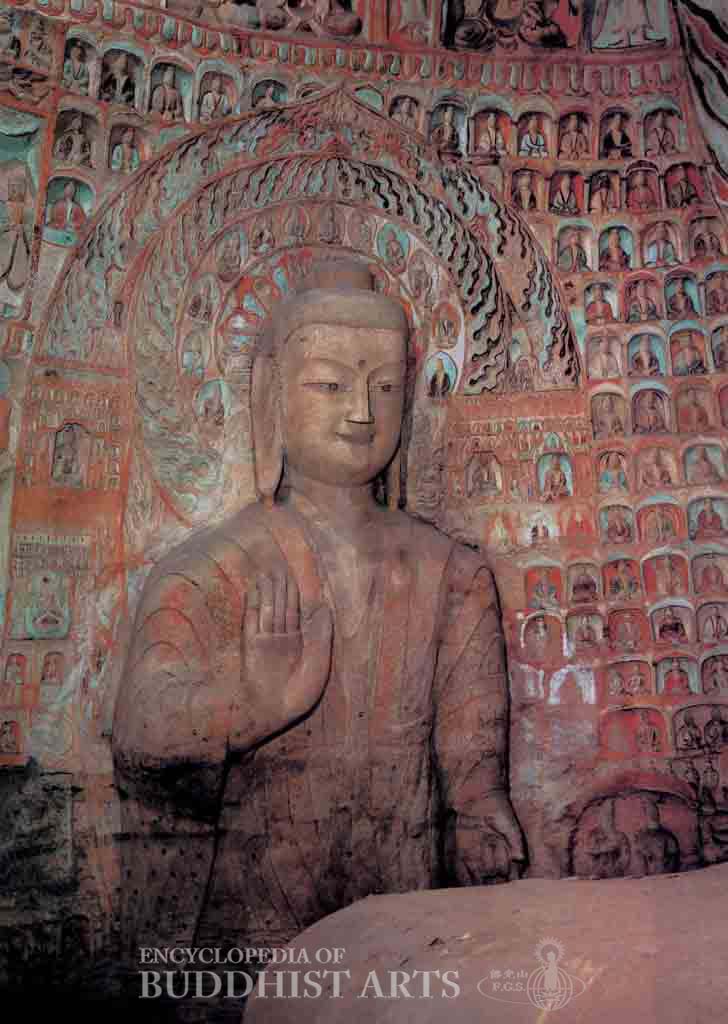
Yungang Grotto 5: Standing Buddha
Stone
Yungang Grotto 5: Standing Buddha
CHINA, Shanxi, Datong; Northern Wei dynasty
Standing Buddhas located on both the east and west walls, together with the central seated Buddha on the back (north) wall, form the Buddhas of the Past, Present, and future. This Buddha located on the west wall wears a loose robe tied at the waist and stands with one hand held in the abhaya (fearlessness) mudra. His face has a gentle, compassionate appearance with a prominent nose, narrow eyes, and a slight smile on the lips. The nimbus behind the Buddha’s head is sculpted with flame patterns on the outer ring, Buddha images in the middle ring, and lotus petal patterns in the inner ring.
This carving is a particularly good example of the significant change in the sculptural style of Yungang Grottoes after the political reforms of Emperor Xiaowen (reigned 471–499) of the Northern Wei dynasty. The Buddha was subsequently repaired and niches were added around it at a later date.
For more details, go to the Encyclopedia of Buddhist Arts: Caves T-Z, page 1654.
Cite this article:
author = Hsingyun and Youheng and Johnson, Peter and Mankuang and Huntington, Susan and Edson, Gary and Neather, Robert,
booktitle = {Encyclopedia of Buddhist Arts: Caves T-Z},
pages = 1654,
title = {{Yungang Grotto 5: Standing Buddha}},
volume = 9,
year = {2016}}