
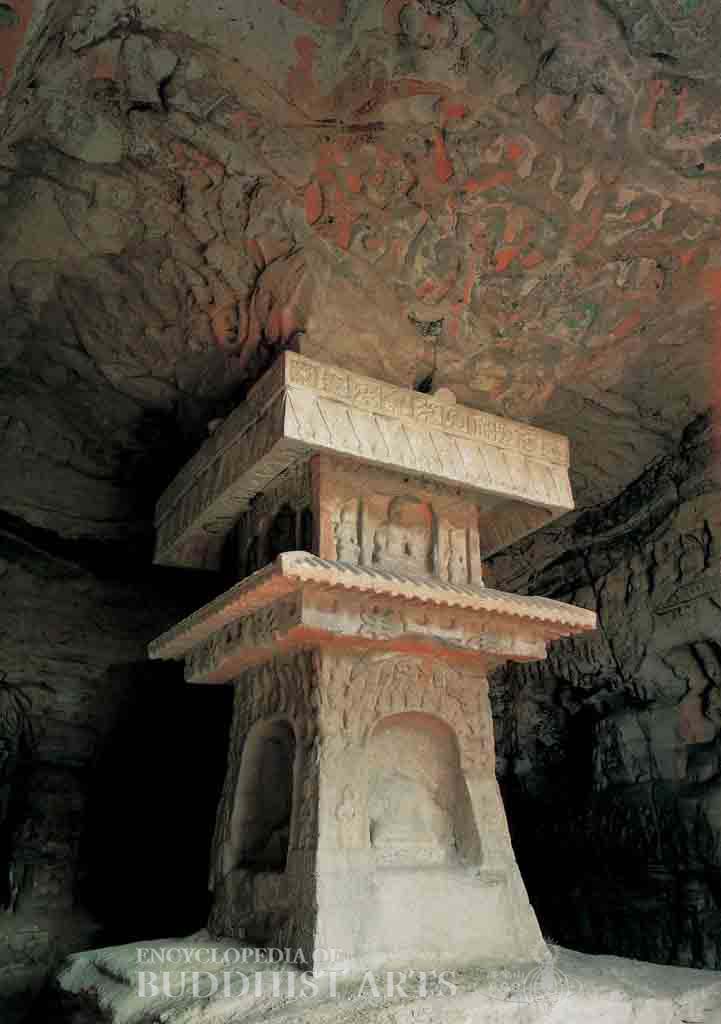
Yungang Grotto 1: Central Pillar
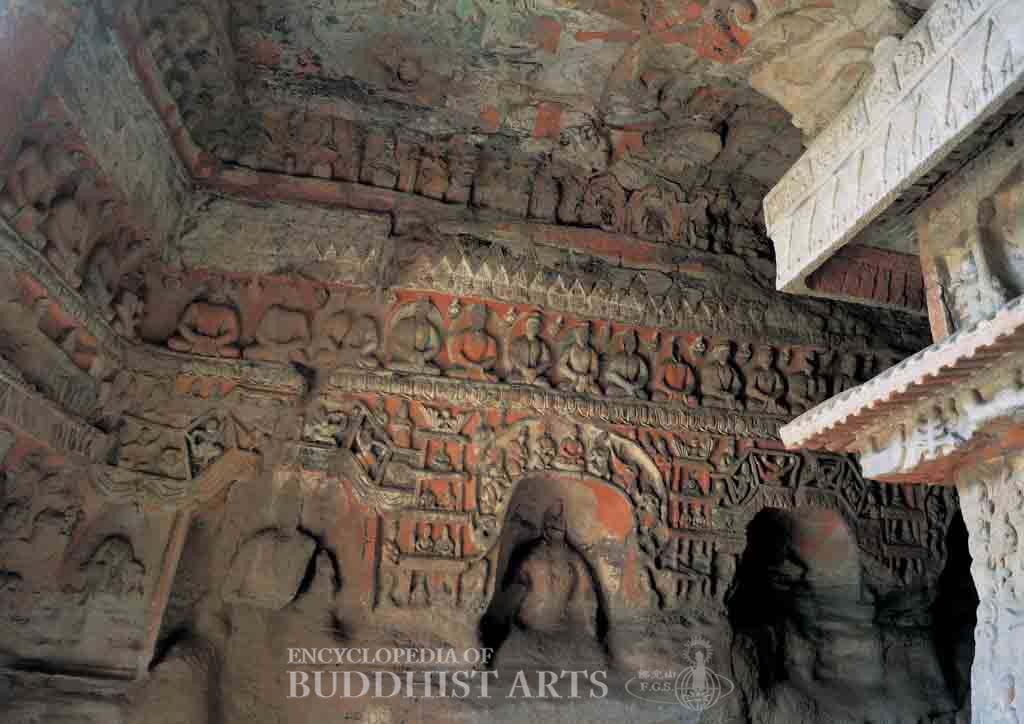
Yungang Grotto 1: West Wall
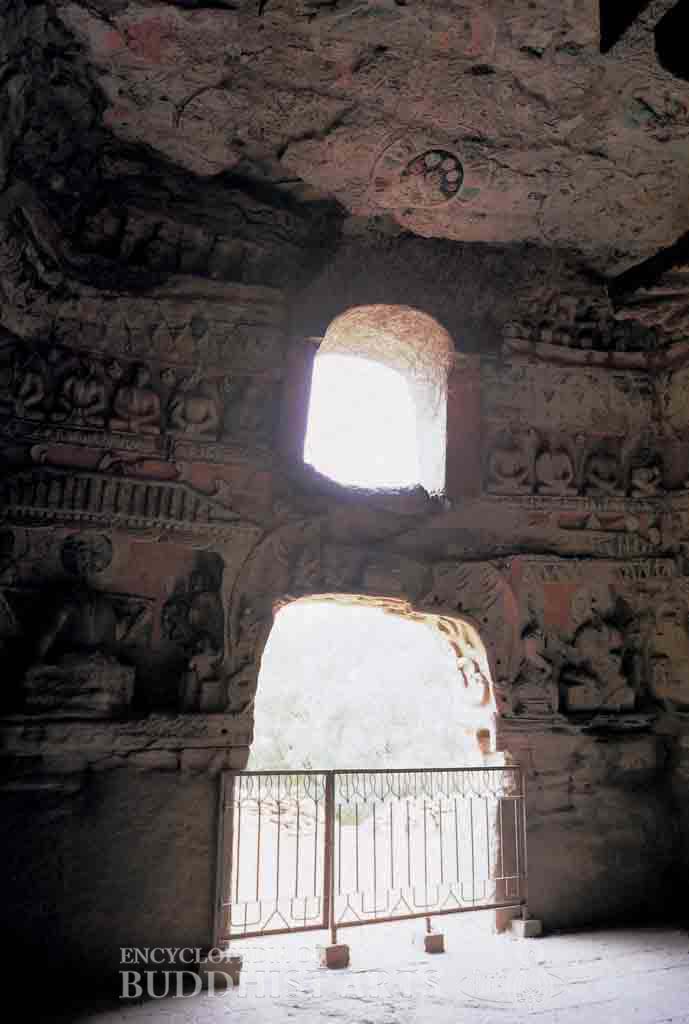
Yungang Grotto 1: Front Wall
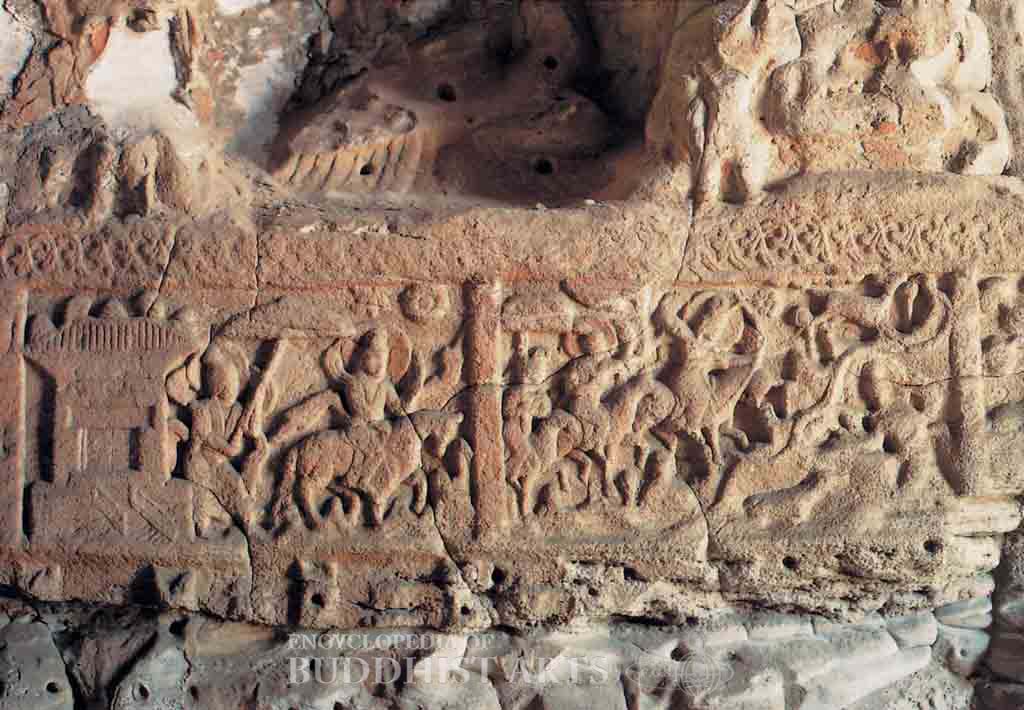
Yungang Grotto 1: Jataka of Syama (east wall, left side)
Yungang Grotto 1
CHINA, Shanxi, Datong
This square grotto is located in the east area and was constructed between the years 465 to 494. It has a barrel-vaulted ceiling and a square central pillar. On the south part of the ceiling there are bas-reliefs of three large lotuses encircled with two rings of petals, and on the north side are five apsaras dancing with stoles.
The central pillar is 5.75 m in height and carved in the shape of a pagoda. The top of the pillar is connected to the ceiling and decorated with carvings of two dragons coiled around Mount Sumeru. The pagoda features two tiers on each of the four sides and each tier has a niche. The upper tier is carved with truncated pyramidal niches beneath a canopy decorated with flowers, trees, and triangular patterns. The niches facing east and west contain cross-legged Bodhisattvas, while the south and north niches feature Buddha triads. Eaves carved above the niches on the lower tier feature details such as imitation wooden bracket sets and corrugated tiles. Around the base of the eaves are carvings of animals and mythical creatures. The niches on the lower tier have suffered significant damage and weathering, thus all that remains of these carvings are the seated Buddhas and donor figures on the niche lintels. On the base of the pillar, only the carvings on the north side can still be discerned. These depict a mountain censer and donor figures.
On the back (north) wall of the grotto three niches feature Maitreya Bodhisattva, centered, flanked by two Bodhisattvas in contemplation. The 3.15 m high Maitreya is seated with legs crossed at the ankles and wearing a flowing stole. These carvings have unfortunately suffered severe weathering and are almost completely destroyed.
Because the doorway on the front (south) wall has been severely weathered, the window above it was restored in the 1960s after it collapsed. Above the doorway is a carved dragon, and the wall on each side is divided into three tiers. The upper tier depicts a row of small Buddha niches, while the middle one features buildings containing Vimalakirti and Manjusri on the left side and a seated Buddha and a brahmin on the right. The bottom tier has collapsed and has undergone restoration in recent times.
Four niches are carved into both the east and west walls, each containing a seated Buddha statue. Between each niche is a carved multi-story pagoda, with a single seated Buddha on the top story and pairs of seated Buddhas on the three lower stories. Atop each pagoda are children being reborn among plantain leaves. Rows of seated Buddhas, triangular patterns, and carvings of apsaras adorn the upper portion of each wall above the niches.
The east, west, and front walls were originally carved with additional illustrations of Jataka tales. The only remaining images, however, are two reliefs of the Syama Jataka on the east wall. Scholars estimate that the east and west walls likely featured at least twelve such illustrations. Below the Jataka reliefs is a row of donor figures.
For more details, go to the Encyclopedia of Buddhist Arts: Caves T-Z, page 1637.
Cite this article:
author = Hsingyun and Youheng and Johnson, Peter and Mankuang and Huntington, Susan and Edson, Gary and Neather, Robert,
booktitle = {Encyclopedia of Buddhist Arts: Caves T-Z},
pages = 1637,
title = {{Yungang Grotto 1}},
volume = 9,
year = {2016}}