
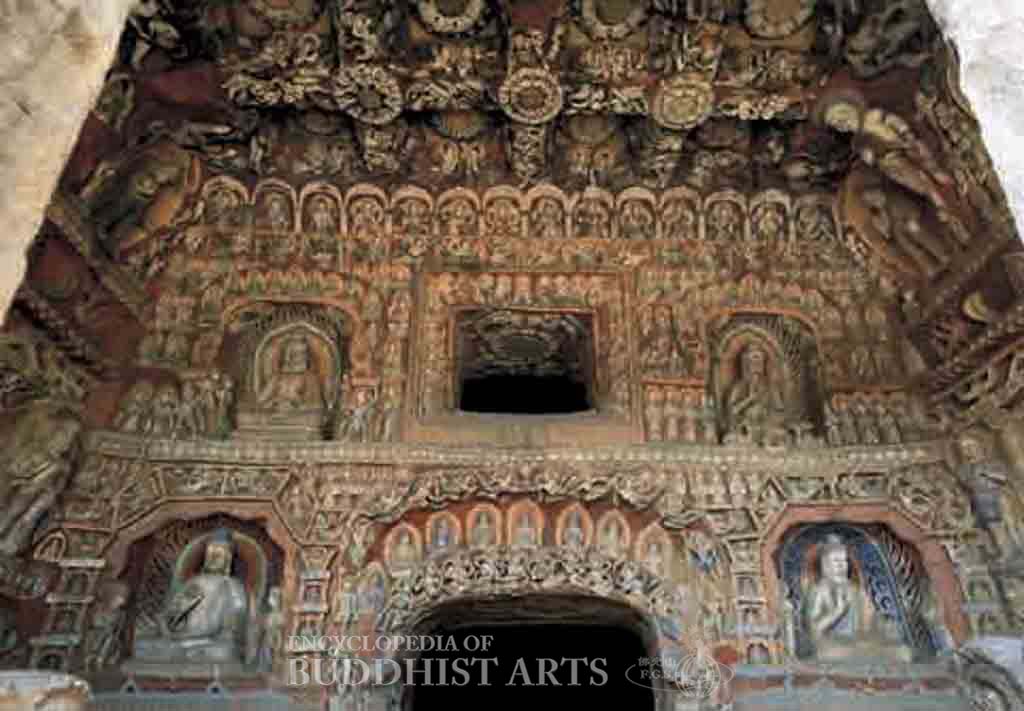
Yungang Grotto 12: Front Chamber - Back Wall
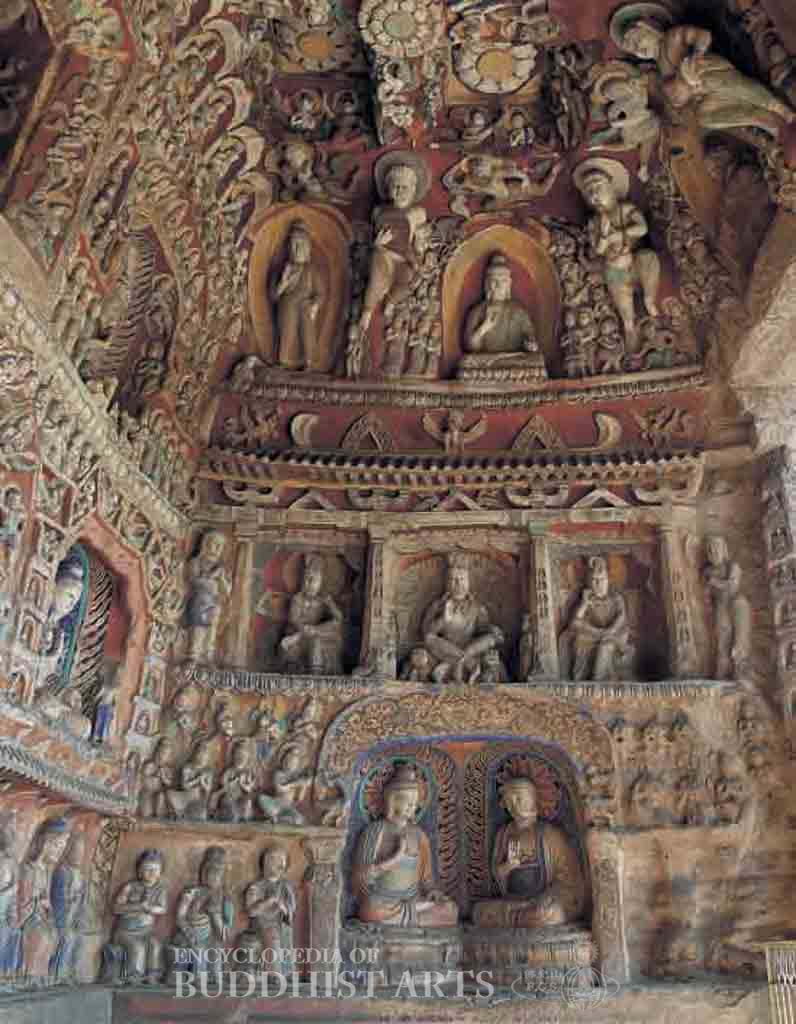
Yungang Grotto 12: Front Chamber - East Wall
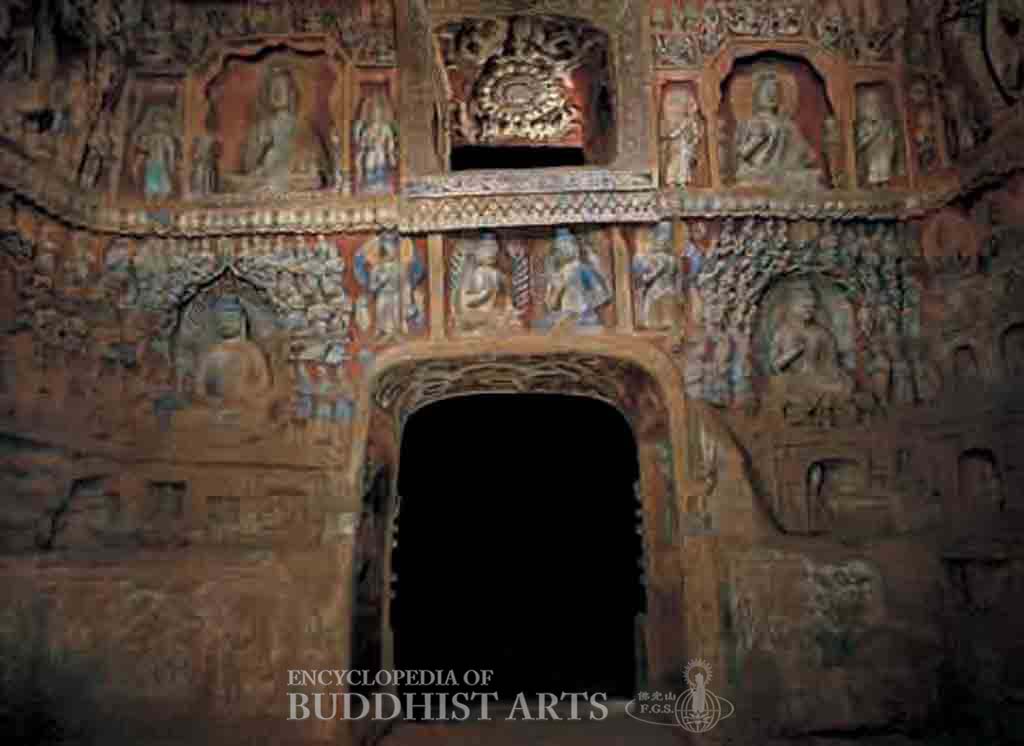
Yungang Grotto 12: Rear Chamber - Front Wall
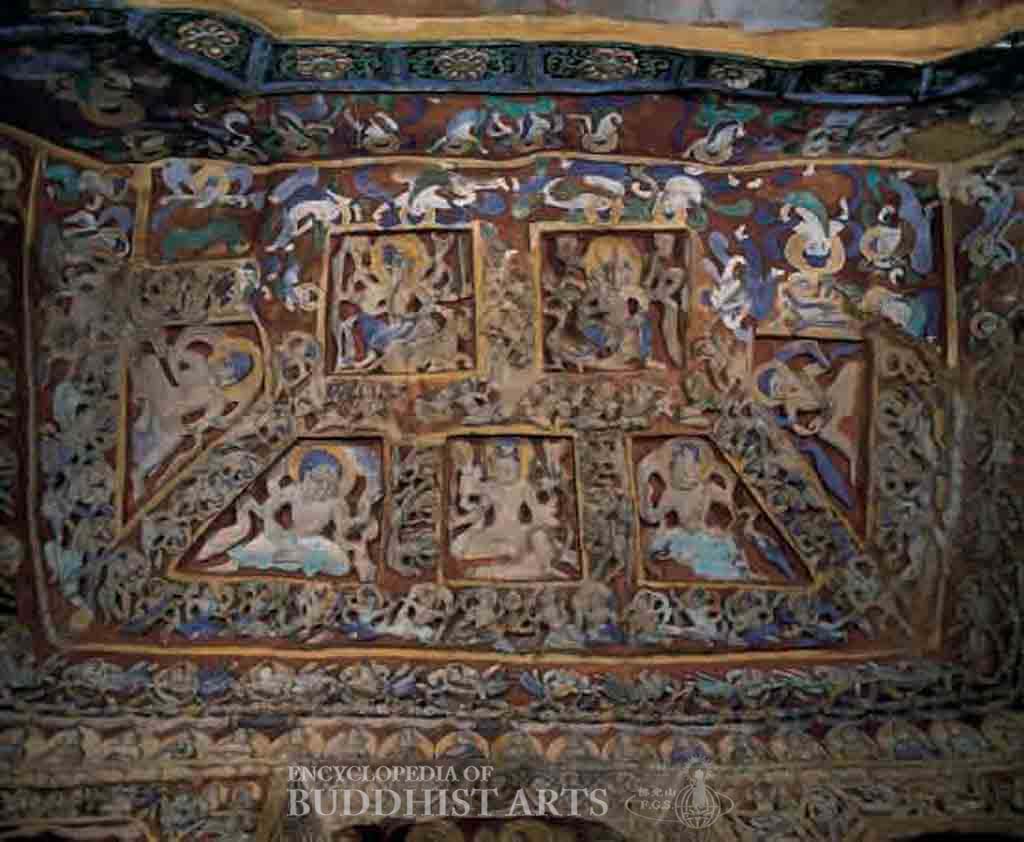
Yungang Grotto 12: Rear Chamber - Ceiling
Yungang Grotto 12
CHINA, Shanxi, Datong
This grotto is located in the central area of the Yungang site and was constructed during the rule of Emperor Xiaowen (reigned 471–499) of the Northern Wei dynasty. The layout of the grotto consists of a front chamber and a rear chamber. The exterior wall of the grotto is made up of two columns which support a hip roof. In addition, the exterior wall was originally carved with inverted V-shaped bracket sets and rafters. Although these have since worn away, the remnants suggest that it had a shape similar to that of the house-like niches inside the grotto. These features are characteristic of the external design of grottoes during the Northern Wei dynasty (386–534).
The ceiling of the front chamber is divided into eight square sections by raised beams, with lotus flowers carved at the intersections, as well as within each beam. On and around the ceiling are numerous carvings of heavenly beings, kinnaras, yaksas, and apsaras carrying musical instruments, such as the pipa, reed instrument, zither, panpipe, flute, and drum.
The side walls of the front chamber are filled with Buddha niches and sculptures scattered symmetrically across three tiers, many of which depict themes or figures from popular Buddhist stories. The central, arched niche on the lower tier of the east wall contains Sakyamuni and Prabhutaratna Buddhas teaching the Dharma, flanked by disciples and heavenly beings making offerings. The middle tier consists of a house-like niche that is three bays wide, with cross-ankled Maitreya in the central bay and Bodhisattvas in contemplation in the side bays. The top tier of the east wall features two figures: the standing Buddha on the left illustrates the story of the Prophecy of Dipamkara Buddha, and the seated Buddha on the right illustrates Sakyamuni’s Defeat of Mara and Enlightenment. The west wall has a layout similar to that of the east, though the figures differ somewhat. A seated Buddha is depicted in each bay of the house-like niche on the east wall. On the top right of the wall, a standing Buddha beside three smaller figures illustrate the story of King Asoka Making a Sand Offering. The seated Buddha and figures on the upper left side of the wall illustrate the Conversion of the Three Kasyapa Bothers by Defeating a Naga.
An arched doorway is constructed in the back (north) wall of the front chamber and above it is a window. On each side of the window is an arched niche, which contains a seated Buddha. The Buddha on the left holds an alms bowl to represent the story of the Four Heavenly Kings Offering Bowls, while the sculpture on the right depicts the First Turning of the Dharma Wheel. The ceiling within the window is decorated with apsaras encircling a lotus.
The walls within the rear chamber are also covered with numerous sculpted figures. Niches containing seated Buddhas are placed in a symmetrical layout on both sides of the window and doorway on the front (south) wall. A smaller niche located between the doorway and upper window contains sculptures of Sakyamuni and Prabhutaratna Buddhas seated together. The lower part of the back wall is severely weathered, but the upper portion is still discernible, showing a Buddha seated with legs pendent as well as two Bodhisattvas. These figures were repaired at some point after the grotto was completed. The lattice ceiling within the rear chamber contains images of a five-headed, six-armed Kumaraka, an eight-armed Mahesvara, and an asura, with rows of apsaras.
For more details, go to the Encyclopedia of Buddhist Arts: Caves T-Z, page 1706.
Cite this article:
author = Hsingyun and Youheng and Johnson, Peter and Mankuang and Huntington, Susan and Edson, Gary and Neather, Robert,
booktitle = {Encyclopedia of Buddhist Arts: Caves T-Z},
pages = 1706,
title = {{Yungang Grotto 12}},
volume = 9,
year = {2016}}