
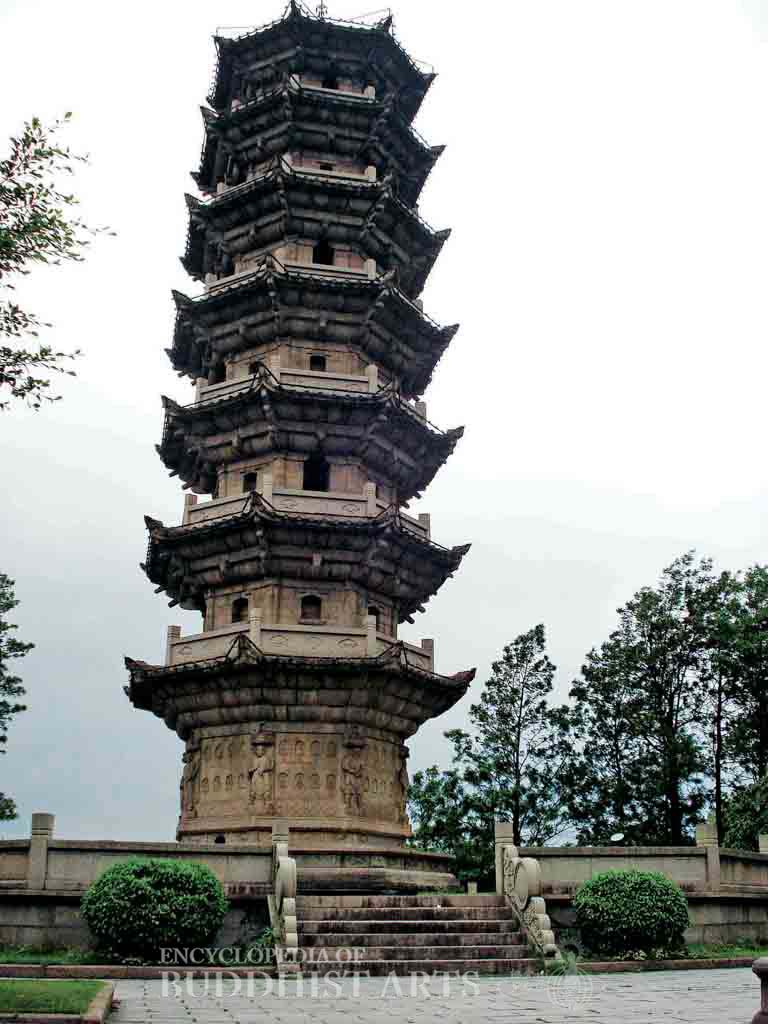
Sanfeng Temple Pagoda
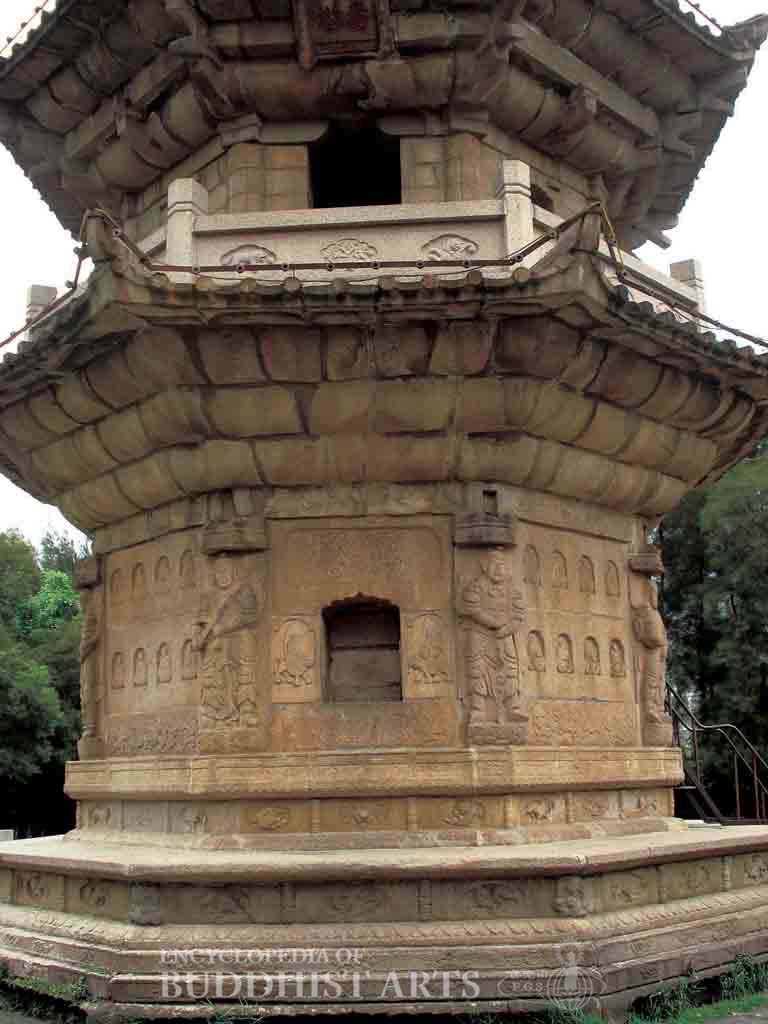
Sanfeng Temple Pagoda (detail)
Sanfeng Temple Pagoda
CHINA, Fujian, Fuzhou
This pagoda is also known as Nanshan Pagoda, as it is located on Nanshan (South Mountain). According to an inscription, it was built in 1117 during the Northern Song dynasty. It had been repaired a number of times throughout its history, including in the early 15th century by Ming dynasty fleet admiral Zheng He, and was listed as a Provincial Cultural Heritage Site in 1961.
The seven-story, octagonal, stone pagoda is 27.4 m high and built in imitation of a timber structure. The Sumeru base has carvings such as lions and peonies on the sides, with Dharma protectors at the corners. There is a single doorway on the first story, two doorways on stories two to six, and four doorways on the seventh story. Dharma protectors are carved at the corners of the first story. Each story above the first has a balcony. The surface of the walls is decorated with Song dynasty (960–1279) carvings of seated Buddhas, apsaras, heavenly musicians, and illustrations from the Life of the Buddha. The central chamber has a vaulted ceiling. There is a stone staircase that leads to the roof.
For more details, go to the Encyclopedia of Buddhist Arts: Architecture M-S, page 938.
Cite this article:
author = Hsingyun and Youheng and Johnson, Peter and Mankuang and Lancaster, Lewis,
booktitle = {Encyclopedia of Buddhist Arts: Architecture M-S},
pages = 938,
title = {{Sanfeng Temple Pagoda}},
volume = 3,
year = {2016}}