

Enryakuji Temple: Ordination Hall
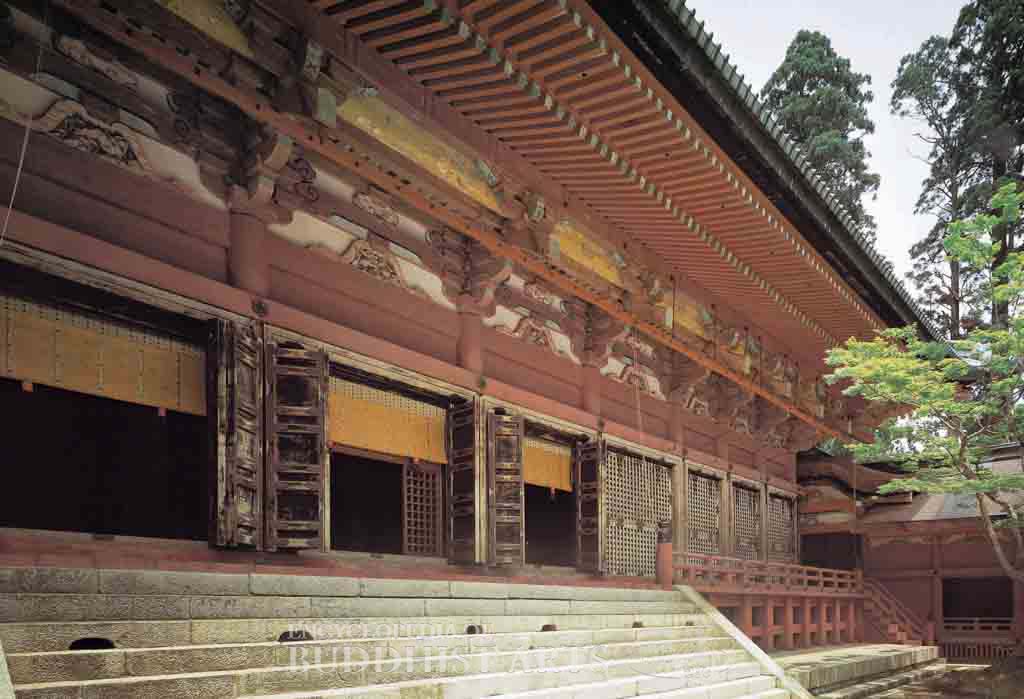
Enryakuji Temple: Konpon Central Hall

Enryakuji Temple: Manjusri Gate

Enryakuji Temple: Lecture Hall
Enryakuji Temple
JAPAN, Shiga, Otsu
The temple is situated on Hieizan (Farsighted Mountain). It is the head temple of the Tendai school of Japanese Buddhism. The temple was founded by Master Saicho after he returned to Japan from China in 805. In 823 Emperor Saga (reigned 809–823) named the temple Enryakuji. Under the protection and support of later emperors, the temple expanded and by the Heian period (794–1185), there were over 3,000 monastic cells. It was listed as one of Japan’s two great Buddhist monasteries, the other one being Kongobuji Temple. During the Azuchi-Momoyama period (1573–1615) Oda Nobunaga completely destroyed the temple. The temple was later restored with the help of generals Toyotomi Hideyoshi and Tokugawa Ieyasu. The present structures are reconstructions from the Edo period (1615–1868). As part of the Historic Monuments of Ancient Kyoto, the temple was listed as a UNESCO World Heritage Site in 1994.
The main buildings include the ordination hall, lecture hall, Konpon Central Hall, Lotus Hall, Sakyamuni Hall, Yokama Central Hall, and Manjusri Gate. The ordination hall contains the earliest ordination platform of the Tendai school. It has a double-eave pyramidal roof covered with shingles.
The Konpon Central Hall was completed in 1642 during the Edo period. The eleven-by-six bay hall has a single-eave hip-and-gable roof covered with cylindrical tiles. The building is 37.5 m wide and 23.9 m deep. The hall houses statues of the Medicine Buddha and Vaisramana, as well as a portrait of the patriarch. It was listed as a National Treasure in 1953.
The Yokawa Central Hall was built on a cliff using clay and steel. The present lecture hall was rebuilt in 1936 during the Showa period by reusing materials from the Praising Buddha Hall, which lies on the eastern foot of Hieizan.
The temple seeks to integrate teachings from different Buddhist schools. After the late Heian period, the temple trained many eminent masters, including Honen, Shinran, Eisai, Dogen, and Nichiren. Just as the founding patriarch Saicho had hoped, Enryakuji Temple produces National Treasures and resembles a comprehensive university.
For more details, go to the Encyclopedia of Buddhist Arts: Architecture A-F, page 275.
Cite this article:
author = Hsingyun and Youheng and Johnson, Peter and Mankuang and Lancaster, Lewis,
booktitle = {Encyclopedia of Buddhist Arts: Architecture A-F},
pages = 275,
title = {{Enryakuji Temple}},
volume = 1,
year = {2016}}