
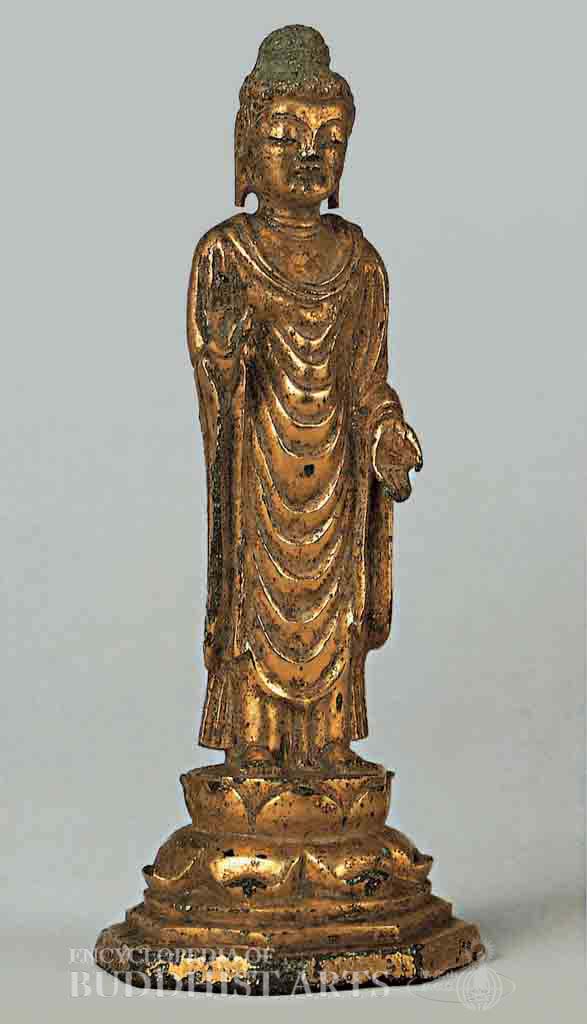
Standing Buddha
Gilt copper alloy
Standing Buddha
KOREA; Unified Silla dynasty
Both the figure and the pedestal were cast in one piece in this 8th century sculpture, displaying the features of small gilt bronze statues from Unified Silla dynasty. There is a protruding tenon at the back to which a mandorla was originally attached.
Contrasting upward and downward curves individualize the piece. The Buddha’s downcast eyes and mouth are contrasted by the upward curve of the chin and cheeks above the three lines on the neck. The monastic robe that covers both shoulders falls in a series of sharply raised ripples. The figure stands on a lotus pedestal. The right hand raised in abhaya (fearlessness) mudra provides a focus of balance while the left hand held by the hip forms the varada (wish-granting) mudra.
For more details, go to the Encyclopedia of Buddhist Arts: Sculpture St-Z, page 1143.
Cite this article:
author = Hsingyun and Youheng and Lovelock, Yann and Chou, Yuan and Huntington, Susan and Edson, Gary and Neather, Robert,
booktitle = {Encyclopedia of Buddhist Arts: Sculpture St-Z},
pages = 1143,
title = {{Standing Buddha}},
volume = 13,
year = {2016}}