
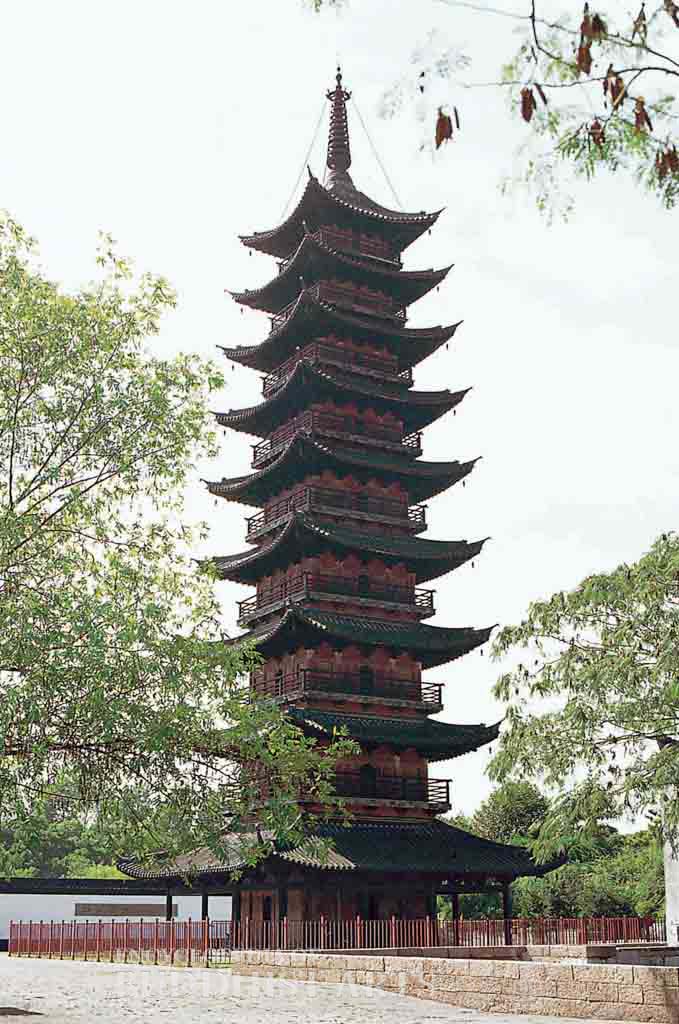
Xingshengjiao Temple Pagoda
Xingshengjiao Temple Pagoda
CHINA, Shanghai
This pagoda is known locally as Songjiang Square Pagoda and it stands in Square Pagoda Park. It was constructed during the Northern Song dynasty (960–1127). Although it has been repaired a few times, it has kept its original structure. About sixty percent of the wooden bracket sets are original, as are the beams above the doorways and under the eaves. It was listed as a National Cultural Heritage Site in 1996.
The nine-story, square, brick and timber pagoda is 42.6 m high. A veranda surrounds the first story and there are balconies on the remaining stories. The eaves turn up at the corners producing curved lines on an otherwise square structure. Each side of the pagoda body has been divided into three bays by brick pilasters. A doorway in the central bay leads to a square chamber. There are stairs on every story. On the exterior walls of the third story, there are two perfectly preserved Song-dynasty murals depicting seated Buddhas. The spire consists of an inverted bowl, stacked rings, a canopy and a jewel. In 1974 the discovery of an underground palace revealed a white marble stone container housing a 40 cm gilt-bronze statue of the reclining Buddha.
For more details, go to the Encyclopedia of Buddhist Arts: Architecture T-Z, page 1327.
Cite this article:
author = Hsingyun and Youheng and Johnson, Peter and Mankuang and Lancaster, Lewis,
booktitle = {Encyclopedia of Buddhist Arts: Architecture T-Z},
pages = 1327,
title = {{Xingshengjiao Temple Pagoda}},
volume = 4,
year = {2016}}