
Fo Guang Shan Monastery: Characters - Buddhism in Practice
Ink on paper
Fo Guang Shan Monastery: Characters - Buddhism in Practice
TAIWAN, Kaohsiung
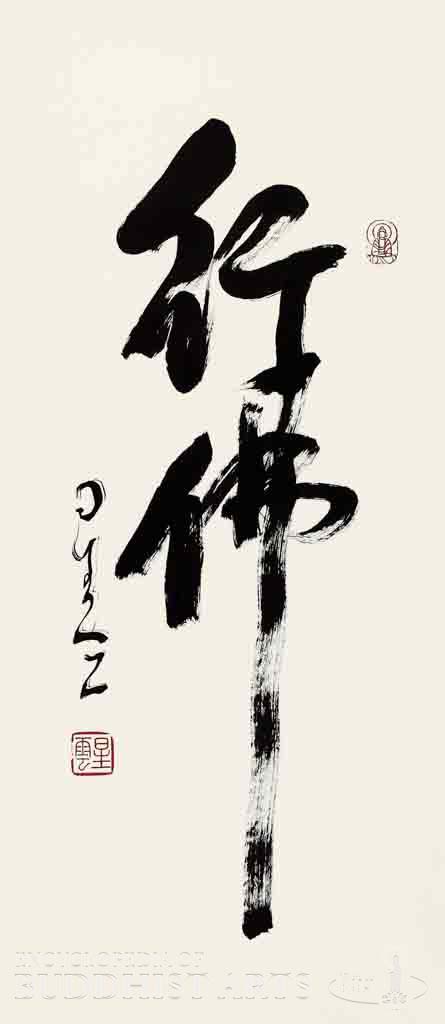
Master Hsing Yun is a prominent writer of Dharma words, advice, and blessings in response to requests from the lay community. He fell ill in 2010, and consequently, his vision deteriorated. Nonetheless, Master Hsing Yun has pursued calligraphy writing as a way to reach out and benefit others. The characters of this piece refer to an important aspect of praxis and perseverance in the Humanistic Buddhism advocated by Master Hsing Yun. Emphasis is placed on practicing Buddhism in daily life and having a holistic sensibility by balancing practice with an understanding of the teachings, which benefits both oneself and others.
Due to his blurred vision, Master Hsing Yun is unable to replenish the ink on his brush or continue from where he stops halfway through writing. Therefore, he ensures that the brush is fully soaked with ink before he begins each piece. His works, as a result, are completed in one attempt, and are affectionately known as “One-Stroke Calligraphy.” The first character in this example begins with broad, saturated strokes that are strong and dense, yet fluently articulated. The second character starts much drier, and strokes become faded with white spaces appearing in between brushwork in the flying white style. The swift movement ends with inconsistent pressure in the tail stroke, yielding a bold, expressive statement and variation to the overall composition. Alongside his other works of One-Stroke Calligraphy, this piece has been exhibited in numerous art galleries and museums around the world.
Master Hsing Yun’s Dharma name is Wuche and his style name is Jinjue. He is the 48th lineage-holder of the Linji school of Chinese Chan Buddhism, as well as the founder of Fo Guang Shan Monastery in Taiwan. He has devoted his life promoting Humanistic Buddhism and has propagated the Buddha’s teachings across the five continents, putting theory into practice.
For more details, go to the Encyclopedia of Buddhist Arts: Calligraphy, page 78.
Cite this article:
author = Hsingyun and Youheng and Youlu and Pokorski, Stefanie and Mankuang and Edson, Gary,
booktitle = {Encyclopedia of Buddhist Arts: Calligraphy },
pages = 78,
title = {{Fo Guang Shan Monastery: Characters - Buddhism in Practice}},
volume = 17,
year = {2016}}