
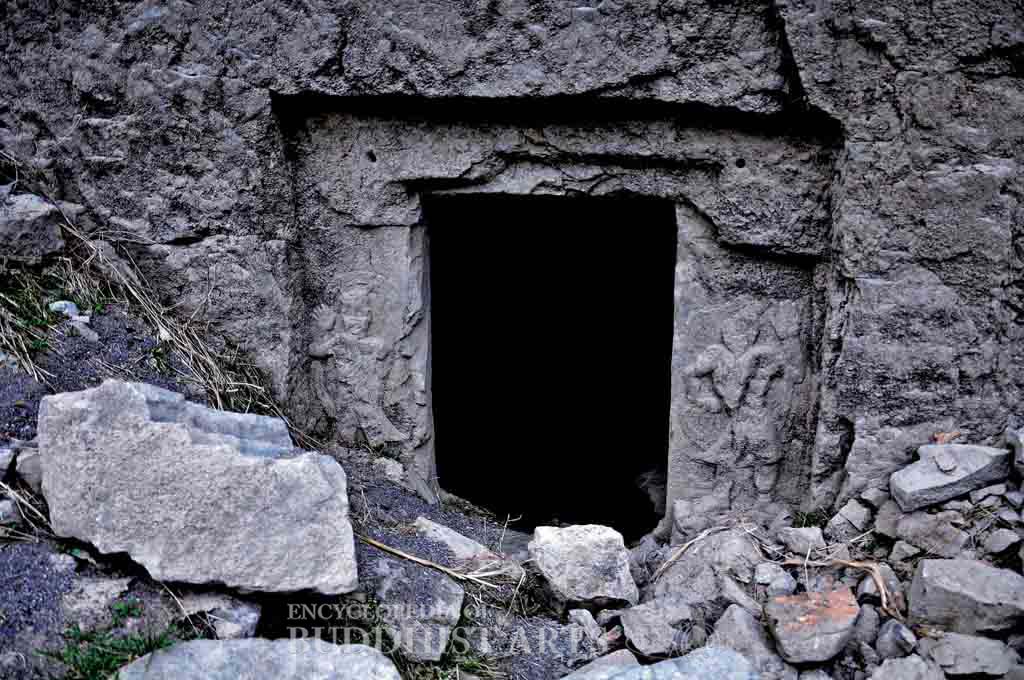
Qianzui Cave: Entrance
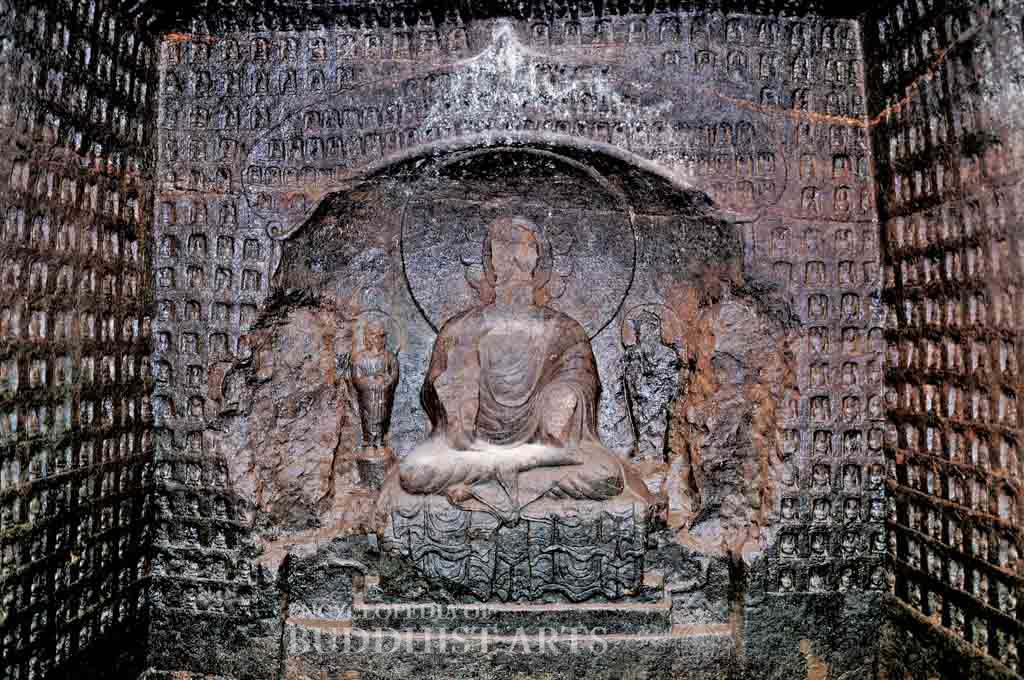
Qianzui Cave: Buddha Pentad (back wall)
Qianzui Cave
CHINA, Henan, Hebi
This cave is located east of Qianzui village, 18 km northwest of Hebi. The carving style is indicative of the Eastern Wei dynasty (534–550). The cave is named for its proximity to Qianzui village. It was listed as a Provincial Cultural Heritage Site in 1986.
The rectangular cave is 1.8 m in width, 2.02 m in height, and 1.92 m in depth. Carved in relief on either side of the cave entrance are warriors with bared upper torsos. The niche on the back wall houses a Buddha with two disciples and two Bodhisattvas. Seated on a Sumeru throne in full lotus position, the Buddha is 74 cm in height. His round nimbus is decorated with a pattern of lotus petals. A long robe with skillfully carved, smooth folds covers the shoulders of the Buddha, and hangs over the lotus throne. Two disciples with damaged faces flank him. The disciples are barefoot, and their hands rest before their abdomens. The two attendant Bodhisattvas beside them are severely damaged. The rest of the back wall and the two side walls are filled with the Thousand Buddhas.
For more details, go to the Encyclopedia of Buddhist Arts: Caves Mo-S, page 1325.
Cite this article:
author = Hsingyun and Youheng and Johnson, Peter and Mankuang and Huntington, Susan and Edson, Gary and Neather, Robert,
booktitle = {Encyclopedia of Buddhist Arts: Caves Mo-S},
pages = 1325,
title = {{Qianzui Cave}},
volume = 8,
year = {2016}}