
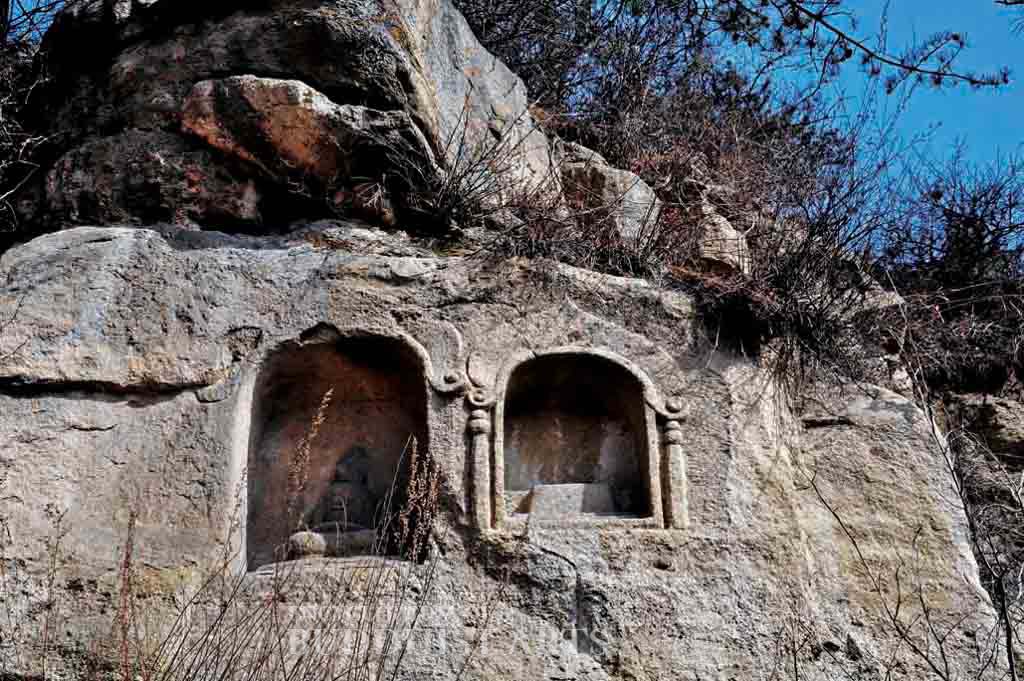
Yunlongshan Caves: Adjacent Niches
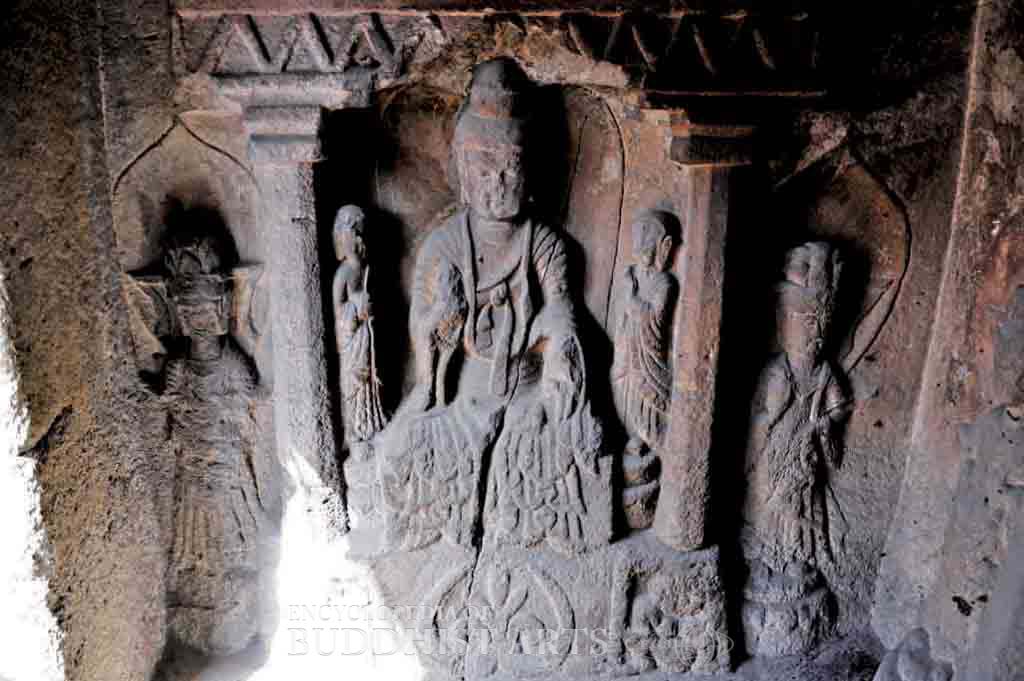
Yunlongshan Cave: East Cave - Niche (west wall)
Yunlongshan Caves
CHINA, Shanxi, Jinzhong
These caves are located halfway up Yunlongshan (Cloud Dragon Mountain), 1 km north of Heshun, Jinzhong. The site consists of two caves, East Cave and West Cave, with a pair of adjacent niches 5 m from the East Cave. Both the caves and the adjacent niches face south. The cave layout and sculptural style suggest that the East Cave and the two adjacent niches were created during the late Northern Wei dynasty (386–534), while the West Cave was made during the Northern Dynasties (386–581). The East Cave is well preserved, but the West Cave has suffered severe weathering.
The East Cave is square with a truncated pyramidal ceiling. Each cave wall has a niche with a similar layout. The niches are carved with hip-and-gable roofs made to imitate wooden structures. Tapered octagonal columns support the niche lintel. Other imitation wooden architectural elements include inverted V-shaped bracket sets, corrugated tiles, ridges, and ridge ornaments.
Inside each niche are statues of a Buddha and two disciples, with two attendant Bodhisattvas outside the niche. The niche on the back (north) wall portrays the Buddha with a high usnisa and a loose, long-sleeved robe that is tied at the waist and covers both shoulders. The robe drapes over the front of the Buddha’s throne. Under the robe is an inner garment with a knotted sash. Seated in full lotus position, the Buddha’s right hand forms the abhaya (fearlessness) mudra, and the left hand displays the varada (wish-granting) mudra. The figure has a petal-shaped mandorla and the base of the throne is decorated with a honeysuckle pattern. The Buddha statue in the west wall niche is similar to that on the back wall, with the left hand placed on the knee. A statue of a Bodhisattva with legs pendent is depicted inside the east wall niche. Disciples flank the Buddha’s lotus throne. Both attendant Bodhisattvas wear high crowns with ribbons that hang from both sides to the shoulders. Adorned with petal-shaped necklaces, the Bodhisattvas wear stoles and slightly flared dhotis.
The adjacent niches, one large and one small, are 1.5 m apart. Both niches are arched with ogee arched lintels. Inside the larger niche is a rectangular throne and a Buddha statue. The Buddha forms the dhyana (meditation) mudra while sitting in full lotus position on the throne. A throne without the Buddha is all that remains in the smaller niche.
For more details, go to the Encyclopedia of Buddhist Arts: Caves T-Z, page 1744.
Cite this article:
author = Hsingyun and Youheng and Johnson, Peter and Mankuang and Huntington, Susan and Edson, Gary and Neather, Robert,
booktitle = {Encyclopedia of Buddhist Arts: Caves T-Z},
pages = 1744,
title = {{Yunlongshan Caves}},
volume = 9,
year = {2016}}