
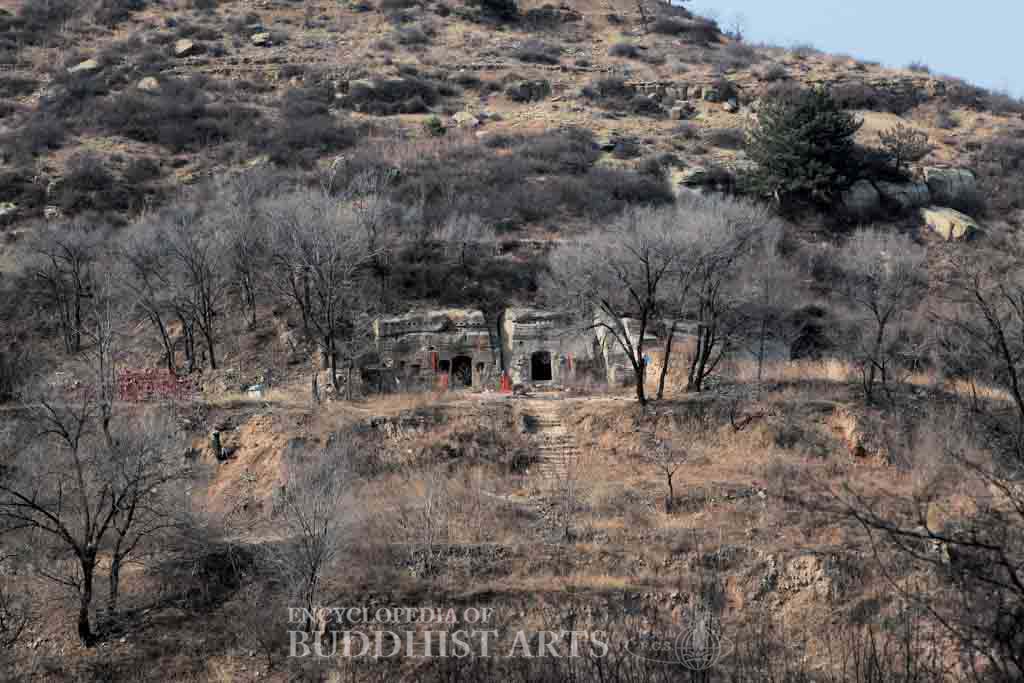
Shifo Temple Caves
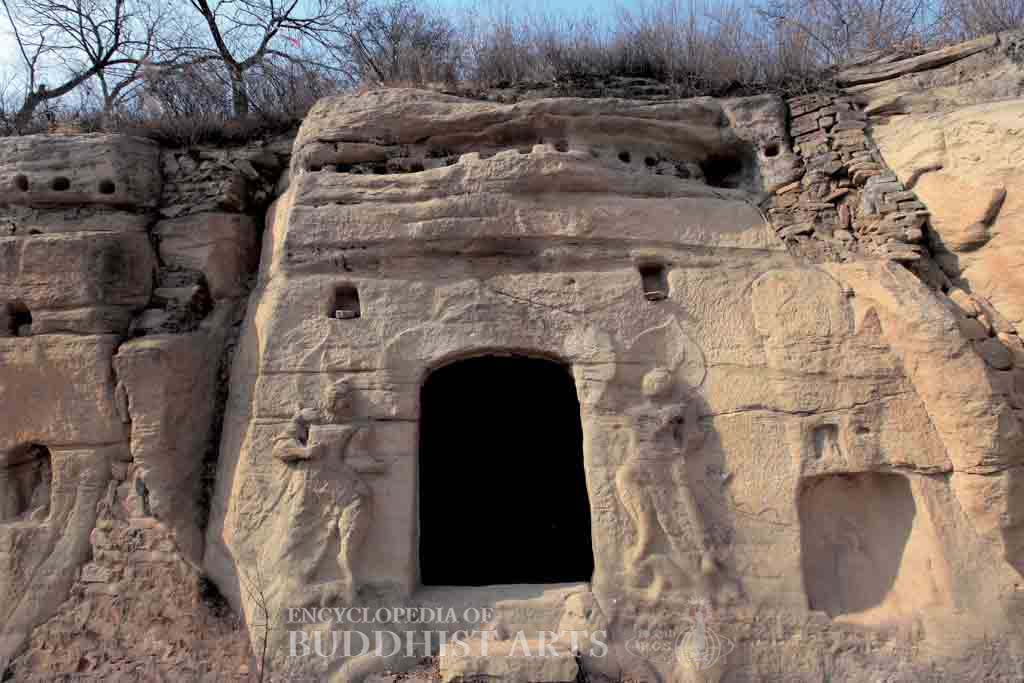
Shifo Temple Caves: Cave 1
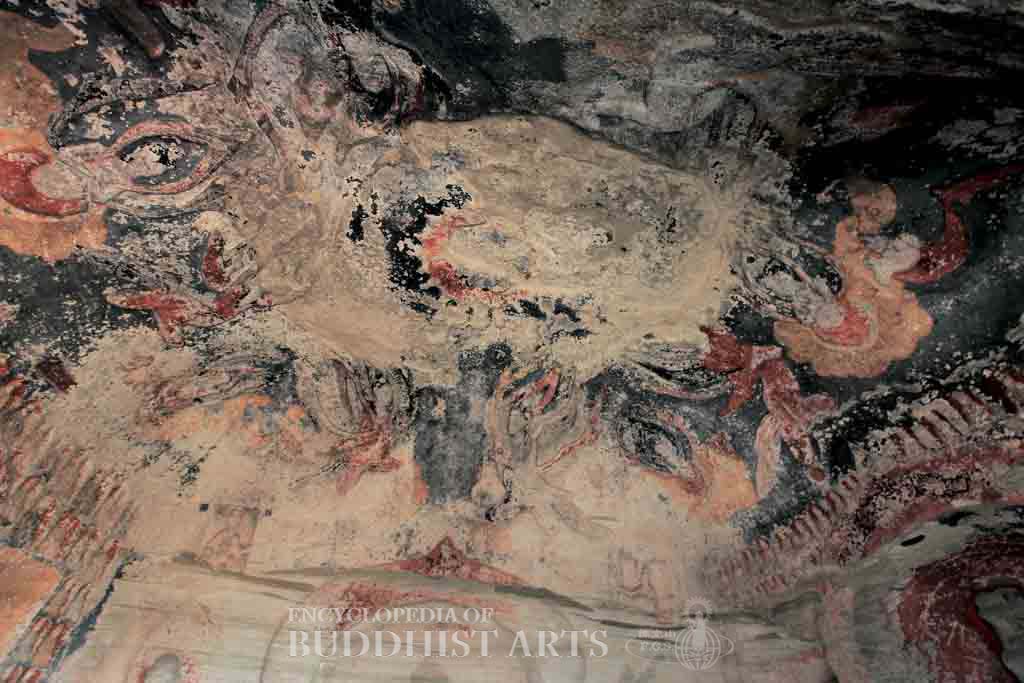
Shifo Temple Caves: Cave 2 - Ceiling

Shifo Temple Caves: Cave 2 - Ceiling (detail)
Shifo Temple Caves
CHINA, Shanxi, Jinzhong
These caves are located southwest of Jinggou village in Shanxi. The date of their creation is unknown. Two adjacent caves can be found facing east. They were carved from yellow sandstone, which renders them susceptible to weathering. The eaves of the caves fall down in 1974. A row of rafter holes outside the cliff serves as evidence that wooden structures once covered the caves’ entrances. Shifo Temple Caves were listed as a Provincial Cultural Heritage Site in 1994.
Cave 1 has a truncated pyramidal ceiling and niches on three walls. Two warriors with weathered faces and nimbuses flank the cave’s entrance. The interior walls are carved with figures making offerings and apsaras. A niche containing a Buddha with two disciples and two Bodhisattvas is located on the back (west) wall of the cave. The Buddha statue, 88 cm high, is portrayed with a high usnisa. The arched niche on the north wall houses a seated Bodhisattva in contemplation, who is accompanied by a standing Bodhisattva on each side.. The arched niche on the south wall houses a statue of Maitreya Buddha sitting with legs pendent. A loose monastic robe is tied at Maitreya’s waist over another inner robe. The figure’s right hand has been lost, but the left hand hangs downward naturally. The Buddha is flanked by standing Bodhisattvas.
Cave 2 has a trapezoidal layout and a gabled ceiling. The arched doorway has a flaming jewel carved on the lintel. There are niches on three walls of the cave, and the niche on the back wall has statues of a Buddha with two disciples and two Bodhisattvas. The Buddha has a high usnisa and sits in full lotus position on a Sumeru throne. The face is weathered and now indistinct. The north niche houses statues of a seated Bodhisattva in contemplation and two additional Bodhisattvas. The south wall contains a statue of Maitreya Buddha attended by two other Bodhisattvas.
For more details, go to the Encyclopedia of Buddhist Arts: Caves Mo-S, page 1364.
Cite this article:
author = Hsingyun and Youheng and Johnson, Peter and Mankuang and Huntington, Susan and Edson, Gary and Neather, Robert,
booktitle = {Encyclopedia of Buddhist Arts: Caves Mo-S},
pages = 1364,
title = {{Shifo Temple Caves}},
volume = 8,
year = {2016}}