
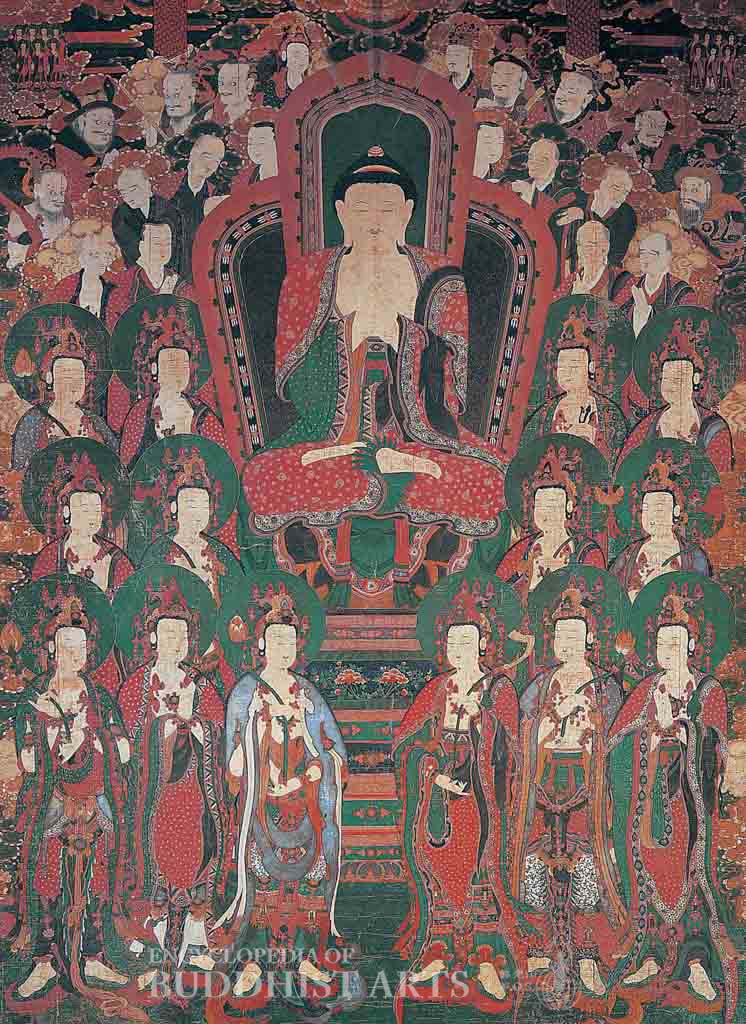
Tongdosa Temple: Assemblies of Trikaya Buddhas - Dharmakaya Buddha
Ink and color on linen
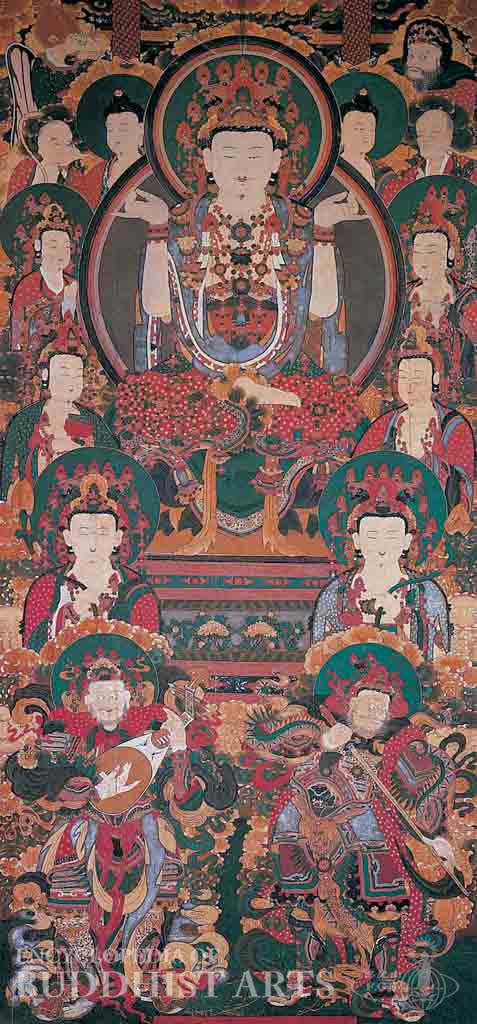
Tongdosa Temple: Assemblies of Trikaya Buddhas - Sambhogakaya Buddha
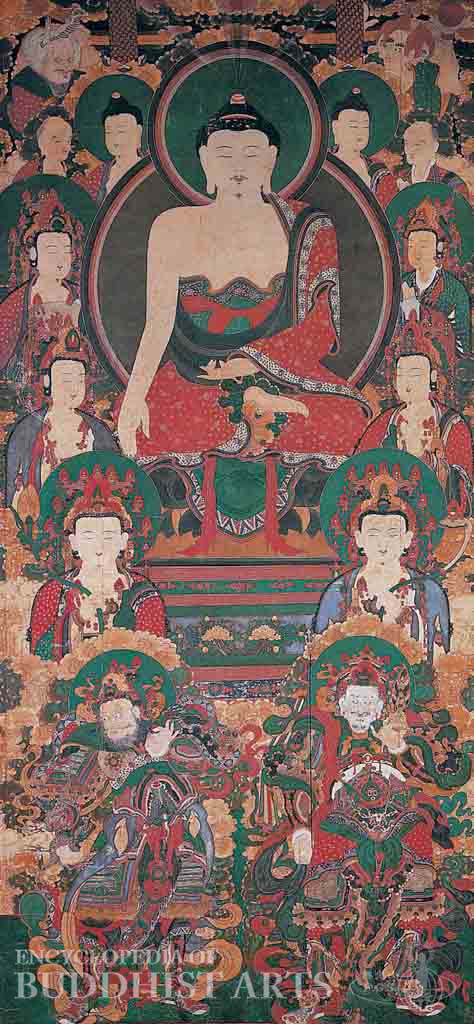
Tongdosa Temple: Assemblies of Trikaya Buddhas - Nirmanakaya Buddha
Tongdosa Temple: Assemblies of Trikaya Buddhas
SOUTH KOREA, South Gyeongsang, Yangsan; Joseon dynasty
The three Trikaya Buddhas represent the three bodies or aspects of a Buddha; the Dharmakya or “Dharma body,” the Sambhogakaya or “reward body,” and the Nirmanakyaya or “manifestation body.” These three painted scrolls once hung behind the three Buddha statues in the Hall of Great Light at Tongdosa Temple. The picture of Dharmakaya Buddha was in the center, flanked by the depictions of Sambhogakaya Buddha on the right and Nirmanakaya Buddha on the left. The scrolls were made in 1759 by a group of 15 painters led by Yim Han. In 1990, they were listed as Treasure No. 1042.
In each picture, a Buddha sits in full lotus position on a throne in the center, surrounded by attendants. Dharmakaya Buddha has a petal-shaped nimbus and aureole, and joins both palms in front of the chest. Fourteen Bodhisattvas stand beside the Buddha and below the throne, while disciples and Dharma protectors fill the upper register. Sambhogakaya Buddha wears an ornate necklace and a headdress decorated with flaming wish-fulfilling jewels. A round nimbus and aureole surround the Buddha. Bodhisattvas and disciples are painted along the sides of the picture, and two of the Four Heavenly Kings stand in dynamic poses in the lower register. Nirmanakaya Buddha wears a monastic robe draped over the left shoulder and forms the bhumisparsa (earth-touching) mudra. The Buddha is accompanied by Bodhisattvas and two of the Four Heavenly Kings. The pictures feature symmetrically arranged figures in beautifully ornamented robes and are primarily colored in red and green, typical of Joseon dynasty Buddhist art.
For more details, go to the Encyclopedia of Buddhist Arts: Painting P-Z, page 932.
Cite this article:
author = Hsingyun and Youheng and Youlu and Wilson, Graham and Manho and Mankuang and Huntington, Susan,
booktitle = {Encyclopedia of Buddhist Arts: Painting P-Z},
pages = 932,
title = {{Tongdosa Temple: Assemblies of Trikaya Buddhas}},
volume = 16,
year = {2016}}