
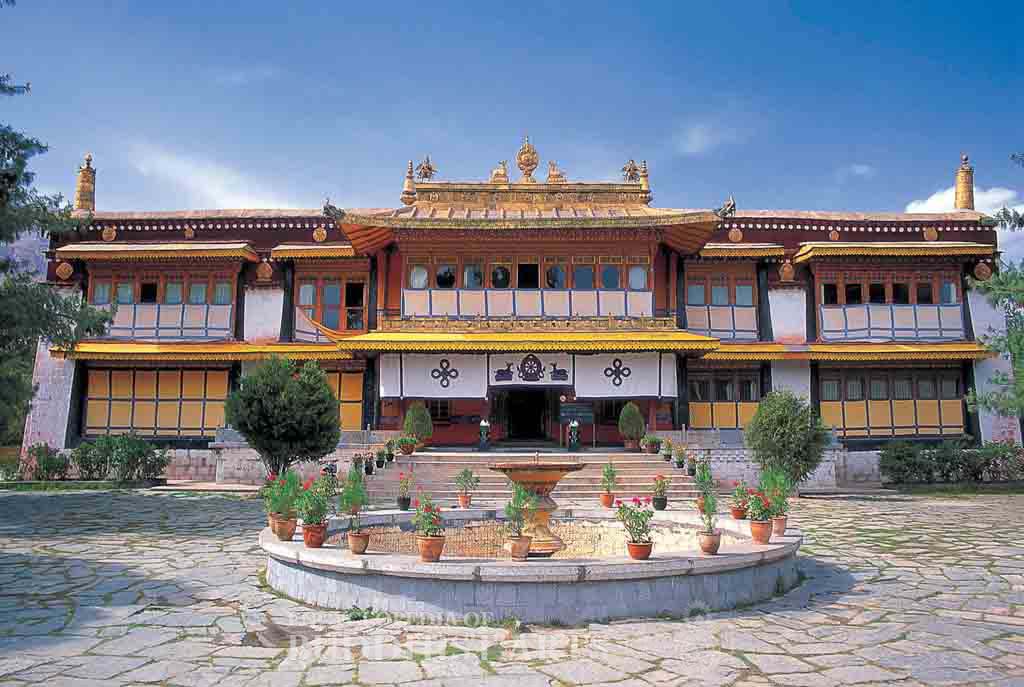
Norbulingka Palace: Takten Migyur Palace
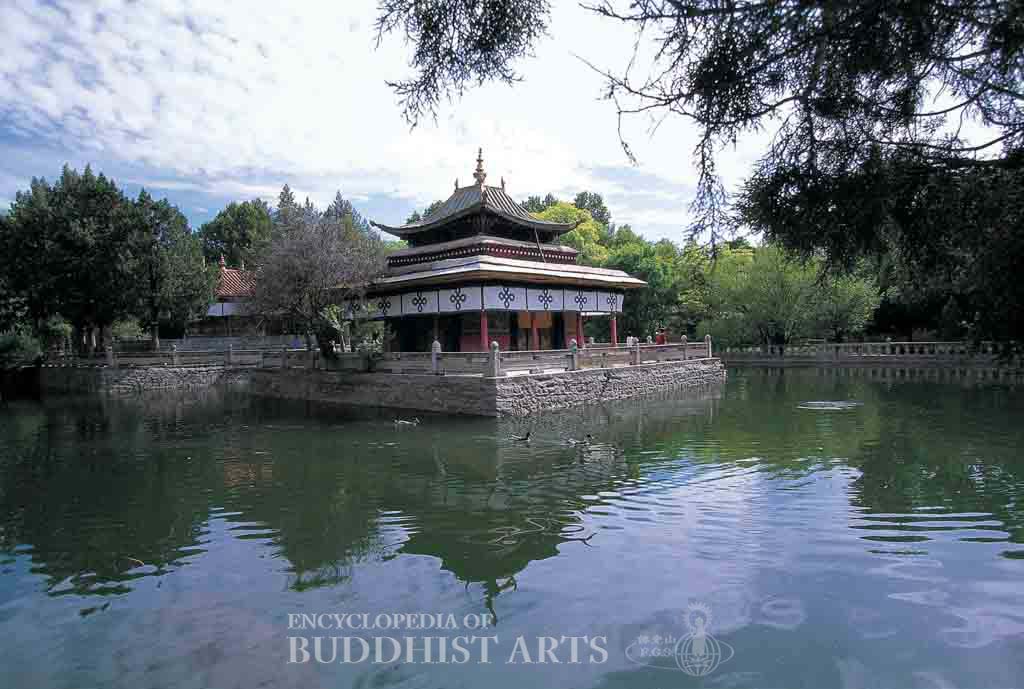
Norbulingka Palace
Norbulingka Palace
CHINA, Tibet, Lhasa
Norbulingka means the Treasure Park. It is approximately three km southwest of the Potala Palace. It was built during the time of the Seventh Dalai Lama in the middle of the18th century. It has been expanded a number of times by various Dalai Lamas. It has served as the Summer Palace for the 7th - 14th Dalai Lamas. In 2001 it was listed as a World Heritage Site by UNESCO as part of the Historic Ensemble of the Potala Palace.
The Norbulingka occupies 36 ha and contains a number of buildings, including the Kelzang Palace, Chensel Palace, Takten Migyur Palace, and the Khamsum Palace. The two-story, five-bay wide, Chinese-style Khamsum Palace has a square performing stage paved with flagstones at the front. It was used by the Dalai Lamas to view opera performances. The two-story Takten Migyur Palace is well-known for its delicate murals. Its walls are filled with narrative scenes that portray the development of Tibetan history. They provide important information for the study and research on the history of Sino-Tibetan relations. Over 100 types of plants are grown in the gardens. The Norbulinka is unique with its combination of palaces and natural landscaping, tall aged trees, open spaces, and lakes.
For more details, go to the Encyclopedia of Buddhist Arts: Architecture M-S, page 801.
Cite this article:
author = Hsingyun and Youheng and Johnson, Peter and Mankuang and Lancaster, Lewis,
booktitle = {Encyclopedia of Buddhist Arts: Architecture M-S},
pages = 801,
title = {{Norbulingka Palace}},
volume = 3,
year = {2016}}