
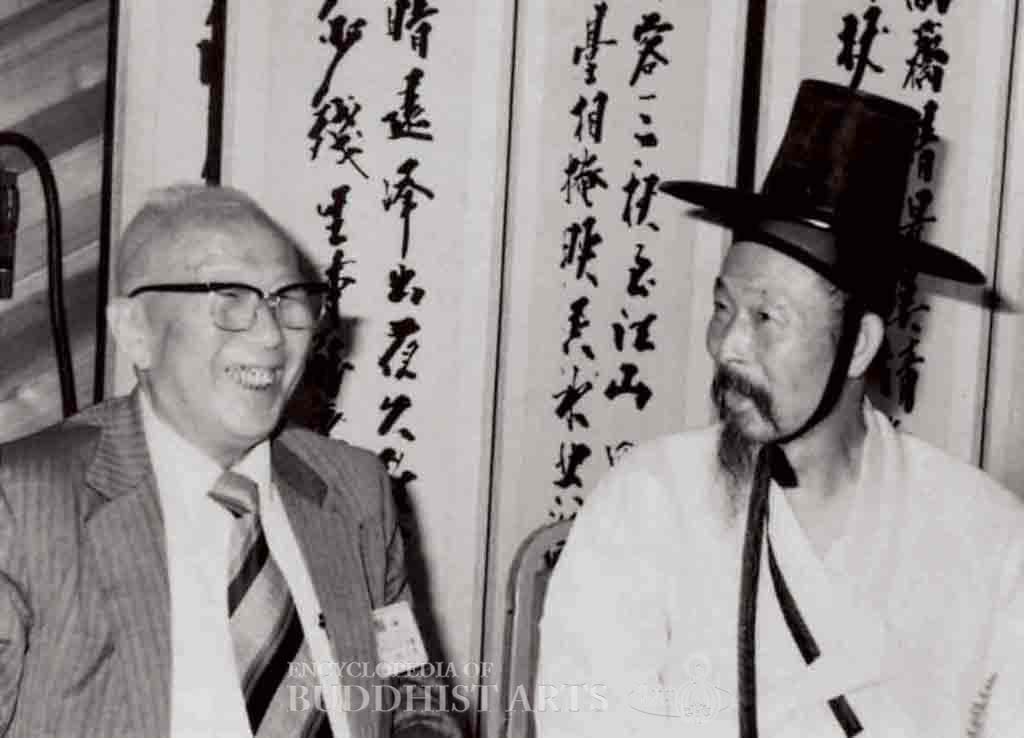
Hsieh Tsung-An
Hsieh Tsung-An
CHINA, Anhui, Chizhou
Also known as Chung-Yen, Hsieh Tsung-An was from Dongzhi county in Chizhou and began learning the art of calligraphy at age seven. He assiduously researched ancient scripts, such as oracle bone script and bronzeware script, and modeled his works after the stele inscriptions of six dynasties from 220 to 589. Later, Hsieh copied the calligraphy of Yan Zhenqing, Liu Gongquan, among others.
After migrating to Taipei, Taiwan in 1952, Hsieh organized the Association of Chinese Calligraphy, and together with Ma Shou-Hua, advocated the development and creation of calligraphic art in Taiwan. In 1973, he established the Chinese Calligraphy Society, and began promoting friendly exchanges with calligraphy associations in Korea and Japan.
Hsieh began creating calligraphy using seal and clerical script. By his later years, the semi-cursive and regular scripts he developed over time characterized his style of calligraphy, which is square, powerful, and unsurpassed.
Aside from participating in over 100 joint and solo exhibitions across the world, Hsieh donated several of his calligraphic works to various museums throughout Europe, America, and Asia. Over the years, he often returned to his hometown in China and financially supported the villagers. In recognition of his virtues, they established the Hsieh Tsung-an Calligraphy Exhibition Hall. Hsieh published many written works which include Collection of Hsieh Tsung-An’s Calligraphy and Collection of Three-Rock Old Man’s Calligraphy.
Fo Guang Shan Monastery in Kaohsiung, Taiwan retains several pieces of Hsieh’s sutra and verse calligraphy. These pieces include Excerpt of the Avatamsaka Sutra, Bhagavan Tells Vajragarbha Bodhisattva a Verse, Bhagavan Tells Maitreya Bodhisattva a Verse, and Bhagavan Tells Samantabhadra Bodhisattva a Verse. In addition, the calligraphy of the inscriptions on the Stele at Fahua Temple is attributed to Hsieh. In his honor, Chinese Calligraphy Society published the Memorial Album of Hsieh Tsung-An’s Calligraphy.
For more details, go to the Encyclopedia of Buddhist Arts: People, page 95.
Cite this article:
author = Hsingyun and Youheng and Youlu and Pokorski, Stefanie and Yichao and Mankuang and Miaohsi,
booktitle = {Encyclopedia of Buddhist Arts: People },
pages = 95,
title = {{Hsieh Tsung-An}},
volume = 19,
year = {2016}}