
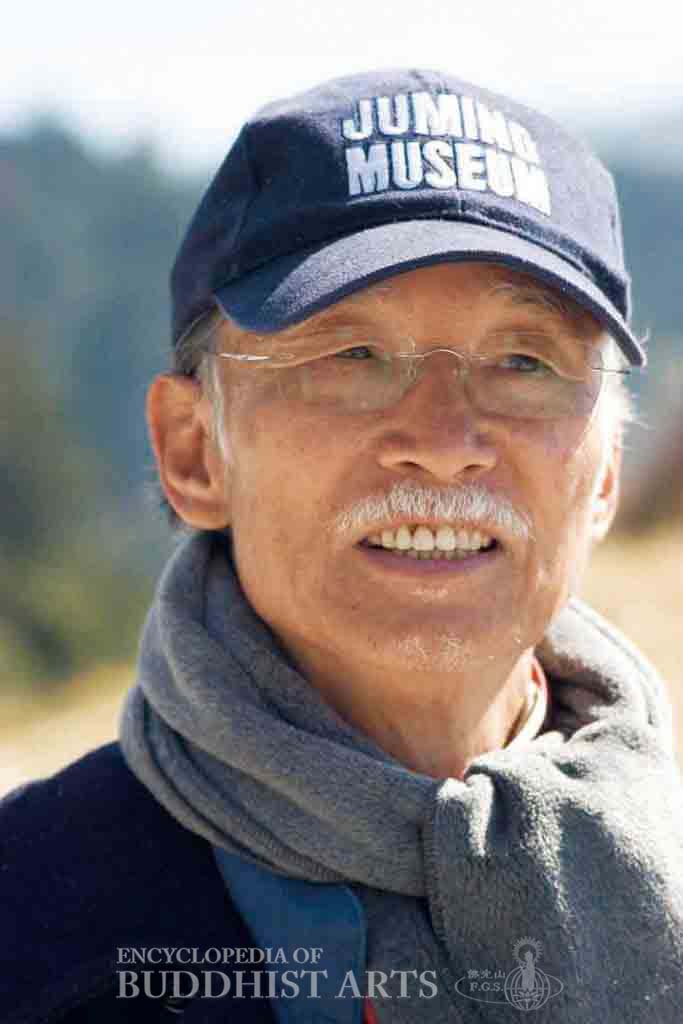
Ju Ming
Ju Ming
TAIWAN, Miaoli
Ju Ming, originally named Ju Chuan-Tai, is a sculptor who began working as a professional to help support his family shortly after graduating from elementary school. He began studying woodcarving and painting at the age of 15 under Lee Chin-Chuan, a local artist. Ju was conscientious in mastering the arts, eventually succeeding his teacher in skills. He won several awards in the Taiwan Art Exhibition beginning in 1966, but soon felt the need to re-apprentice himself, and began to study under Yuyu Yang in 1968. At this time, Ju decided to change his name to Ming as a reflection of his advancement into a new arena of artistic creation. He is well-known throughout Taiwan for his distinct woodcut style, and his local efforts earned him the status as an important symbol of the nativist movement in Taiwan during the 1970s. Over the years, Ju has won several other awards, and in 1976, he was recognized as one of the Ten Outstanding Young People in Taiwan.
Ju’s Taichi Series was developed in the late 1970’s, and is comprised of a unique and innovative collection of works that are based on his personal experience of the martial art. In 1980, at the peak of his creative career, he traveled solo to New York, USA to develop the Living World Series, which was based on his observation and reflection of contemporary living. At this time, Ju also made a transition from woodcarvings to sculptures from clay, foam, bronze, and stainless steel. He subsequently won international acclaim as he took his exhibition on tour around the world. Other creations include a bronze sculpture of Ten Thousand Buddhas. The Juming Museum in Taipei, Taiwan’s largest outdoor art museum, displays nearly 2,000 pieces of his works today.
For more details, go to the Encyclopedia of Buddhist Arts: People, page 125.
Cite this article:
author = Hsingyun and Youheng and Youlu and Pokorski, Stefanie and Yichao and Mankuang and Miaohsi,
booktitle = {Encyclopedia of Buddhist Arts: People },
pages = 125,
title = {{Ju Ming}},
volume = 19,
year = {2016}}