
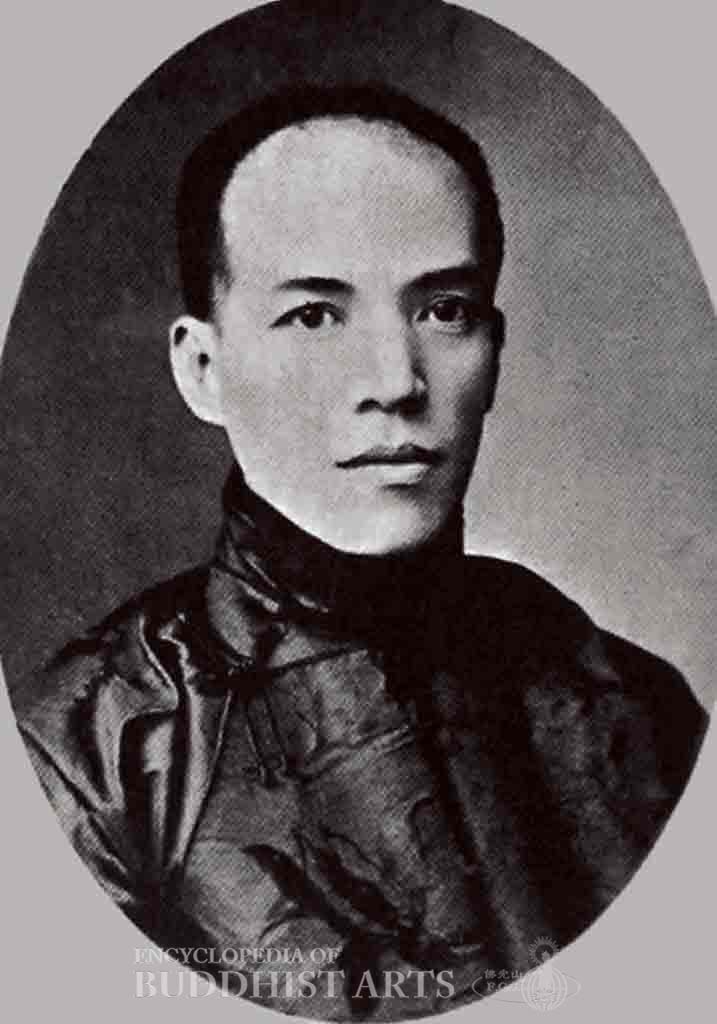
Liang Qichao
Liang Qichao
CHINA, Guangdong, Jiangmen
Liang Qichao was a calligrapher, politician, philosopher, and a scholar of Buddhist Studies from Xinhui district in Jiangmen. In 1898, Liang and Kang Youwei organized the ill-fated Hundred Days Reform, after which he was exiled to Japan for 14 years. Liang returned to China in 1912, and in 1920, he began his career as a professor at various universities in China. He had also published several books.
With an interest in Buddhism, particularly Buddhist history and literature, Liang’s ideas were often influenced by Buddhist philosophy, as expressed in his article, Commentary on the Relationship Between Buddhism and Community. An advocate of the Buddhist concepts of virtue, morality, and equality, he incorporated them into the philosophy of his Reform Party in an attempt to improve the contemporary political environment. In later years, as his belief in Buddhism grew stronger, Liang became the first president of the Wuchang Buddhist College in Hubei, and wrote essays on various Buddhist topics that included Research on the Awakening of Faith in the Mahayana.
Also an excellent calligrapher, Liang studied Tang regular script, Han clerical script, and stele engravings from the Northern Wei dynasty (386–534). His calligraphic work, Poem of an Old Man on the Mountain, is kept at Fo Guang Shan Monastery in Kaohsiung, Taiwan. His other calligraphic works, including rubbings of 12 bronze screens that he made with Zhang Yuecheng and Yao Hualian, are collected at the National Museum of China.
For more details, go to the Encyclopedia of Buddhist Arts: People, page 169.
Cite this article:
author = Hsingyun and Youheng and Youlu and Pokorski, Stefanie and Yichao and Mankuang and Miaohsi,
booktitle = {Encyclopedia of Buddhist Arts: People },
pages = 169,
title = {{Liang Qichao}},
volume = 19,
year = {2016}}