
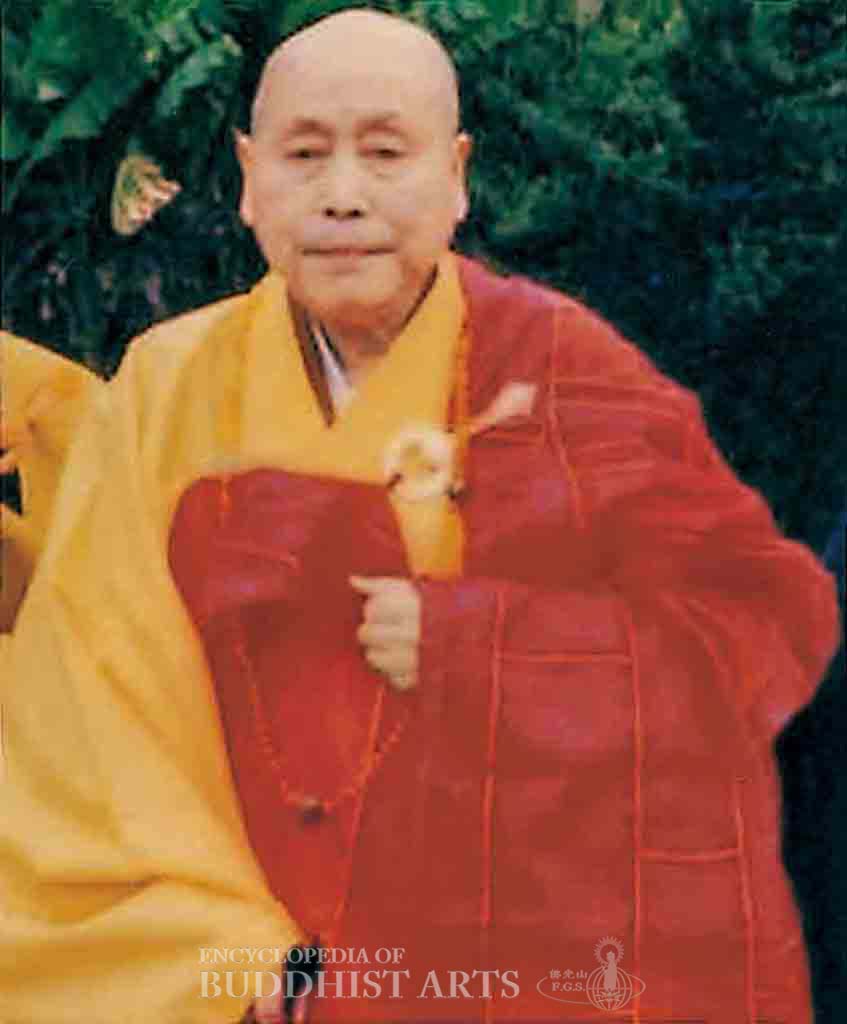
Mingyang
Mingyang
CHINA, Fujian, Fuzhou
Mingyang was a monk and calligrapher from Minhou (present day Fuzhou, Fujian). His original name was Chen Xintao and his Dharma name was Rixin. Mingyang renounced under Master Yuanying at Xuefeng Chongsheng Temple in Fujian at the age of 13. After receiving precepts, he followed Master Yuanying to Tiantong Temple in Zhejiang, where he served as his attendant before receiving Dharma transmission from him. He belonged to the 41st generation of the Linji school and 47th generation of the Caodong school.
Throughout his career, Mingyang served various positions within a variety of Buddhist institutions and associations, such as vice chairman, vice director, dean, and committee member. He assumed abbacy at such temples as Guangji Temple in Beijing, Longhua Temple in Shanghai, Tiantong Temple in Ningbo, Xichan Temple in Fuzhou, and Guangxiao Temple in Fujian. In addition, he authored Chronicle of Master Yuanying and Synopsis of Buddhism.
Master Yuanying’s influence on Mingyang extended beyond in-depth studies of Buddhism, and also included the teaching of poetry and calligraphy. Through his calligraphy, Mingyang implied the essence of Chan with a unique style that was strong yet fickle, bold yet unrestrained, and elegant yet surreal. In 2000, his disciples organized the Calligraphy Exhibition in Celebration of Master Mingyang’s 85th Birthday, where 108 pieces of his calligraphy were displayed at the Yuanming Lecture Hall in Shanghai. Tiantong Temple in Zhejiang still retains an inscribed board with his calligraphy, as well as several rhyming couplets he scripted.
For more details, go to the Encyclopedia of Buddhist Arts: People, page 195.
Cite this article:
author = Hsingyun and Youheng and Youlu and Pokorski, Stefanie and Yichao and Mankuang and Miaohsi,
booktitle = {Encyclopedia of Buddhist Arts: People },
pages = 195,
title = {{Mingyang}},
volume = 19,
year = {2016}}