
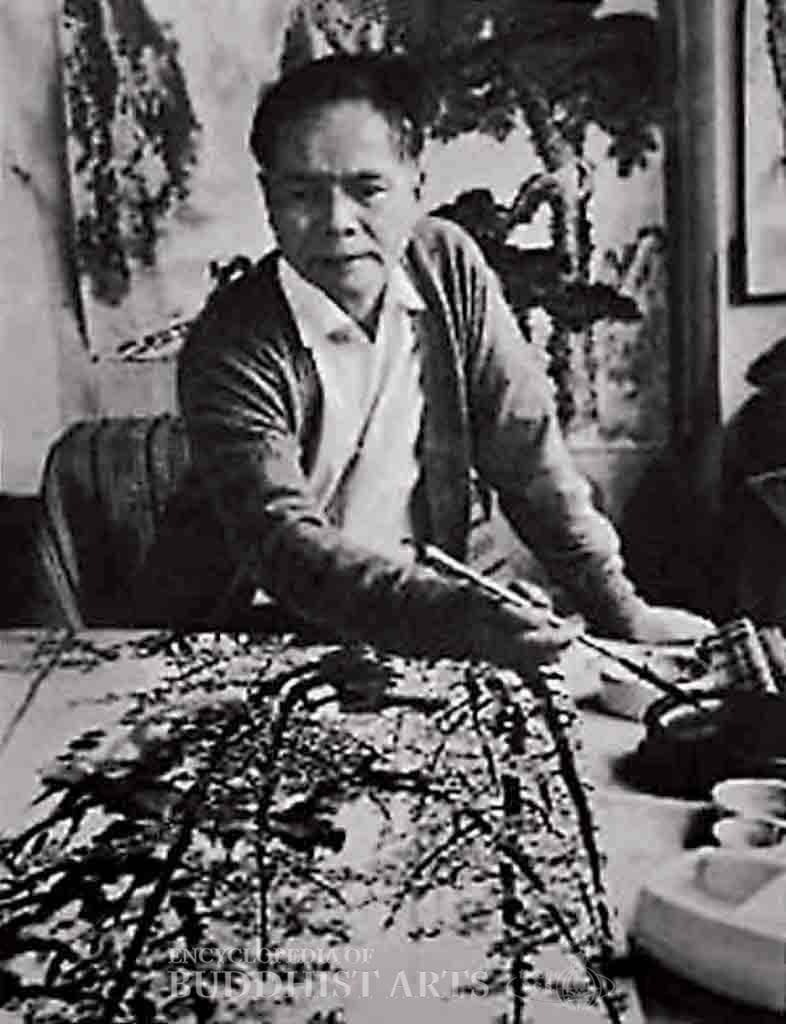
Guan Shanyue
Guan Shanyue
CHINA, Guangdong, Yangjiang
Guan Shanyue, who had an original name of Guan Zepei, was a painter and art educator. Influenced by his father, he had a particular liking for painting since youth. He studied painting under Gao Jianfu, a renowned contemporary painter, who gave him the nickname “Guan Shanyue.” His works upheld the spirit of the Lingnan school painting style which claimed to “compromise the East and the West, and fuse the traditional and the modern.”
Guan was skilled in painting landscapes and plum flowers. Alongside Zhao Shao’ang, Li Xiongcai, and Yang Shanshen, he was known as one of the Four Great Painters of the Second Generation of the Lingnan school. Guan also held several official positions in various art academies and associations.
His relationship with Buddhism can be traced to his visit to the Dunhuang Caves in Gansu in 1943. There, Guan carried out an observation study on ancient Buddhist art by creating copies of the many famous murals. He subsequently produced the publication entitled Replicas of Dunhuang Murals. His relationship with Buddhism can be traced to his visit to the Dunhuang Caves in Gansu in 1943. There, Guan carried out an observation study on ancient Buddhist art by creating copies of the many famous murals. He subsequently produced the publication entitled Copies of Dunhuang Murals. Furthermore, Guan, together with Gao Jianfu, later moved to Puji Chan Monastery in Macau, where he became a good friend of monk Huiyin. During this time, he carved himself a seal to commemorate his conversion to Buddhism. He also began painting works encompassing anti-war themes, which were exhibited in Macau, and later Hong Kong. In 1997, the Guan Shanyue Art Museum was established in Shenzhen, Guangdong, which collected some 800 artworks he donated in recognition of his artistic achievements.
For more details, go to the Encyclopedia of Buddhist Arts: People, page 83.
Cite this article:
author = Hsingyun and Youheng and Youlu and Pokorski, Stefanie and Yichao and Mankuang and Miaohsi,
booktitle = {Encyclopedia of Buddhist Arts: People },
pages = 83,
title = {{Guan Shanyue}},
volume = 19,
year = {2016}}