
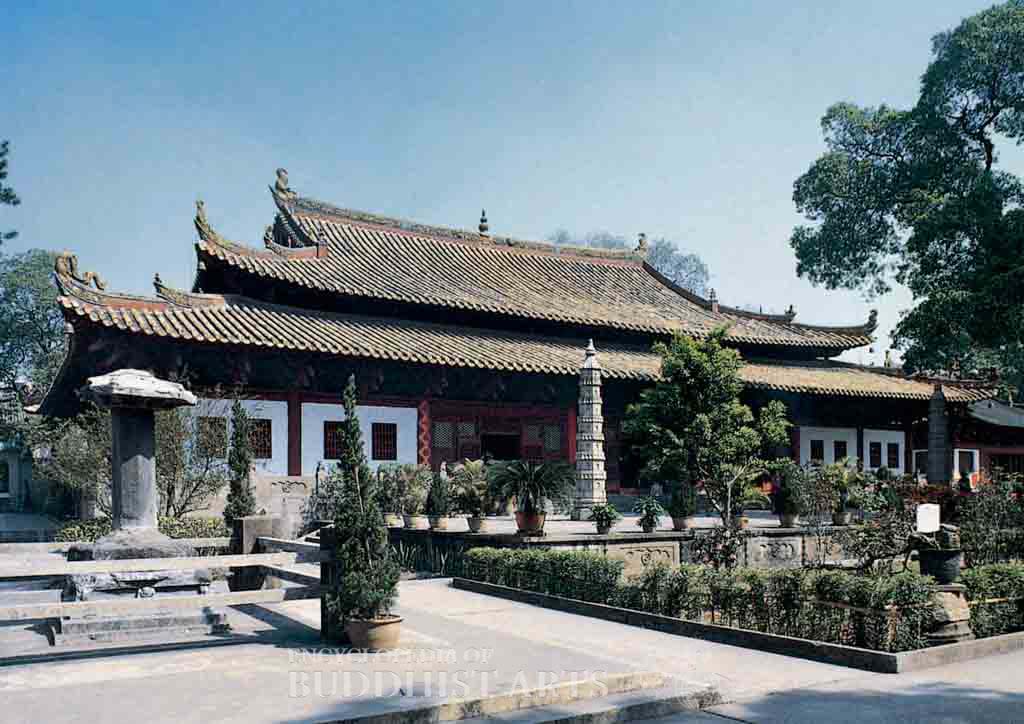
Guangxiao Temple Great Hero Hall
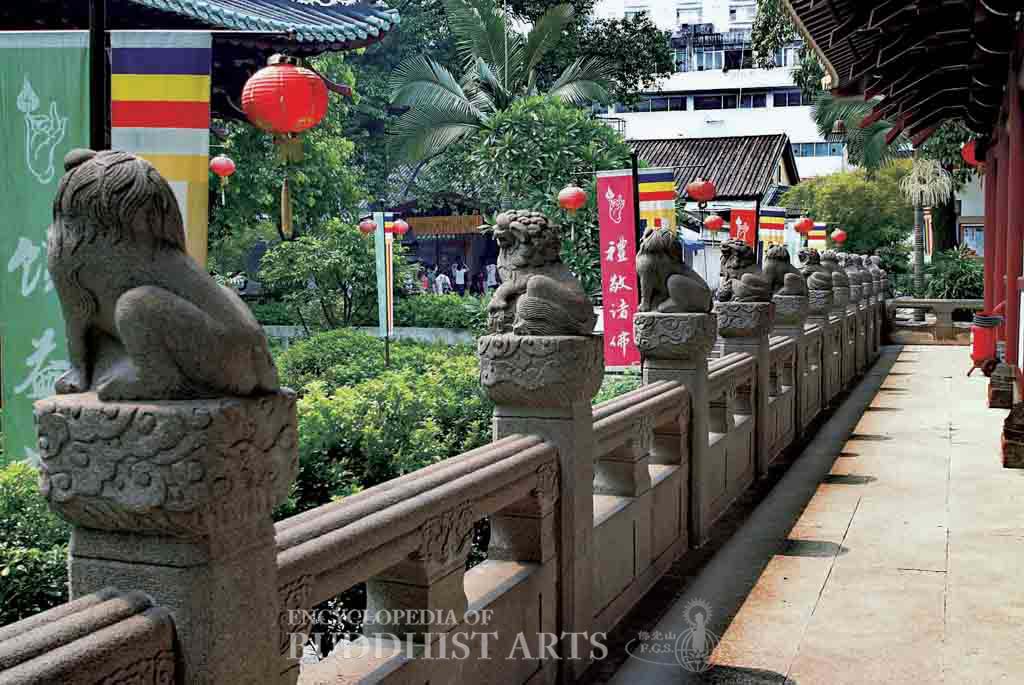
Guangxiao Temple Great Hero Hall: Stone Railings
Guangxiao Temple Great Hero Hall
CHINA, Guangdong, Guangzhou
The hall was built by the monk Dharmayasas in 401 during the Eastern Jin dynasty. It has undergone repairs throughout its history, and the present building was reconstructed in 1654 during the Qing dynasty.
This seven-by-six bay structure has a double-eave hip-and-gable roof and is 13.6 m high. It stands upon a 1.4 m stone platform. The eaves extend 2.5 m from the wall. The ridge decorations are in the shapes of gourds, monks, Dharma protectors, and dragons. The outer sections of the eaves are supported by three-tier bracket sets with a single projecting bracket arm and two cantilevers, while the inner sections are supported by three-tier decorated bracket sets. Stone balustrades surround the hall. At the back of the hall there are 13 sandstone newel posts with stone lions dating back to the Southern Song dynasty (1127–1279). The columns inside the hall are now made of reinforced concrete, but they are still in Song dynasty (960–1279) style and are tapered at both ends. The original Buddha statue inside the hall was destroyed in 1951 and has been replaced by the Avatamsaka Triad: Vairocana Buddha flanked by Manjusri and Samantabhadra Bodhisattvas. There are also statues of Buddhas, Bodhisattvas, and Arhats from different periods made from wood or clay.
For more details, go to the Encyclopedia of Buddhist Arts: Architecture G-L, page 401.
Cite this article:
author = Hsingyun and Youheng and Johnson, Peter and Mankuang and Lancaster, Lewis,
booktitle = {Encyclopedia of Buddhist Arts: Architecture G-L},
pages = 401,
title = {{Guangxiao Temple Great Hero Hall}},
volume = 2,
year = {2016}}