
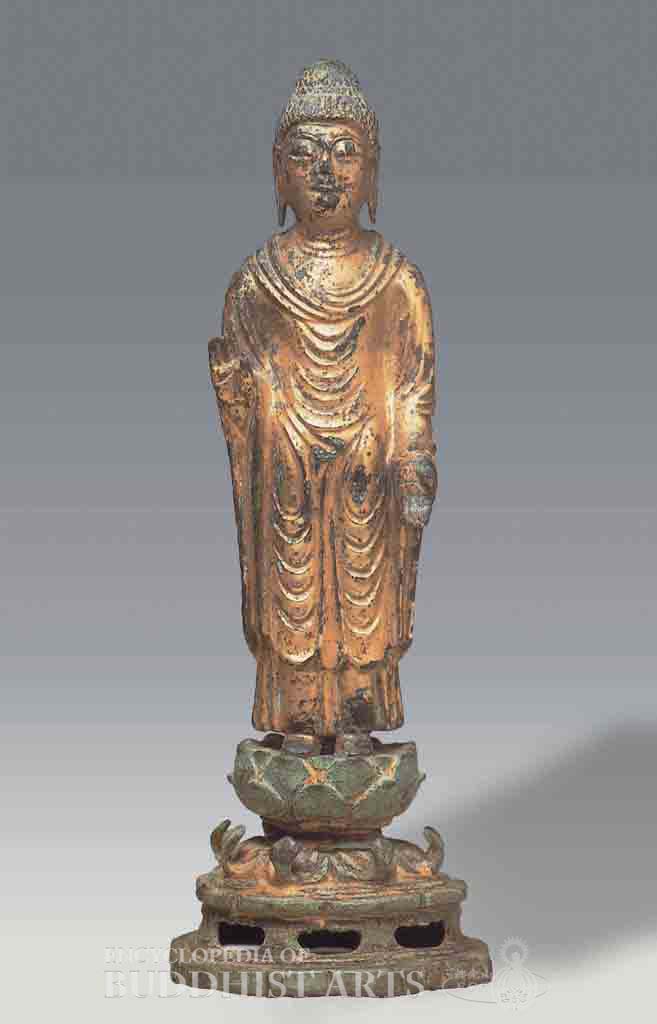
Sakyamuni Buddha
Gilt copper alloy
Sakyamuni Buddha
KOREA; Unified Silla dynasty
The Buddha’s monastic robe covers both shoulders with its rippling folds divided over the legs, a stylistic feature of the 8th century the time in which the statue was made. The usnisa is large and domed above the curled hair. Other Buddha characteristics are the long earlobes and the three lines on the neck. The figure’s hands are in abhaya (fearlessness) and varada (wish-granting) mudras. The Buddha’s feet are joined by tenons to the lotus pedestal on which the figure stands. This in turn rests on a bed of opened petals supported on an octagonal openwork base.
For more details, go to the Encyclopedia of Buddhist Arts: Sculpture N-Sr, page 920.
Cite this article:
Hsingyun, et al. "Sakyamuni Buddha." Encyclopedia of Buddhist Arts: Sculpture N-Sr, vol. 12, 2016, pp. 920.
Hsingyun, Youheng, Yann Lovelock, Yuan Chou, Susan Huntington, Gary Edson, and Robert Neather. 2016. "Sakyamuni Buddha" In Encyclopedia of Buddhist Arts: Sculpture N-Sr, 12:920.
Hsingyun, Youheng, Lovelock, Y., Chou, Y., Huntington, S., Edson, G., & Neather, R.. (2016). Sakyamuni Buddha. In Encyclopedia of Buddhist Arts: Sculpture N-Sr (Vol. 12, pp. 920).
@misc{Hsingyun2016,
author = Hsingyun and Youheng and Lovelock, Yann and Chou, Yuan and Huntington, Susan and Edson, Gary and Neather, Robert,
booktitle = {Encyclopedia of Buddhist Arts: Sculpture N-Sr},
pages = 920,
title = {{Sakyamuni Buddha}},
volume = 12,
year = {2016}}
author = Hsingyun and Youheng and Lovelock, Yann and Chou, Yuan and Huntington, Susan and Edson, Gary and Neather, Robert,
booktitle = {Encyclopedia of Buddhist Arts: Sculpture N-Sr},
pages = 920,
title = {{Sakyamuni Buddha}},
volume = 12,
year = {2016}}